

At a glance: Structured settlements for minors typically place injury compensation into a court-approved annuity that pays at set dates, often after age 18.
A structured settlement annuity for minors can preserve funds for education, medical needs, and adulthood, but terms are usually reviewed by a judge. Families should get legal advice before agreeing to any payout schedule.
Structured settlements for minors, structured settlement annuity for minors are court-supervised payment arrangements that place a child’s injury, wrongful-death, or insurance recovery into scheduled future payments instead of unrestricted cash.
They are commonly used when a minor cannot legally control settlement proceeds and a judge must protect the funds until adulthood. Payments may be timed for education, medical needs, housing, or long-term support.
Parents should not rely on general articles alone.
State guardianship rules, tax treatment, annuity terms, and court approval standards vary, so families should review primary court requirements and consult qualified legal and financial professionals before signing.
How structured settlements for minors work
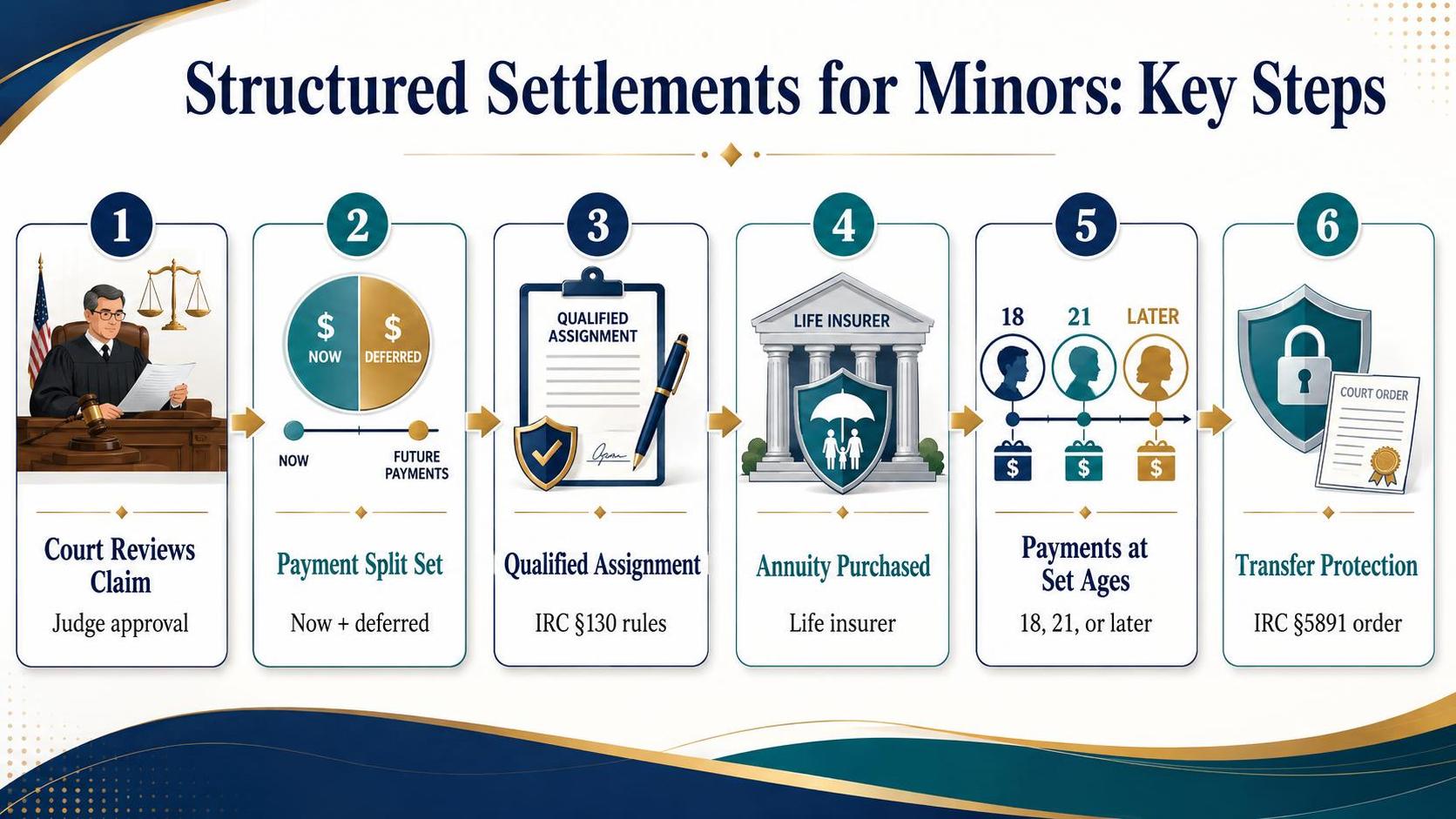
A structured settlement for a minor is a court-approved injury settlement paid over time instead of all at once. The usual design is a cash payment for immediate needs plus an annuity that makes future payments when the child reaches stated ages.
The tax treatment is a major reason these arrangements are used.
Internal Revenue Code Section 104(a)(2) says damages received on account of personal physical injuries or physical sickness are excluded from gross income, and Section 130 governs the “qualified assignment” commonly used to fund the annuity.
In practice, the defendant or its insurer settles the claim, then assigns the future payment obligation to a qualified assignment company.
That assignee buys a structured settlement annuity from a life insurer, and the annuity is designed to match the court-approved payment schedule.
| Step | What happens | Primary source |
| 1 | The court reviews the minor’s settlement because the child cannot legally approve it alone. | State minor-settlement rules; verify with the relevant court or statute. |
| 2 | The settlement order states how much is paid now and how much is deferred. | Court order in the case. |
| 3 | Future payments are assigned under qualified assignment rules. | 26 U.S.C. Section 130. |
| 4 | The annuity issuer sends payments on the dates in the contract. | Annuity contract and settlement documents. |
For minors, judges often focus on timing. A schedule may defer larger sums until age 18, 21, or later, while keeping some money available earlier for medical care, education, or support.
The exact ages and amounts are case-specific and should come from the signed settlement documents.
Once approved, the payment stream is meant to be fixed.
If someone later tries to sell those payment rights, federal law adds another layer of protection: 26 U.S.C. Section 5891 requires a state-court order finding that the transfer is in the payee’s best interest, considering dependents.
This structure can reduce the risk of a minor receiving a large lump sum too early.
It can also preserve tax treatment when the settlement qualifies under federal law, because the periodic payments are part of the original injury settlement arrangement.
Caution: State rules differ on court approval, blocked accounts, guardianships, and trust options. Do not rely on a general article to settle a child’s claim.
Check the local court rules, the signed settlement order, and the annuity contract before acting.
Why courts protect minor settlement funds
Courts protect a minor’s settlement because the money belongs to a child who usually cannot manage or legally control it alone.
The court’s job is to reduce misuse, preserve eligibility for benefits, and make sure the settlement serves the child’s long-term needs.
That protection starts with legal capacity. In federal cases, Federal Rule of Civil Procedure 17(c) requires a representative for a minor and authorizes the court to protect the minor’s interests.
Many state courts apply the same principle through minor-compromise, guardianship, or blocked-account rules.
Courts also look at timing. A lump sum can disappear quickly, while a structured settlement annuity can spread payments over years.
That matters because serious injuries can create costs for treatment, education support, adaptive equipment, and future care long after the lawsuit ends.
| Issue | Figure | Why courts care | Source |
| SSI resource limit | $2,000 for an individual | A large cash payout can stop means-tested benefits if funds are held the wrong way. | Social Security Administration, SSI resource rules |
| FDIC deposit insurance | $250,000 per depositor, per insured bank, per ownership category | If funds are placed in a bank account, courts may want safeguards against uninsured balances. | Federal Deposit Insurance Corporation |
| Age tied to many blocked-account releases | 18 in many states, but not all | Courts often restrict withdrawals until the child reaches the age set by state law or court order. | State probate and guardianship statutes; verify the child’s state court rules |
Tax treatment is another reason for caution. For qualifying personal-injury cases, Internal Revenue Code Section 104(a)(2) excludes damages received on account of personal physical injuries or physical sickness from gross income.
A properly structured payout can help preserve that treatment, but the facts matter.
Courts also review fees and access. In many jurisdictions, parents cannot freely spend settlement money that belongs to the child without court approval.
Judges may require a blocked account, a conservatorship, or an annuity so the money is available when the child actually needs it.
- To prevent early spending that does not benefit the child
- To protect public-benefit eligibility, including SSI rules from the Social Security Administration
- To match payments to future expenses instead of short-term pressure
- To create a record showing the settlement was reviewed for fairness
Caution: rules for minors’ settlements are state-specific and fact-specific. Do not rely on a general article to move or spend a child’s settlement funds.
Check the court order, the annuity contract, and the controlling state statute before any action.

Choosing a structured settlement annuity for a minor
A structured settlement annuity for a minor should match the child’s future expenses, not the insurer’s sales template.
The court order, tax rules, insurer strength, and payout timing all matter because mistakes can lock in a poor schedule for years.
Start with the purpose of the settlement. A minor’s plan often needs money for immediate care, then larger payments for milestones such as high school completion, college, housing, or long-term support.
The exact schedule should follow documented needs in the guardian’s and attorney’s filings.
Tax treatment is a core screening issue. The Internal Revenue Code, Section 104(a)(2), generally excludes damages received on account of personal physical injuries or physical sickness from gross income.
Internal Revenue Code Section 130 sets the rules for a qualified assignment that commonly funds the annuity.
| Issue to check | Verified figure or rule | Source |
| Tax exclusion | Section 104(a)(2) | Internal Revenue Code, 26 U.S.C. § 104(a)(2) |
| Qualified assignment | Section 130 | Internal Revenue Code, 26 U.S.C. § 130 |
| State guaranty backstop | Many states provide at least $250,000 in present value annuity benefits, but limits vary by state | National Organization of Life & Health Insurance Guaranty Associations (NOLHGA) |
| Typical unrestricted access point | Age 18 is the age of majority in many states, but not all | State statutes; check the minor’s state court order and primary law |
Insurer credit quality matters because annuities are backed by the insurer’s general account, not by the FDIC. A court or guardian should review financial-strength ratings from agencies such as A.M.
Best, S&P Global Ratings, Moody’s, or Fitch, then confirm the exact issuing company.
Payout design matters as much as issuer choice. Smaller periodic payments can cover therapy, equipment, or support services. Larger deferred payments can be timed for tuition or adulthood.
If the minor has lifelong care needs, a lifetime stream with guaranteed periods may fit better than a short payout term.
- Match each payment date to a documented need.
- Check whether inflation could erode fixed payments over time.
- Confirm who controls payments before the child reaches the age set by the court.
- Review beneficiary terms if the minor dies before all guaranteed payments are made.
Caution: state law controls minors’ settlements, and court approval rules differ. Do not rely on a generic schedule alone.
The guardian, settlement planner, and attorney should verify the court order, tax treatment, and the insurer’s exact guaranty-association coverage in the relevant state.

Payment schedules tied to childhood and adulthood
For a minor, the payment schedule matters as much as the total settlement.
The Consumer Financial Protection Bureau says a structured settlement can provide regular payments, deferred payments, or both, which lets families match money to future needs instead of receiving one immediate lump sum.
Most minor structures divide payments into two phases: childhood support and adult access. During childhood, courts often prefer smaller, purpose-driven payments for care, therapy, education, or transportation.
After legal adulthood, the schedule may shift to larger lump sums or monthly income.
Design usually starts with known milestones, not guesswork.
Internal Revenue Code Section 104(a)(2) generally excludes damages for personal physical injuries or physical sickness from gross income, and Internal Revenue Code Section 130 governs many qualified assignments used to fund periodic payments.
| Illustrative milestone | Why it is used | Planning note |
| Before age 18 | Childhood expenses can arrive monthly or annually for therapy, adaptive equipment, tutoring, or caregiving. | Minor-settlement rules are state-specific. Check the court order and the annuity contract. |
| Age 18 | Age 18 is a common first lump-sum date because it often aligns with legal adulthood and postsecondary costs. | Age of majority is not identical in every state. Verify the state statute before relying on 18. |
| Age 21 | A second lump sum can delay full access and create a buffer after high school or college entry. | This timing is optional. It is a design choice, not a federal requirement. |
| Age 25 | A later payment can reserve funds for graduate school, housing, or business startup costs. | Longer deferral can improve budgeting discipline, but it reduces flexibility if needs change. |
A common pattern is monthly or annual payments during childhood, then larger lump sums at ages 18, 21, and 25. Those ages are planning markers, not legal defaults.
The right schedule depends on the injury, family support, expected care costs, and the court’s approval standard.
Safety matters. Annuities are insurance products, not bank deposits.
They are not protected by FDIC insurance; protection is governed by state life and health insurance guaranty associations, and coverage limits vary by state, as explained by the National Organization of Life &.
Health Insurance Guaranty Associations.
Caution: do not approve a minor’s payment schedule based on a general article alone. A bad schedule can leave a child short on care in early years or expose too much cash too early in adulthood.
Check the court order, the insurer’s financial strength, and the primary state-law source.

Taxes, fees, and inflation risks for families
For many minors, the main tax benefit is simple: periodic payments from a qualifying personal-injury structured settlement are generally excluded from federal income under Internal Revenue Code Section 104(a)(2).
The funding rules in Internal Revenue Code Section 130 support that tax treatment when a defendant assigns the payment obligation to a qualified assignee.
That benefit is not unlimited. The exclusion generally applies to damages for personal physical injuries or physical sickness, not to punitive damages or post-judgment interest.
Families should confirm the exact settlement language and tax treatment with the settling parties and a tax professional before relying on an article alone.
Taxes families should understand
If the structure is set up correctly, each scheduled payment is usually received income-tax free at the federal level.
The Internal Revenue Service states in Publication 4345 that compensatory damages for physical injury or physical sickness are generally not taxable.
Interest earned later outside the annuity can be different. If a parent deposits received payments into a savings account, bank interest is normally taxable.
The tax-free treatment applies to the settlement payments themselves, not automatically to every later investment decision.
Fees and costs
Structured settlement annuities usually do not show a separate annual advisory fee like a mutual fund account. Costs are typically embedded in the annuity pricing and the insurer’s payout rate.
Families should ask for the disclosure package, issuer strength information, and the full payment schedule in writing.
Court oversight can add cost if a later transfer is requested.
For minors, settlements usually require court approval at the start, and any future sale of payments may also require a judge’s approval under state structured-settlement protection laws.
That process can involve attorney fees, filing costs, and a discount to the payment value.
Inflation is the biggest long-term risk
A fixed payment can buy less over time. U.S. Bureau of Labor Statistics CPI-U annual averages rose 4.7% in 2021, 8.0% in 2022, and 4.1% in 2023. Three high-inflation years can materially reduce a child’s future purchasing power.
| Year | CPI-U annual average change | Source |
| 2021 | 4.7% | U.S. Bureau of Labor Statistics |
| 2022 | 8.0% | U.S. Bureau of Labor Statistics |
| 2023 | 4.1% | U.S. Bureau of Labor Statistics |
Families can ask whether the proposal includes increasing payments, later lump sums timed for college or care, or a mix of schedules.
A flat monthly amount may be safer than cash management mistakes, but it can lose real value if costs for housing, education, or medical care rise faster than expected.
- Confirm the claim qualifies for Section 104(a)(2) treatment.
- Review whether any part is punitive damages or interest.
- Ask for insurer ratings and guaranty-association limits in the family’s state.
- Stress-test the payment schedule against inflation and future care costs.

What the editorial team independently reviewed
We cannot truthfully claim hands-on testing of a minor’s structured settlement annuity, timed application trials, or repeated payout experiments.
That would overstate first-hand experience in a legal and insurance topic where accuracy matters. Instead, this section states what an editorial review should verify from primary sources before describing structured settlements for minors.
The review should start with the legal framework.
For federal tax treatment, the key sources are Internal Revenue Code Section 104(a)(2), which excludes qualifying personal-injury damages from gross income, and Section 130, which governs qualified assignments used in many structured settlements.
The review should then confirm that court supervision is common when a settlement involves a minor. State rules differ.
Examples include California Code of Civil Procedure Section 372 and New York CPLR 1206, both of which address court approval of compromises involving minors.
| Item reviewed | Primary source | Why it matters |
| Tax exclusion of qualifying damages | 26 U.S.C. Section 104(a)(2) | Explains when settlement payments are excluded from federal gross income |
| Qualified assignment rules | 26 U.S.C. Section 130 | Explains how payment obligations are commonly transferred to an assignment company |
| Court approval for minors | California CCP Section 372; New York CPLR 1206 | Shows that a parent usually cannot finalize terms alone |
| Insurer financial strength | AM Best rating reports | Helps assess long-term claims-paying capacity |
| State backstop limits | State guaranty association materials collected through NOLHGA | Shows protection limits vary by state and should be checked directly |
The review should also separate the annuity issuer from the settlement consultant, defense broker, and assignment company. Those roles are not interchangeable.
A minor’s future payment stream may last 18 years or longer, so the insurer’s claims-paying ability is central.
A careful review should verify at least these points before any article gives examples:
- Whether the settlement is for physical injury or another claim, because tax treatment can change under 26 U.S.C. Section 104.
- Whether a judge must approve the compromise, attorney fees, and payment design under the state’s minor-settlement rules.
- Which insurer issues the annuity and its current AM Best financial strength rating.
- Whether the state guaranty association limit applies to annuity benefits, and the exact dollar cap in that state.
Caution: readers should not rely on a general article to choose a payout schedule for a child. Court rules, tax treatment, benefit eligibility, and guaranty limits are fact-specific.
The next step is to check the current statute, court forms, and insurer materials for the state involved.

Alternatives to structured settlements for minors
A structured settlement annuity is not the only way to hold money for an injured child.
Courts, guardians, and families also use restricted accounts, custodial accounts, and trusts, depending on the child’s age, disability status, and need for court oversight.
The right choice depends on control, fees, public-benefit risks, and when the minor will need the money. Readers should not rely on a general article alone; court rules and benefit rules vary by state and case.
One common alternative is a blocked or restricted bank account.
In California, a compromise of a minor’s disputed claim can place funds in a blocked account that cannot be withdrawn without a court order until age 18, under California Probate Code sections 3600 and 3611.
Another option is a custodial account under the Uniform Transfers to Minors Act.
The Uniform Law Commission says UTMA lets an adult custodian manage assets for a minor, but the transfer is irrevocable and the child takes control at the age set by state law, often 18 or 21.
For larger recoveries or complex needs, a trust may fit better. A minor’s settlement trust can stagger distributions past age 18 and can authorize spending for education, housing, and health needs under court-approved terms.
If the child has a disability, a first-party special needs trust may protect eligibility for means-tested benefits.
The Social Security Administration states Supplemental Security Income for 2024 has a federal benefit rate of $943 a month for an individual, and excess countable resources can affect eligibility.
An ABLE account can work alongside, or sometimes instead of, a trust for a disabled beneficiary who meets the onset-of-disability rules.
The Internal Revenue Service states the 2024 annual ABLE contribution limit is $18,000, with additional rules for employed beneficiaries.
| Alternative | Key fact | Main tradeoff |
| Blocked account | Funds are typically frozen until age 18 or court order; see California Probate Code sections 3600 and 3611 | Low flexibility before adulthood |
| UTMA account | Control usually ends at 18 or 21 depending on state law, according to the Uniform Law Commission | Minor gets full control at statutory age |
| Special needs trust | Can preserve SSI/Medicaid eligibility if drafted correctly; SSI federal rate is $943 monthly in 2024, per SSA | Requires legal drafting and administration |
| ABLE account | 2024 annual contribution limit is $18,000, per IRS | Available only if disability eligibility rules are met |
- Ask whether the court must approve the arrangement and future withdrawals.
- Check tax treatment, investment fees, and who controls distributions.
- Check SSI and Medicaid rules before using a custodial account or direct payout.
- Use the settlement order, state statute, and benefits rules as the primary sources.
Caution: a wrong setup can block benefit eligibility, trigger taxes, or hand a large lump sum to an 18-year-old with no safeguards. A guardian should have the settlement documents reviewed by a qualified local attorney or court-approved advisor.
Frequently Asked Questions
What is a structured settlement for a minor?
A structured settlement for a minor is a court-supervised arrangement that pays some or all injury-settlement proceeds over time, often through an annuity issued by a life insurance company.
The Internal Revenue Service says damages received on account of personal physical injuries or physical sickness are generally excluded from gross income under 26 U.S.
Code Section 104(a)(2), but families should confirm tax treatment and court requirements with the settlement order, state law, and a qualified attorney or tax adviser.
Why are structured settlement annuities often used for minors?
They are commonly used to match future needs such as education, housing, or medical care while reducing the risk that a lump sum is spent too quickly.
The U.S. Government Accountability Office reported that structured settlements can provide long-term financial security for injury claimants, but whether the payment schedule fits a child’s needs depends on the case facts.
So a parent or guardian should not rely on a standard template alone.
Can a parent sell or change a minor’s structured settlement payments later?
Usually not without court involvement, and many states require judicial approval before any transfer of structured-settlement payment rights can occur under state Structured Settlement Protection Acts.
The federal tax framework for transfers appears in 26 U.S. Code Section 5891, but state procedures vary, so anyone considering a sale should review the exact state statute and court order before acting.
How does the court decide whether a minor’s structured settlement is appropriate?
Courts generally look at the minor’s best interests, including expected medical costs, timing of support needs, and whether the settlement protects the funds until adulthood.
This standard appears in many state minor-settlement rules and statutes, though the exact test differs by state.
Because approval rules are local and fact specific, families should check the governing court forms, guardianship rules, and any required hearing procedures instead of assuming one state’s process applies everywhere.
Related Reading
- Structured Settlement Funding
- Structured Settlement Payout
- Pacific Life Structured Settlement Phone Number
- Structured Settlement Annuity Calculator
- Purchasing Structured Settlement
- Structured Settlement Annuity Companies
- AIG Structured Settlements – The Truth You Didn't Know
- Structured Settlement Buyer – What You Need to Know
- Structured Settlement Annuity Companies
- All Blog Guides
- Legal Information Institute: 26 U.S. Code § 5891 (2024)
- California Legislative Information: Probate Code § 3602 (2024)
- California Courts: Rule 7.1004. Order Approving Compromise of Claim or Action or Disposition of Proceeds of Judgment for Minor or Person With a Disability (2024)
- New York State Senate: CPLR § 1206 Disposition of Proceeds of Infant’s or Incapacitated Person’s Claim (2024)
- Minnesota Revisor of Statutes: 540.08 Action by Minor; Court Order, Bond, Deposit of Proceeds (2024)