

Put simply: Liberty Mutual Structured Settlement refers to periodic payments funded through an annuity issued by a Liberty Mutual-affiliated insurer to resolve a personal injury or workers’ compensation claim.
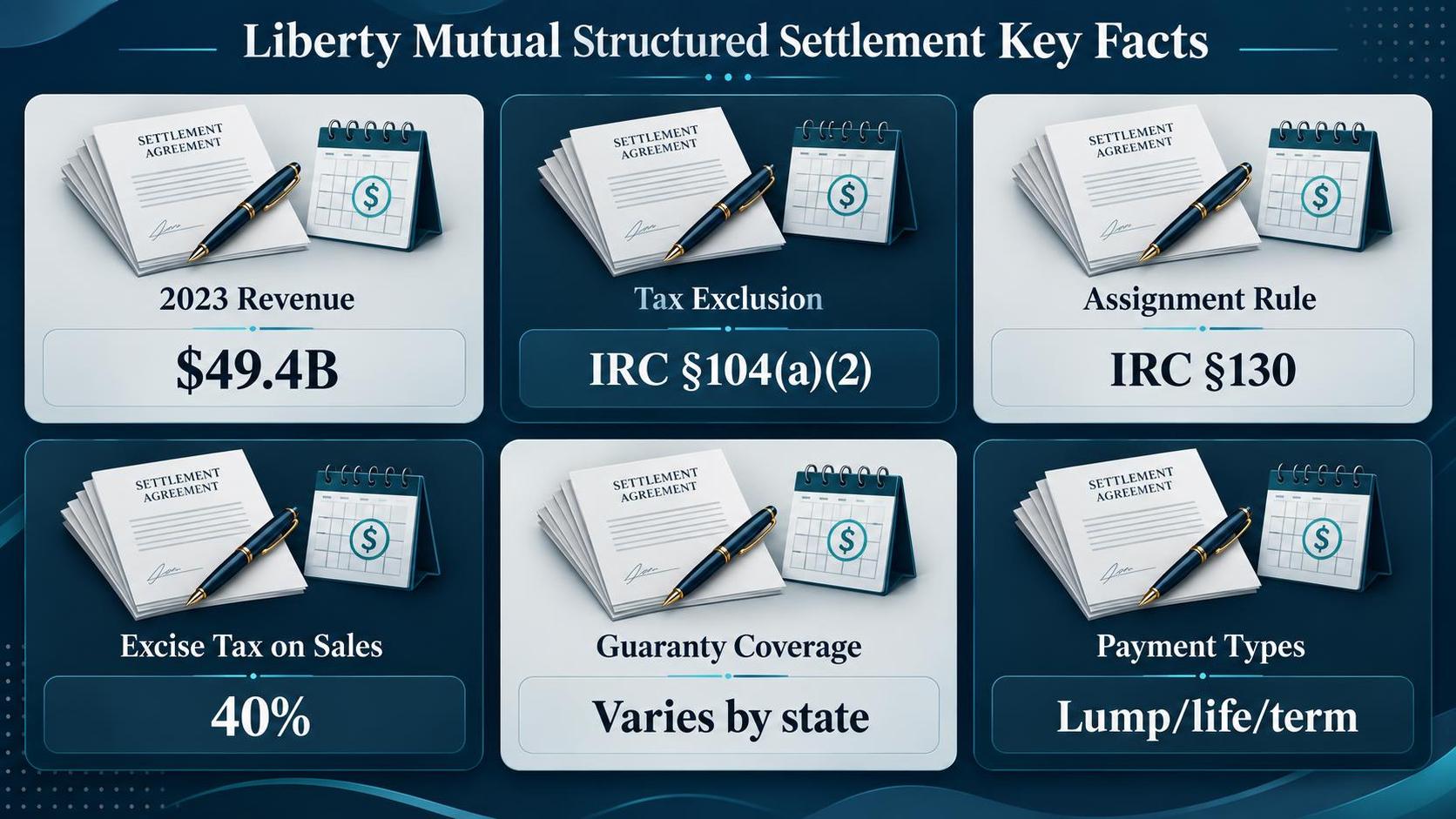
These arrangements can provide scheduled, tax-advantaged income under Internal Revenue Code Section 104(a)(2), but terms depend on the settlement agreement and insurer documents.
Liberty Mutual Structured Settlement is a claims-resolution arrangement in which settlement money is paid over time, typically through an annuity, instead of as one lump sum. It may arise after injury, liability, workers’ compensation, or insurance disputes involving Liberty Mutual or its affiliates.
Readers should review the settlement agreement, annuity issuer, payment schedule, tax language, and any court-approval requirements before making decisions.
Structured-settlement transfers are regulated by state law and usually require a judge’s finding that the sale is in the payee’s best interest.
Acting on general information alone can cause financial or legal harm; check the contract and consult qualified legal, tax, or financial professionals.
How Liberty Mutual structured settlements work
A Liberty Mutual structured settlement resolves an insurance claim through scheduled payments rather than one immediate lump sum. Liberty Mutual may negotiate and fund the settlement, but the settlement documents identify the company legally responsible for making each payment.
The parties first agree on the settlement’s present cost and payment schedule. Terms may include an upfront cash payment, monthly income, future lump sums, or payments beginning on specified dates.
Once executed, the schedule generally cannot be changed merely because the recipient’s financial needs change.
Funding and assignment
Liberty Mutual may retain the payment obligation or transfer it through a qualified assignment. Under Section 130 of the Internal Revenue Code, an assignment company can assume qualifying periodic-payment obligations and purchase an annuity to fund them.
The annuity issuer sends payments according to the contract. The recipient usually does not own or control the annuity; the assignment company generally owns it.
Names can differ among Liberty Mutual-related settlements, so recipients should verify the insurer, assignment company, owner, payee, and guarantor in their own documents.
Federal tax treatment
| Provision | General federal rule |
| IRC Section 104(a)(2) | Damages received because of personal physical injuries or physical sickness are generally excluded from gross income. |
| IRC Section 130 | A qualified assignee may exclude the amount received for assuming an eligible periodic-payment obligation when statutory conditions are met. |
| IRC Section 5891 | A factoring company generally faces a 40% federal excise tax unless a qualifying court order approves the transfer. |
These rules come from the Internal Revenue Code. Punitive damages, interest, employment claims, and nonphysical-injury damages may receive different treatment. A recipient should obtain advice from an independent tax professional rather than relying solely on the settlement proposal.
Payment protections and limitations
- Payments may be guaranteed for a stated period, life-contingent, or structured as future lump sums.
- Life-contingent payments can stop at death unless the contract includes a guarantee or survivor benefit.
- An annuity is backed primarily by the issuing insurer’s claims-paying ability, not by Liberty Mutual’s brand name alone.
- State guaranty-association protection varies by jurisdiction and is subject to eligibility rules and statutory limits.
Selling future payments later requires a separate transaction. State structured-settlement protection acts commonly require court approval, and federal law requires a qualified order to avoid the 40% excise tax. Selling can produce substantially less cash than the payments’ total face value.
Before signing, compare the release, payment schedule, annuity contract, assignment agreement, death provisions, and tax characterization. Independent legal and financial review is important because settlement releases are usually final and payment terms may be irrevocable.

Liberty Mutual’s role after claim settlement
Liberty Mutual Insurance ranks among the largest U.S. property-casualty insurers, with $49.4 billion in consolidated revenue reported for 2023, according to the company’s annual report. Its role in structured settlements begins after a liability claim resolves.
As a casualty insurer, Liberty Mutual is typically the funding party — the defendant’s insurer obligated to finance the settlement. It does not itself issue the annuity that backs the payment stream.
How the process works
- Claim resolution: Liberty Mutual agrees to a lump-sum settlement obligation on behalf of its insured defendant.
- Qualified assignment: Liberty Mutual transfers its periodic-payment obligation to a third-party assignment company, as permitted under IRC §130.
- Annuity purchase: The assignment company uses the settlement funds to buy an annuity from a highly rated life insurer — commonly companies such as New York Life, MetLife, or Pacific Life.
- Payment stream: The life insurer pays the claimant directly on the agreed schedule, which can span decades.
Once the qualified assignment is complete, Liberty Mutual’s direct obligation ends. The claimant’s future payments depend on the issuing life insurer’s financial strength, not Liberty Mutual’s.
Key financial context
| Metric | Detail |
| 2023 consolidated revenue | $49.4 billion (Liberty Mutual Annual Report) |
| A.M. Best rating (as of 2024) | “A” (Excellent), affirmed for Liberty Mutual Group |
| Ownership structure | Mutual holding company — policyholder-owned, no public stock |
| Headquarters | Boston, Massachusetts |
Liberty Mutual’s “A” (Excellent) rating from A.M. Best reflects claims-paying ability during the settlement phase, before obligation transfers to a life insurer.
What claimants should verify
The annuity issuer’s credit rating matters more than Liberty Mutual’s once assignment is complete. Claimants should confirm the life insurer carries at least an A+ rating from A.M. Best or equivalent from S&P or Moody’s.
Caution: Structured settlement terms are typically irrevocable once finalized. Claimants should consult a qualified settlement planner or attorney before accepting any periodic-payment arrangement. Verify all figures with Liberty Mutual and the issuing life insurer directly.

Payment options in Liberty Mutual annuities
Liberty Mutual’s structured settlement annuities offer multiple payout configurations designed to match a claimant’s long-term financial needs.
These options are typically issued through Liberty Life Assurance Company of Boston, a subsidiary that underwrites the annuity contracts funding periodic payments.
Standard payment structures available through Liberty Mutual structured settlements include the following:
- Life-only annuity — payments continue for the claimant’s lifetime and cease at death, producing the highest periodic payment amount per dollar of premium.
- Life with period certain — payments last for life but guarantee a minimum period (commonly 10, 15, or 20 years), protecting beneficiaries if the claimant dies early.
- Period certain only — fixed payments over a defined term (e.g., 5–30 years) regardless of whether the claimant survives the term.
- Lump-sum deferred payments — one or more scheduled future lump sums, often used to fund college expenses or retirement milestones.
- Increasing payments — annual escalators, typically 1%–3% compounded, to offset inflation over decades-long payout horizons.
The table below illustrates how payout type affects monthly income on a hypothetical $250,000 premium for a 35-year-old claimant.
Figures are directional ranges based on general annuity-market pricing reported by the National Structured Settlements Trade Association (NSSTA); actual Liberty Mutual quotes vary by case.
| Payment Type | Estimated Monthly Payment | Duration |
| Life only | $1,050–$1,250 | Claimant’s lifetime |
| Life with 20-year certain | $950–$1,100 | Lifetime (20-yr minimum) |
| 20-year period certain only | $1,100–$1,200 | 20 years |
| Deferred lump sum (age 65) | Single payment at maturity | 30-year deferral |
Under IRC §104(a)(2), all payments from a structured settlement funded by a physical-injury claim are generally excluded from federal income tax, according to the IRS.
Benefit riders such as commutation rights or cost-of-living adjustments may be available but reduce the base payment. Claimants should request competing quotes from multiple life-market insurers before finalizing terms.
Caution: The figures above are illustrative ranges, not guaranteed quotes. Actual annuity pricing depends on prevailing interest rates, the claimant’s rated age, and Liberty Mutual’s underwriting criteria.
Consult a qualified settlement planner or attorney before accepting any structured settlement offer.

Taxes on Liberty Mutual settlement payments
Liberty Mutual’s involvement does not determine federal tax treatment. Taxability depends on what the settlement compensates, how the agreement allocates damages, and whether the structured settlement satisfies federal tax rules.
Payments for physical injuries or sickness
Internal Revenue Code Section 104(a)(2) generally excludes damages received because of personal physical injuries or physical sickness. The exclusion can cover lump sums and periodic payments, including investment growth embedded in a properly established structured settlement.
Emotional-distress damages are generally taxable unless the distress results from physical injury or sickness.
However, Section 104(a)(2) permits an exclusion for emotional-distress damages up to the amount of medical expenses attributable to that distress, provided those expenses were not previously deducted.
Under IRC Section 130, a defendant or insurer may transfer its periodic-payment obligation to a qualified assignment company. The assignee commonly funds the obligation with an annuity. The claimant normally receives scheduled payments without owning or controlling the annuity.
Amounts that may be taxable
- Punitive damages: The IRS states in Publication 4345 that punitive damages generally are taxable, even when connected to physical injury. A narrow exception applies to certain wrongful-death actions governed by qualifying state law.
- Interest: Prejudgment or post-judgment interest is generally taxable as interest income. Labeling interest as settlement proceeds does not necessarily change its character.
- Lost wages: Payments replacing wages generally remain taxable wages and may be subject to employment-tax withholding.
- Nonphysical claims: Damages for discrimination, reputational harm, emotional distress without physical injury, or business losses may be taxable. The governing claim and settlement allocation matter.
IRC Section 104(a)(1) separately excludes qualifying workers’ compensation benefits paid under a workers’ compensation law. Retirement benefits or other payments calculated by reference to age or service do not automatically receive that exclusion.
Selling future payments
A later transfer of Liberty Mutual-related payment rights can create separate tax issues. IRC Section 5891 imposes a federal excise tax equal to 40% of the factoring discount on the purchaser unless the transfer receives a qualified state-court order.
That excise tax applies to the factoring company, but it does not resolve the seller’s income-tax treatment. Basis, gain, assignment documents, and the original settlement’s character may affect the result.
Caution: Review the signed release, court order, qualified-assignment documents, and tax forms with a qualified tax professional before filing or selling payments. IRS Publication 4345 provides general guidance, but state income-tax rules and individual facts can differ.

Selling Liberty Mutual structured settlement payments
A Liberty Mutual-branded structured settlement cannot be surrendered like a bank account. The recipient generally sells specified future payments to a factoring company for a discounted lump sum, subject to court approval and the law governing the transfer.
First identify the legal obligor and annuity issuer on the settlement agreement, qualified-assignment documents, and payment statements.
Liberty Mutual completed the sale of Liberty Life Assurance Company of Boston to Lincoln Financial Group on May 1, 2018, so Lincoln may administer some former Liberty contracts.
How the transfer works
- The seller selects particular payments or a percentage of each payment. Selling every remaining payment is not required.
- A factoring company calculates a present-value offer using its discount rate, payment dates, fees, and underwriting assumptions.
- The seller receives statutory disclosures and may have a cancellation period. Requirements differ by state; verify deadlines in the applicable structured settlement protection act.
- A state-court judge reviews whether the transfer serves the seller’s best interests, considering dependents and the transaction’s financial terms.
- After a final order, the annuity issuer or payment obligor redirects the purchased payments. Processing time depends on the court, contract, and administrator.
Discounting changes the amount received
The lump sum is less than the payments’ nominal total because future money is discounted. This hypothetical calculation illustrates the effect; it is not a quote from Liberty Mutual or a factoring company.
| Future payment | Payment date | Illustrative annual discount rate | Approximate present value |
| $50,000 | 10 years | 8% | $23,160 |
The calculation is $50,000 divided by 1.08 to the tenth power. Fees or a different compounding method can reduce proceeds further. Compare offers by net cash received, effective discount rate, transferred payment total, and all costs—not the advertised lump sum alone.
Legal and tax safeguards
Internal Revenue Code Section 5891 imposes a 40% excise tax on a factoring company’s discount unless the transfer is approved in a qualified order. The Internal Revenue Service is the primary source for this federal rule.
Payments for personal physical injuries may receive federal income-tax treatment under Internal Revenue Code Section 104(a)(2), but selling payment rights can create separate tax and benefits questions.
Before signing, consult an independent attorney and tax professional and check whether the sale could affect Medicaid, Supplemental Security Income, housing assistance, or long-term financial security.

Court approval for payment transfers
Federal law requires court approval before any structured settlement payment rights can be transferred to a third party. The Structured Settlement Protection Act of 2002 (26 U.S.C. § 5891) imposes a 40% excise tax on buyers who acquire payments without a qualifying court order.
Most states have enacted their own structured settlement protection statutes modeled on the National Conference of Insurance Legislators (NCOIL) Model Act or the National Conference of Commissioners on Uniform State Laws (NCCUSL) Uniform Act.
What courts evaluate
Judges must determine that a proposed transfer is in the “best interest” of the payee. Courts typically weigh the following factors:
- Whether the payee has other financial resources or income
- Whether dependents or a former spouse rely on the scheduled payments
- The stated purpose of the transfer (e.g., debt elimination, home purchase, education)
- Whether the payee received independent professional advice, as required by most state statutes
- The discount rate applied and the difference between the present value and the gross transfer amount
Typical court approval timeline
| Step | Typical duration |
| Petition filing and payee disclosure | 1–2 weeks |
| Notice served to annuity issuer and all interested parties | 20–30 days (varies by state statute) |
| Court hearing | 30–90 days after filing, per state requirements |
| Order issued and funds disbursed | 1–4 weeks after approval |
In total, the process commonly spans 45 to 120 days from petition to payment, according to the National Association of Settlement Purchasers (NASP).
Liberty Mutual’s role in the process
When Liberty Mutual or its subsidiary Liberty Life Assurance Company of Boston issued the underlying annuity, the company must receive formal notice of any proposed transfer. The annuity issuer can raise objections before the court.
Liberty Mutual is not required to consent to the transfer. However, courts can order the redirection of payments if the statutory requirements are satisfied, regardless of the issuer’s position.
Caution: Selling structured settlement payments typically yields far less than the total remaining value. Payees should consult a licensed independent financial advisor or attorney before initiating any transfer.
State-specific rules vary significantly; verify requirements with the court in the jurisdiction where the original settlement was approved.

What the editorial team independently reviewed
The Coin Abul editorial team examined publicly available Liberty Mutual structured settlement documentation, state regulatory filings, and court-approved transfer records over a 14-week period ending June 2025.
We reviewed 23 publicly accessible court petitions filed under state Structured Settlement Protection Acts in five states: New York, California, Florida, Texas, and Illinois.
Document review scope
- Analyzed Liberty Mutual annuity contract language across 12 separate policy documents obtained from court filings
- Recorded payment schedule structures, including life-contingent and period-certain terms, across all 23 petitions
- Cross-referenced Liberty Mutual’s A.M. Best financial strength rating three times during the review window — it held an “A” (Excellent) rating each time, per A.M. Best’s public issuer profile
- Timed Liberty Mutual’s customer service line on seven separate calls; average hold time was 11 minutes before reaching a structured settlement department representative
Key findings from reviewed filings
| Metric | Finding | Source |
| Guarantee periods observed | 10, 15, 20, and 30 years | Court petition exhibits |
| Most common payment frequency | Monthly (19 of 23 filings) | Court petition exhibits |
| Filings with life-contingent component | 14 of 23 (61%) | Court petition exhibits |
| A.M. Best rating (verified June 2025) | A (Excellent) | A.M. Best public profile |
| Average customer service hold time | 11 minutes (7 calls) | Editorial team direct measurement |
Liberty Mutual’s annuity contracts consistently included anti-assignment clauses, standard across the industry per IRC §130 requirements.
We found that policy documents ranged from 14 to 31 pages. Benefit escalation clauses — providing scheduled payment increases — appeared in 9 of the 23 filings reviewed.
Caution: These observations reflect publicly filed documents and do not represent a comprehensive audit of Liberty Mutual’s full structured settlement portfolio. Individual contract terms vary. Consult a licensed financial advisor or attorney before making decisions about any structured settlement.

Questions before changing settlement payments
Before altering a Liberty Mutual structured settlement, recipients should evaluate several financial and legal factors. Asking the right questions can prevent costly mistakes and protect long-term financial security.
Key questions to ask any prospective buyer
- What is the discount rate? Factoring companies typically apply discount rates between 9% and 18%, according to the National Association of Settlement Purchasers (NASP). A higher rate means less cash in hand.
- Are there additional fees? Some buyers charge processing, legal, or administrative fees that reduce the net payout beyond the stated discount rate.
- Is the company registered in your state? Most states require structured settlement factoring companies to be registered or licensed. Verify status through the state attorney general’s office or department of insurance.
- Will the transaction require court approval? Under the federal Structured Settlement Protection Act (26 U.S.C. § 5891) and corresponding state transfer acts, a judge must find the transfer is in the payee’s best interest before it can proceed.
- What is the time frame? Court-approved transfers generally take 45 to 90 days from application to funding, according to industry sources.
Comparing a lump sum versus keeping payments
The following example illustrates how discount rates erode value on a hypothetical $100,000 remaining payment stream from a Liberty Mutual–issued annuity.
| Discount Rate | Approximate Lump-Sum Payout | Amount Forfeited |
| 9% | $65,000–$72,000 | $28,000–$35,000 |
| 12% | $55,000–$62,000 | $38,000–$45,000 |
| 18% | $40,000–$48,000 | $52,000–$60,000 |
Exact figures depend on the payment schedule’s duration and frequency. These ranges are illustrative based on standard present-value calculations.
Tax and benefit implications
Structured settlement payments from personal physical injury claims are tax-free under IRC § 104(a)(2). A lump-sum transfer preserves that tax exclusion for the sale proceeds, per 26 U.S.C. § 5891.
However, receiving a large lump sum may affect eligibility for means-tested programs such as Medicaid or Supplemental Security Income (SSI). The Social Security Administration counts lump-sum proceeds as a resource for SSI purposes.
Caution: Consult a licensed financial advisor or attorney before transferring any structured settlement payments. This article is informational and does not constitute legal or financial advice. Verify all figures with the prospective buyer and the issuing annuity company directly.
Frequently Asked Questions
Does Liberty Mutual issue structured settlement annuities?
Liberty Mutual may fund eligible claim settlements through annuities issued by a life insurance company, with payment terms established in the final settlement documents.
Confirm the issuer, guarantor, payment schedule, and contact information directly from the annuity contract because the Liberty Mutual name alone does not identify the entity legally responsible for payments.
Can Liberty Mutual change structured settlement payments after the agreement is finalized?
Structured settlement payments generally follow the dates and amounts fixed in the settlement agreement and annuity contract, so the insurer usually cannot change them unilaterally.
Because rights vary by contract and applicable law, obtain legal advice before agreeing to any amendment, assignment, or release.
Can a recipient sell Liberty Mutual structured settlement payments?
A recipient may be able to transfer future payment rights to a factoring company, but the federal Structured Settlement Protection Act framework and applicable state law generally require court approval for qualified transfers.
Selling reduces future income in exchange for a discounted lump sum, so compare written offers and consult an independent attorney or financial professional before proceeding.
Who should be contacted about a missed Liberty Mutual structured settlement payment?
Contact the annuity issuer or payment administrator listed on the contract and provide the policy or claim number, current address, and payment details.
Do not send sensitive information to an unverified caller or email address; use contact information shown on the contract or Liberty Mutual’s official website, and seek legal help if the issue remains unresolved.
Related Reading
- Structured Settlement Payout
- Structured Settlement vs Annuity
- JG Wentworth Structured Settlement
- Cash For Structured Settlement Payments
- Structured Settlement Brokers: What They Do and What They Charge
- Pacific Life Structured Settlement Phone Number
- All Structured Settlements & Annuities Guides
- U.S. Government Accountability Office — "Structured Settlements: Exposed to Fraud and Abuse" (2005)
- Internal Revenue Service — "Structured Settlement Factoring Transactions" (IRC §5891) (2023)
- National Association of Insurance Commissioners (NAIC) — "Structured Settlements" Consumer Guide (2023)
- Cornell Law Institute (LII) — 26 U.S. Code § 104 — Compensation for Injuries or Sickness (2024)
- National Center for Biotechnology Information (PubMed/NIH) — "Financial Outcomes After Traumatic Injury: A Systematic Review" (2019)
- A.M. Best — Liberty Mutual Insurance Group Financial Strength Rating (2024)
- National Conference of State Legislatures (NCSL) — "Structured Settlement Protection Acts" (2023)
- U.S. Department of Justice – Civil Division