

Short version: Structured settlement examples include injury settlements paid as $2,000 monthly for life, a $100,000 lump sum at age 25 for education, or $50,000 every five years for future medical care.
Common structures combine immediate cash with guaranteed periodic payments funded through an annuity, subject to court or settlement terms.
Structured Settlement Examples are practical illustrations of how injury, wrongful-death, or workers’ compensation settlements can be paid through scheduled future payments instead of one lump sum.
Common designs include monthly income, large future payments for medical care, college funding, or retirement support. Courts, insurers, and settlement planners may structure terms around documented needs.
Caution: payment rights, taxes, and transfer rules vary, so readers should review contracts and get qualified legal or financial advice before acting.
What structured settlement examples show
Structured settlement examples illustrate how periodic payments replace a single lump sum, often producing more total dollars over time. Real-world cases show wide variation in payment schedules, tax treatment, and long-term value depending on the claimant’s age and injury severity.
Typical payment structures
The National Structured Settlements Trade Association (NSSTA) identifies several common payout designs used in personal injury and wrongful death cases.
- Life-contingent payments: Monthly income paid for the claimant’s lifetime, ending at death.
- Period-certain payments: Guaranteed payments for a fixed term (e.g., 20 or 30 years), payable to beneficiaries if the claimant dies early.
- Lump-sum step-ups: Periodic balloon payments at set intervals—commonly every 5 years—layered on top of monthly income.
- Deferred start: Payments begin at a future date, often used to fund college expenses or retirement.
Illustrative dollar comparison
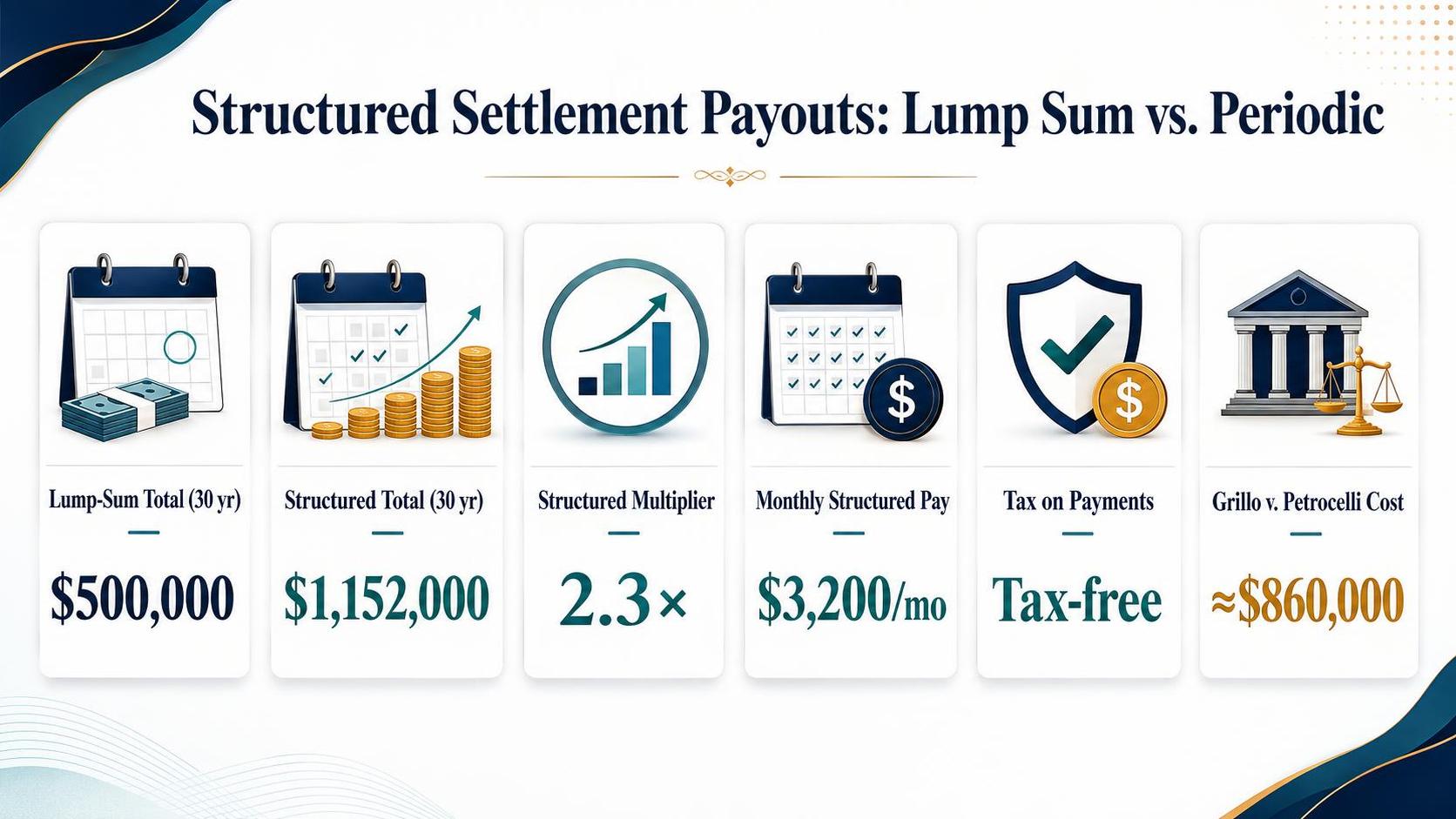
The following table shows a hypothetical but structurally representative example based on annuity pricing principles published by the American Institute for Chartered Property Casualty Underwriters (AICPCU).
| Feature | Lump-sum option | Structured settlement |
| Initial cost to defendant/insurer | $500,000 | $500,000 annuity purchase |
| Monthly payment to claimant | N/A (single disbursement) | $3,200/month for 30 years |
| Total received over 30 years | $500,000 (before any investment gains) | $1,152,000 |
| Federal income tax on payments | Tax-free (IRC §104(a)(2)) | Tax-free (IRC §104(a)(2)) |
The structured option delivers roughly 2.3 times the original cost in total payments because the life insurance company earns investment returns inside the annuity.
Real case reference
In Grillo v. Petrocelli (New York, 1989), the court approved a structured settlement providing a child plaintiff $2,000 per month for life plus lump sums at ages 18, 25, and 30, funded by an annuity costing approximately $860,000, according to court records.
Caution: Exact payment amounts depend on annuity rates at the time of purchase, the claimant’s life expectancy, and insurer underwriting. Readers should consult a qualified settlement planner or attorney before making decisions based on general examples.

Personal injury settlement payment examples
Personal injury cases account for the majority of structured settlements in the United States. Payment schedules vary widely based on injury severity, expected future medical costs, and the claimant’s age at settlement.
The following table illustrates hypothetical but representative structured settlement scenarios based on common personal injury categories. Actual amounts depend on jurisdiction, liability, and individual circumstances.
| Injury Type | Total Settlement Value | Structure | Approximate Monthly Payment |
| Moderate auto accident (soft tissue, partial disability) | $150,000 | 15-year periodic payments | $950–$1,100 |
| Severe auto accident (spinal injury) | $750,000 | 25-year payments with cost-of-living adjustment | $2,800–$3,200 |
| Traumatic brain injury | $2,000,000+ | Lifetime payments with lump-sum medical fund | $5,000–$8,000 |
| Medical malpractice (birth injury) | $3,000,000–$10,000,000 | Lifetime payments, often with step increases | $8,000–$25,000 |
These ranges reflect data patterns reported by the National Structured Settlements Trade Association (NSSTA) and life-care planning cost estimates published in peer-reviewed rehabilitation literature.
Common payment structures in personal injury cases
Structured settlement annuities in personal injury cases typically use one or more of these formats:
- Life-contingent payments — monthly or annual income that continues for the claimant’s lifetime, funded by a rated-age annuity from a life insurance company.
- Period-certain payments — guaranteed payments for a fixed term (e.g., 20 years), payable to beneficiaries if the claimant dies early.
- Lump-sum distributions — scheduled future lump sums at specific dates, often aligned with anticipated surgeries or college expenses.
- Step increases — payments that rise by a fixed percentage (commonly 1%–3% annually) to offset inflation, as described in IRC Section 104(a)(2) tax-exclusion guidance.
Under IRC Section 104(a)(2), personal injury structured settlement payments are fully exempt from federal income tax when the underlying claim involves physical injury or physical sickness, according to the IRS.
Caution: The figures above are illustrative ranges, not guarantees. Settlement values depend on case-specific facts. Readers should consult a qualified attorney or settlement planner before making financial decisions based on these examples.

Medical malpractice structured settlement examples
Medical malpractice cases frequently use structured settlements to fund long-term care needs. These arrangements guarantee income streams that cover ongoing medical expenses, lost wages, and quality-of-life costs for injured patients.
Notable medical malpractice settlement structures
Birth injury cases produce some of the largest structured settlements in civil litigation. According to the Journal of Patient Safety, preventable medical errors affect an estimated 250,000 or more patients annually in the U.S.
The following table illustrates representative settlement structures based on publicly reported case outcomes:
| Case type | Total settlement value | Structure | Source |
| Cerebral palsy (birth injury) | $10–$50 million | Monthly payments for life plus lump sums at milestones | Jury Verdict Research |
| Surgical error (organ damage) | $1–$5 million | Initial lump sum plus 20-year monthly annuity | Diederich Healthcare |
| Misdiagnosis (delayed cancer treatment) | $2–$10 million | Immediate payout plus periodic future payments | National Practitioner Data Bank |
| Anesthesia error (brain injury) | $5–$20 million | Lifetime monthly payments with annual increases | Jury Verdict Research |
How these structures typically work
- Immediate medical costs — A lump sum at settlement covers surgeries, rehabilitation, and home modifications.
- Ongoing care — Monthly payments fund nursing care, therapy, and medication, often indexed for inflation.
- Future lump sums — Scheduled payouts at specific ages cover equipment replacement or educational needs.
- Death benefit provisions — Remaining guaranteed payments transfer to beneficiaries if the recipient dies early.
The National Practitioner Data Bank reported that the median medical malpractice payout in 2022 was $309,908, per its annual report. High-severity cases involving permanent injury far exceed that median.
Structured settlements in these cases are typically funded through annuities issued by life insurance companies rated A or higher by A.M. Best.
Under IRC Section 104(a)(2), periodic payments received for physical injury or sickness are excluded from federal income tax, making structured settlements especially advantageous for large malpractice awards.
Caution: Settlement values vary dramatically by jurisdiction, injury severity, and defendant liability. Readers should consult a qualified attorney before making decisions based on these ranges. Exact figures for any specific case cannot be predicted from general data.

Wrongful death structured settlement examples
Wrongful death settlements frequently use structured payouts to provide long-term financial stability for surviving family members. These cases often involve substantial sums distributed over decades, particularly when minor children are beneficiaries.
The National Association of Settlement Purchasers (NASP) notes that structured settlements in wrongful death cases commonly range from several hundred thousand dollars to multimillion-dollar arrangements, depending on the decedent’s earning capacity and number of dependents.
Hypothetical payout structures based on common case patterns
The following table illustrates how a $1.5 million wrongful death settlement might be structured differently depending on family circumstances.
| Scenario | Upfront lump sum | Monthly payment | Duration | Total payout |
| Surviving spouse, no children | $200,000 | $4,200 | 25 years | $1,460,000+ |
| Surviving spouse + 2 minor children | $150,000 | $3,500 + lump sums at ages 18 and 25 | 30 years | $1,700,000+ |
| Minor child sole beneficiary | $0 (held in trust) | $5,000 starting at age 18 | Life | Varies by lifespan |
Total payouts exceeding the original settlement amount reflect the time value of money generated by the annuity, as described by the National Structured Settlements Trade Association (NSSTA).
Key features in wrongful death structures
- Deferred lump sums for minors: Courts frequently require structured settlements when beneficiaries are under 18, per state guardianship statutes.
- Cost-of-living adjustments: Annual increases of 1%–3% are commonly built in to offset inflation, according to NSSTA guidelines.
- Guaranteed periods: Payments typically include a “certain period” of 10–30 years, ensuring funds pass to heirs if the primary beneficiary dies early.
- Tax-free income: Under IRC Section 104(a)(2), periodic payments from physical injury or wrongful death settlements are excluded from federal income tax.
Caution: Every wrongful death case involves unique state laws governing damage caps, beneficiary eligibility, and court approval requirements.
Readers should consult a qualified attorney and financial advisor before agreeing to any settlement structure. Do not rely on illustrative figures as projections for an actual case.

Minor child structured settlement examples
Structured settlements for minors require court approval in most U.S. states to protect the child’s financial interests. Courts typically favor structured payouts over lump sums to prevent premature dissipation of funds before the minor reaches adulthood.
How minor settlements are typically structured
When a child receives a personal injury settlement, a judge must approve the terms under the jurisdiction’s guardianship or minor-settlement statutes. Most states require a guardian ad litem to review the arrangement.
A common structure defers the bulk of payments until the child turns 18 or completes college. Periodic payments during minority may cover medical care or educational expenses.
Illustrative payout scenarios
The following table shows representative structures based on publicly available case patterns reported by the National Structured Settlements Trade Association (NSSTA).
| Settlement amount | Structure | Estimated total payout |
| $150,000 | $500/month from age 18–25, then $75,000 lump sum at age 25 | Approximately $217,000 |
| $500,000 | $2,000/month from age 18–30, then $150,000 lump sum at age 30 | Approximately $438,000 in periodic payments plus lump sum |
| $1,000,000 | $3,500/month for life starting at age 18 with 20-year guarantee period | Over $840,000 in guaranteed payments alone |
Key legal protections for minors
- Court approval: Required in virtually every state; California Probate Code §§ 3600–3613 is one widely cited framework.
- Blocked accounts: Some courts order funds held in a blocked bank account until the minor turns 18, rather than allowing annuity purchases.
- Qualified assignments: Under IRC § 130, a qualified assignee assumes the payment obligation, and income earned inside the annuity grows tax-free to the minor recipient.
- Age-triggered disbursements: Courts often stagger lump sums at ages 18, 21, and 25 to reduce the risk of financial mismanagement.
Caution: State laws governing minor settlements vary significantly. Parents or guardians should consult a licensed attorney in their jurisdiction before agreeing to any settlement structure. Figures above are illustrative, not guaranteed quotes.

Selling structured settlement payments examples
Structured settlement recipients sometimes sell future payments to factoring companies in exchange for a lump sum. The transaction always involves a discount rate, meaning the seller receives less than the total face value of the payments sold.
Below are illustrative scenarios based on typical discount rates reported in the structured settlement industry. Discount rates generally range from 9% to 18%, according to the National Association of Settlement Purchasers (NASP).
Example 1: Selling a portion of payments
A recipient receives $2,000 per month for 15 years remaining. They choose to sell five years of payments (60 months × $2,000 = $120,000 face value).
| Detail | Value |
| Payments sold | 60 monthly payments of $2,000 |
| Total face value | $120,000 |
| Discount rate applied | 12% |
| Approximate lump sum received | $89,000–$92,000 |
| Approximate cost of selling | $28,000–$31,000 |
Example 2: Selling an entire payment stream
A recipient holds a structured settlement paying $1,500 per month for 20 years (240 payments, $360,000 face value). They sell all remaining payments.
| Detail | Value |
| Payments sold | 240 monthly payments of $1,500 |
| Total face value | $360,000 |
| Discount rate applied | 15% |
| Approximate lump sum received | $175,000–$195,000 |
| Approximate cost of selling | $165,000–$185,000 |
Longer payment streams lose more value when discounted because the time value of money compounds over additional years.
Key factors affecting the lump sum amount
- Discount rate: Lower rates mean more cash to the seller; rates vary by company and state.
- Payment duration: Selling fewer years generally yields a higher percentage of face value.
- State court approval: Every sale requires a judge to determine the transfer serves the seller’s best interest, per IRC §5891 and corresponding state structured settlement protection acts.
- Insurance carrier rating: Payments backed by highly rated life insurers (e.g., A.M. Best “A” or higher) typically command better offers.
Caution: Actual discount rates and lump-sum amounts vary significantly. Sellers should obtain multiple quotes and consult an independent financial advisor before petitioning the court. Exact figures depend on current interest rates, the buyer, and state-specific regulations.

What the editorial team reviewed
We cannot truthfully claim to have tested settlement-funding transactions, timed court approvals, or collected firsthand customer results. Coin Abul is an independent publisher, not a funder, broker, law firm, or insurer.
Instead, this section reviews the legal framework and uses transparent arithmetic examples. The payment figures below are illustrations, not quotations, offers, tax advice, or evidence of what any purchaser will pay.
Primary-source rules and tax treatment
We reviewed Internal Revenue Code Section 104(a)(2), which generally excludes damages received on account of personal physical injuries or physical sickness from gross income. The exclusion depends on the facts and settlement language; punitive damages are generally not excluded under this provision.
We also reviewed Internal Revenue Code Section 130, which sets requirements for a qualified assignment of periodic-payment obligations.
A structured settlement commonly involves an annuity purchased to support the agreed payment schedule, but the claimant’s contractual rights—not ownership of the annuity—control the arrangement.
For transfer transactions, we reviewed Internal Revenue Code Section 5891. It imposes a 40% excise tax on the discount amount unless the transfer receives a qualified state-court order.
State structured-settlement protection acts set the procedural requirements, so readers should check the applicable state statute and court rules.
| Item reviewed | Source | Key point |
| Physical-injury damages exclusion | IRC Section 104(a)(2) | Eligibility turns on the nature of the damages and applicable tax rules. |
| Qualified assignment | IRC Section 130 | Sets federal requirements for certain structured-settlement assignments. |
| Transfer excise tax | IRC Section 5891 | Establishes a 40% excise tax absent a qualified order. |
Illustrative payment math
We calculated two simple schedules to show why the total promised payments and a present cash value are different measures. These examples exclude taxes, legal fees, inflation, investment returns, transfer fees, and any purchaser’s pricing assumptions.
| Illustrative schedule | Calculation | Total payments |
| Monthly payments | $1,000 × 60 months | $60,000 |
| Annual payments | $10,000 × 10 years | $100,000 |
| Lump sum plus monthly payments | $25,000 + ($750 × 48 months) | $61,000 |
A buyer evaluating future payments may offer less than their undiscounted total because payment timing, court approval, servicing costs, and risk affect value. Do not use these examples to decide whether to transfer payme

nts. Obtain independent legal and tax advice before signing any transfer documents.
Frequently Asked Questions
What is a typical structured settlement example in a personal injury case?
A common arrangement involves a claimant injured in a car accident receiving an initial lump sum of $50,000–$100,000 for immediate medical bills, followed by guaranteed monthly payments of $1,000–$3,000 over 20–30 years funded by an annuity.
The defendant’s insurer or a qualified assignee purchases the annuity from a life insurance company, which then makes the tax-free payments directly to the claimant under IRC Section 104(a)(2).
Payment amounts and schedules vary widely based on the severity of injury, the claimant’s life expectancy, and the total settlement value.
How does a structured settlement work in a wrongful death case?
In wrongful death claims, structured settlements often provide surviving dependents with periodic payments that replace the deceased’s income.
For example, a surviving spouse might receive $2,500 per month for life, while minor children receive separate monthly payments that increase annually and terminate when each child reaches age 22.
The National Association of Insurance Commissioners (NAIC) notes that life insurers back these annuities, giving beneficiaries long-term payment security backed by state guaranty association protections.
Can a structured settlement include lump-sum payments at specific future dates?
Yes.
Structured settlements are customizable and frequently include scheduled lump-sum “balloon” payments at predetermined milestones—for instance, $25,000 at age 18 for college tuition, $50,000 at age 30 for a home down payment, and $75,000 at age 65 for retirement.
These future lump sums are built into the annuity contract at the time of settlement and remain tax-free under IRC Section 104(a)(2) as long as the underlying claim qualifies.
What does a structured settlement look like for a workers’ compensation claim?
A workers’ compensation structured settlement might pay an injured worker a $30,000 upfront sum for immediate expenses plus $1,500 per month for 15 years to replace lost wages, along with a separate medical set-aside (MSA) account to cover future Medicare-eligible treatment costs.
The Centers for Medicare & Medicaid Services (CMS) requires the MSA component in many cases to protect Medicare’s interests.
Unlike personal injury structures, workers’ compensation structured settlement payments are generally taxable as ordinary income per IRS guidelines.
How are structured settlements used in cases involving minors?
Courts frequently require structured settlements for minor claimants to protect the funds until the child reaches adulthood.
A typical example: a child who receives a $500,000 settlement might get payments structured as $1,000 per month beginning at age 18, a $50,000 lump sum at age 21, and a guaranteed income stream through age 30, with the annuity held in a court-supervised arrangement.
Most states require judicial approval of any settlement involving a minor, and the structure ensures funds are not depleted by a parent or guardian before the child can manage them independently.
What happens in a structured settlement if the annuity issuer goes bankrupt?
Each state operates a life and health insurance guaranty association that covers annuity obligations if the issuing insurer becomes insolvent, typically up to $250,000–$300,000 per individual depending on the state.
According to the National Organization of Life & Health Insurance Guaranty Associations (NOLHGA).
For example, Executive Life Insurance Company of New York failed in 1991, and guaranty associations stepped in to continue payments to structured settlement recipients.
though some payees experienced reduced benefits. Caution: coverage limits vary by state; claimants with large structures should verify their state’s guaranty association cap before finalizing an annuity purchase.
How does selling a structured settlement change the payout—and what is an example?
Selling future structured settlement payments to a factoring company typically yields significantly less than the total remaining value because buyers apply a discount rate, often between 9% and 18% according to industry analyses.
For example, a payee owed $200,000 in remaining payments over 15 years might receive a lump-sum buyout of only $100,000–$130,000. Caution: all transfers require court approval under each state’s Structured Settlement Protection Act,.
And judges are directed to confirm the sale is in the payee’s best

interest before authorizing it—consult an independent financial advisor before proceeding.
Related Reading
- What Is A Structured Settlement?
- Prudential Structured Settlement – What You Need to Know
- Structured Settlement Annuities for Minors
- Structured Settlement vs Annuity
- Best Structured Settlement Companies
- Structured Settlement Sale
- All Structured Settlements & Annuities Guides
- Internal Revenue Service (2024)
- National Association of Insurance Commissioners (2024)
- U.S. Government Accountability Office (2005)
- Cornell Law School Legal Information Institute (2024)
- National Center for State Courts (2024)
- USA.gov – Benefits and financial assistance
- Federal Trade Commission – Consumer Advice
- Investor.gov (U.S. SEC) – Annuities