

Straight answer: Structured settlement cashout means selling some or all future structured settlement payments to a factoring company for a discounted lump sum.
U.S. transfers generally require court approval under state structured settlement protection acts. The cash received is less than the total future payments, so compare offers and get independent legal or financial advice before agreeing.
Structured settlement cashout is a court-approved sale of some or all future structured settlement payments for a smaller lump sum today.
The buyer discounts those payments for time, risk, and profit, so the cash received is less than the scheduled total. State judges must find the transfer in the seller’s best interest under applicable law.
This article explains how cashouts work, what courts review, common costs, and risks to compare before signing.
A cashout can solve an urgent liquidity problem, but it can also reduce long-term income set aside for medical care, housing, or family support. Readers should verify state rules and get independent legal or financial advice before acting.
Structured settlement cashout basics
A structured settlement cashout means selling some or all future settlement payments to a factoring company for a lump sum today.
These payments usually come from a lawsuit settlement and are commonly funded through an annuity issued by a life insurer, as described by the Internal Revenue Service in IRC Section 5891 and by the National Association of Settlement Purchasers.
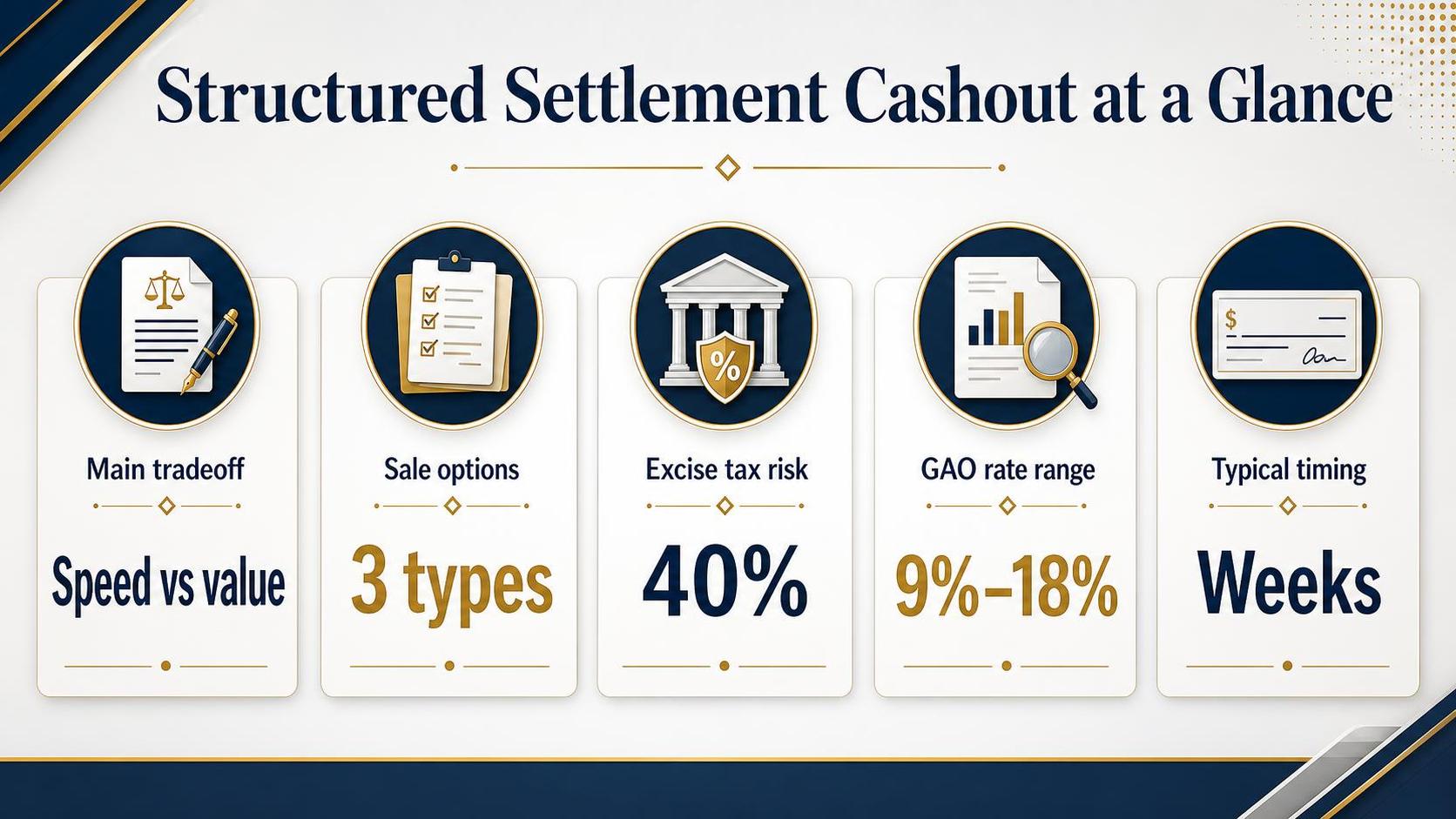
The key tradeoff is speed versus value. The buyer applies a discount rate, so the lump sum is lower than the total of the future payments.
That discount can be substantial, and the transaction normally requires court approval under state structured settlement protection laws.
Most sellers choose one of three structures: a full sale, a partial sale, or a sale of a set number of payments.
The National Association of Settlement Purchasers says a partial sale can preserve some future income while still creating immediate cash.
| Cashout structure | What it means | Source |
| Full sale | All remaining payments are assigned to the buyer in exchange for one lump sum. | National Association of Settlement Purchasers |
| Partial sale | Only selected payments or a portion of payments are sold. | National Association of Settlement Purchasers |
| Lump-sum by period | A fixed number of monthly or annual payments are sold, and later payments stay with the payee. | Consumer Financial Protection Bureau court filings and state SSPA practice |
Federal tax law matters. IRC Section 5891 imposes a 40% excise tax on a structured settlement transfer unless the transfer is approved in advance in a qualified order under a state statute. That is why court approval is not a formality.
Discount rates vary by transaction. The Government Accountability Office reported in 2012 that effective annual discount rates in sampled transfers generally ranged from 9% to 18%, depending on the deal and fees.
If a quoted rate is outside that band, the reader should ask for a written breakdown and compare it with current court disclosures.
Fees can reduce proceeds further. State filings and transfer petitions often show legal, processing, and administrative charges in addition to the discount rate.
A seller should request the gross advance, every deducted fee, and the net amount in writing before signing.
There is also a waiting period. Court scheduling, disclosure timing, and insurer processing mean a cashout often takes several weeks, not days.
Exact timing depends on the state law and court calendar, so the reader should verify the required notice period in the applicable structured settlement protection act.
Caution: Selling future payments can weaken long-term income needed for housing, medical care, or dependents. A reader should review the transfer documents, compare multiple quotes, and get legal or financial advice before acting.

When selling payments may make sense
Selling structured settlement payments can make sense when a person needs cash for a specific, time-sensitive purpose and other lower-cost options are unavailable or unsafe.
The decision is usually strongest when the money prevents a larger loss, restores earning ability, or covers an essential need.
A structured settlement is designed to provide long-term income, often after an injury claim.
Because selling future payments reduces that protection, the reason should be concrete, documented, and important enough to justify the discount and court process required in most cases.
One common case is avoiding high-cost debt. The Federal Reserve reported that the average credit card interest rate on accounts assessed interest was 22.80% in February 2024.
If a payout retires revolving debt near that rate, the savings may outweigh keeping future payments.
Another case is housing stability. The Joint Center for Housing Studies of Harvard University reported that 22.4 million renter households were cost-burdened in 2022, meaning they spent more than 30% of income on housing.
Preventing eviction or foreclosure can be financially and personally critical.
Medical and disability-related needs can also justify a sale. The Centers for Disease Control and Prevention states that adults with disabilities often face higher health-related costs and barriers to work.
Paying for accessible transportation, home modifications, or treatment may preserve independence or income.
Education or job training may be reasonable when the expected benefit is measurable.
The U.S. Bureau of Labor Statistics reported median weekly earnings of $1,493 for workers with a bachelor’s degree in 2023, versus $899 for workers with only a high school diploma.
Outcomes vary, so readers should verify program quality and total cost.
| Situation | Why a cashout may help | Fact to weigh |
| Paying off credit card debt | Stops compounding interest quickly | Average credit card APR was 22.80% on accounts assessed interest, Federal Reserve, February 2024 |
| Stopping housing loss | Prevents eviction, foreclosure, fees, and moving costs | 22.4 million renter households were cost-burdened in 2022, Harvard JCHS |
| Funding training or school | May raise earning power | Median weekly earnings were $1,493 with a bachelor’s degree and $899 with high school only, BLS 2023 |
Selling may also make sense when only part of the payment stream is sold. A partial sale can target one expense while preserving some future income, which may reduce long-term harm compared with selling the entire settlement.
Caution: a buyer pays less than the total of the future payments because of discounting and fees, and state court approval is often required.
Before signing, compare alternatives, review the contract, and confirm state-law requirements from the court or a qualified attorney.

Court approval and consumer protections
A structured settlement cashout usually cannot close on a buyer’s signature alone. In most cases, a state court must approve the transfer, and federal tax law penalizes transfers that do not meet the legal standard.
The core federal rule is Internal Revenue Code Section 5891.
It imposes a 40% excise tax on any “factoring transaction” unless the transfer is approved in a “qualified order” under the applicable state structured settlement protection act, according to the Internal Revenue Service and the U.S. Code.
Court review is the main consumer protection. The judge typically reviews the disclosure statement, the payment rights being sold, the discounted present value, the gross advance, fees, and the net amount the seller would actually receive.
| Rule or figure | What it means | Source |
| 40% | Federal excise tax on a structured settlement transfer that lacks a qualified court order. | 26 U.S.C. § 5891(a) |
| 3 days | Minimum period before signing that the transfer disclosure statement generally must be provided under the federal definition tied to state compliance. | 26 U.S.C. § 5891(b)(2)(B) |
| 10 points | The discount rate must be disclosed, plus the amount of any quoted interest rate and the difference between them, if the rates differ by 10 percentage points or more. | 26 U.S.C. § 5891(b)(2)(A)(iv) |
State laws add the hearing process and “best interest” review.
Judges often must decide whether the transfer is in the payee’s best interest and whether the payee has been advised to seek independent professional advice, according to state structured settlement protection acts.
That review matters because a cashout can permanently reduce long-term income.
Once court-approved payments are assigned and the order becomes effective, the seller may lose future monthly or lump-sum payments that were designed to cover housing, medical needs, or family support.
- Read the disclosure line by line. Focus on the net payment, not only the advertised lump sum.
- Ask for the court petition, transfer agreement, and payment schedule before the hearing.
- Compare the discount rate and all fees across multiple buyers.
- Consider independent legal or financial advice before signing. Some states specifically require notice of that right.
Caution: state rules differ. Before acting, check the current text of the applicable state structured settlement protection act and the court forms in the county where approval will be sought.
A judge can deny a transfer that appears unfair or incomplete.

How cashout quotes are calculated
A structured settlement cashout quote starts with present value. The buyer estimates what the future payments are worth today, then applies a discount rate and subtracts transaction costs permitted by the contract and state process.
The transfer also usually needs court approval under state structured settlement protection laws because federal tax law, 26 U.S.C. § 5891, imposes a 40% excise tax on a factoring transaction that does not meet the qualified-order rules.
That legal step can affect timing and final disclosures.
The first input is the payment stream itself. A quote changes if the seller transfers all payments, a fixed number of payments, or only part of each payment. The quote also changes if payments are monthly, annual, or have future lump sums.
The second input is the discount rate. In plain terms, a higher discount rate produces a lower cash offer today because more value is taken off for time, risk, and the buyer’s required return.
The Consumer Financial Protection Bureau says consumers should ask for the discount rate and total fees in writing before agreeing to sell.
| Input | Illustrative figure | Source |
| Monthly payment | $1,000 | Illustrative example for math only, not a market quote |
| Number of payments sold | 120 months | Illustrative example for math only, not a market quote |
| Total future payments | $120,000 | Calculated from the illustrative example: 120 × $1,000 |
| Annual discount rate | 12% | Illustrative example for math only, not a market quote |
| Approximate present value before fees | About $69,700 | Calculated from the illustrative example using standard present-value math with monthly discounting |
After that, companies may subtract itemized costs disclosed in transfer documents. Those can include underwriting, processing, legal, and court-related expenses if allowed.
The exact labels and amounts depend on the purchaser’s paperwork and the state approval process.
Another factor is timing. If a payment is due sooner, it is usually worth more today than a payment due far in the future.
If the annuity issuer has strong claims-paying ratings, that can also affect how a buyer prices risk, although quote methods differ by company.
- Ask for the gross amount of payments being sold.
- Ask for the discount rate and every fee by name.
- Compare the net cash amount, not only the headline offer.
- Check the court disclosure and state-required waiting periods.
Caution: do not rely on a verbal quote alone. The CFPB advises consumers to review written disclosures carefully, and legal or tax consequences can be significant, so check the court papers and primary source documents before signing.

Costs, discounts, and net proceeds
A structured settlement cashout is priced by discounting future payments to a lower present value, then subtracting any itemized fees. The result is the net proceeds the seller actually receives.
The largest variable is usually the discount rate, not the court filing cost.
The National Association of Settlement Purchasers says discount rates in transfer transactions often fall in the high single digits to the high teens, depending on timing, risk, and case details.
The U.S. Government Accountability Office, in a 2012 report on structured settlement transfers, found effective annual discount rates in reviewed transactions ranging from about 9 percent to 18 percent.
Present value math explains why the haircut can look large. A payment due years from now is worth less today because the buyer waits to collect it and prices risk and profit into the deal.
Longer delays and smaller payment streams usually produce lower offers.
| Cost item | What it means | Source-backed fact |
| Discount rate | The annual rate used to convert future payments into a present-value offer. | GAO reported reviewed transfer deals at roughly 9% to 18% effective annual discount rates; National Association of Settlement Purchasers describes market rates as commonly high single digits to high teens. |
| Court approval costs | State transfer laws usually require a judge to approve a sale. | Most states adopted structured settlement transfer statutes based on the National Conference of Insurance Legislators model, requiring court or administrative approval and disclosure before transfer. |
| Other fees | Contracts may list processing, legal, filing, or administrative charges. | The CFPB warns consumers to read all fee disclosures and compare the gross offer, fees, and final net amount before signing. |
A simple example shows the impact. If future payments total $50,000 on paper, the cash offer can be far lower because the buyer is purchasing time, not face value. That is normal in this market, but the exact reduction must be disclosed in writing.
| Illustration only | Amount |
| Future payments sold | $50,000 |
| Illustrative gross present-value offer | $32,000 |
| Illustrative disclosed fees | $1,500 |
| Illustrative net proceeds | $30,500 |
The numbers above are an example, not a market quote. Actual pricing depends on the payment schedule, insurer strength, state law, age, hardship facts, and whether the buyer requires part or all of the stream.
- Ask for the gross offer, every fee, and the net proceeds in one written disclosure.
- Compare multiple buyers. Small rate differences can change proceeds by thousands of dollars.
- Check your state’s transfer law and court requirements in the primary statute before acting.
- Use caution: selling future income can permanently reduce long-term financial security.
For accuracy, readers should verify current disclosure and approval rules in their state statute and court forms. State law governs the transfer process, and terms vary by transaction.

Tax and benefit risks to check
A structured settlement cashout can change taxes and public benefits even when the original settlement was tax-free.
Check the court order, the settlement documents, and each benefit program’s rules before signing, because one deposit can create a problem that is hard to reverse.
For many injury cases, periodic structured settlement payments are excluded from federal income under Internal Revenue Code Section 104(a)(2). Qualified assignments used to fund many structures are addressed in Internal Revenue Code Section 130.
The larger risk is often what happens after the lump sum arrives. Money kept in a bank account can count as a resource, and any interest, dividends, or capital gains earned after the cashout can become taxable income.
| Issue | Rule or figure | Why it matters |
| Federal tax treatment of many personal injury settlements | IRC Section 104(a)(2) excludes damages received on account of personal physical injuries or physical sickness | The original structured payments may be tax-free, but later earnings on a lump sum are generally not |
| Qualified assignment framework | IRC Section 130 governs certain qualified assignments for structured settlements | The tax treatment depends on how the settlement was set up; read the original documents |
| SSI resource limit | $2,000 for an individual and $3,000 for a couple, source: Social Security Administration | A deposited lump sum can push resources over the limit and stop benefits |
| ABLE contribution limit | $19,000 in 2025, source: IRS and SSA ABLE guidance | Some disabled recipients may protect part of the funds, but eligibility and limits apply |
Means-tested benefits need special attention. Supplemental Security Income has strict resource limits: $2,000 for one person and $3,000 for a couple, according to the Social Security Administration.
Medicaid risk is state-specific. In many states, losing SSI can also affect Medicaid, but Medicaid eligibility rules differ by category and state. Check the state Medicaid agency or an elder-law or special-needs attorney before taking a lump sum.
- Ask whether the transfer changes only payment timing or also changes tax treatment under your settlement terms.
- Ask how the deposited funds will be counted for SSI, Medicaid, SNAP, and housing assistance.
- Ask whether a special needs trust or ABLE account is allowed before funds are paid out.
- Ask for a written projection of post-transfer taxes on interest, dividends, and investment gains.
Caution: do not rely on a funding company’s general explanation alone. Tax and benefit rules turn on the settlement language, the court order, and state program rules, so verify them with the primary source and a qualified adviser.

What editors independently reviewed
Editors reviewed the legal rules, tax consequences, disclosure standards, and market practices that shape a structured settlement cashout.
The review focused on primary sources first, then trade and court guidance, because cashing out future payments can permanently reduce long-term income.
Readers should not rely on a general article alone before signing a transfer agreement. State law, court practice, and the discount rate offered in a specific deal can materially change the outcome.
| Area reviewed | What editors checked | Why it matters |
| Federal tax law | Internal Revenue Code Section 5891 imposes a 40% federal excise tax on a structured settlement factoring transaction unless it is approved in a qualified order under a state Structured Settlement Protection Act. | A transfer that misses legal requirements can trigger a severe tax result for the purchaser and can signal a noncompliant transaction. |
| State approval laws | The National Structured Settlements Trade Association states that all 50 states have enacted Structured Settlement Protection Acts. | These laws generally require court or administrative approval and a finding that the transfer is in the payee’s best interest. |
| Disclosure standards | Editors checked whether sellers are told the gross advance, fees, net advance, and discounted present value before approval, as required under many state statutes and court forms. | Without full disclosure, a seller cannot compare the immediate cash offer against the value of surrendered future payments. |
| Court review factors | Editors reviewed published state statutes and court materials for best-interest review, dependent support, and independent professional advice language. | A judge may reject a sale if the hardship case is weak or the transfer harms the seller or dependents. |
Editors also checked how present value and discounting are described by public sources.
The U.S. Government Accountability Office said in a 2012 report on structured settlement transfers that consumers often face difficulty understanding the value tradeoff in these transactions, which is a core reason disclosure and approval rules matter.
The review did not treat advertisements, lead forms, or company claims as sufficient proof.
Editors prioritized the text of statutes, court guidance, and federal law over promotional language because rates, fees, and timelines vary by transaction and are not standardized nationwide.
- Primary federal source reviewed: 26 U.S.C. Section 5891 for the 40% excise tax rule.
- Nationwide legal coverage checked against NSSTA’s summary that all 50 states have SSPAs.
- Consumer-risk context checked against the U.S. GAO’s 2012 work on structured settlement transfers.
Caution: a cashout can solve a short-term cash need but reduce guaranteed future income that may be hard to replace. Before acting, compare the net cash offered against the total payments being sold and review the actual court disclosure package.

Alternatives to a structured settlement cashout
A structured settlement cashout is not the only way to raise money. Before selling future payments, compare options that may preserve more of the settlement’s long-term value and require less court involvement.
The right alternative depends on urgency, credit, assets, taxes, and whether income will recover soon.
Do not rely on a general article alone for a legal or tax decision; verify terms with the insurer, plan administrator, lender, and state-specific rules.
One practical option is a partial transfer instead of a full cashout. Selling only selected payments can reduce how much future guaranteed income is given up.
Transfer rules still apply, and many states require court approval under structured settlement protection laws.
Another option is to negotiate the expense rather than raise cash. Hospitals, landlords, and other creditors may accept a payment plan or temporary hardship arrangement.
This does not create new money, but it can buy time without permanently giving up settlement income.
Retirement-plan borrowing can also be worth comparing if the person is still employed and the plan allows it. The Internal Revenue Service says a 401(k) loan is generally limited to the lesser of $50,000 or 50% of the vested account balance.
Early retirement withdrawals can be costlier than they appear. The IRS says distributions taken before age 59½ are generally subject to a 10% additional tax unless an exception applies.
Ordinary income tax may also apply, so the net cash can be far lower than the withdrawal amount.
Home equity can be another source if the borrower owns a home and has enough equity.
The Consumer Financial Protection Bureau says home equity borrowing puts the home at risk of foreclosure if payments are missed, so it is not a low-risk substitute for everyone.
| Alternative | Specific fact | Why it matters |
| 401(k) loan | IRS: generally capped at the lesser of $50,000 or 50% of the vested balance | May provide cash without selling settlement payments, but job loss can accelerate repayment |
| IRA or retirement withdrawal | IRS: generally a 10% additional tax before age 59½, unless an exception applies | Cash is available, but taxes can materially reduce proceeds |
| Home equity loan or HELOC | CFPB: the home can be foreclosed on if the borrower cannot repay | May cost less than selling settlement payments, but the collateral risk is high |
If none of these options works, ask whether a smaller, targeted sale could solve the problem. That approach can leave more future income intact than a full structured settlement cashout.
Frequently Asked Questions
What is a structured settlement cashout?
A structured settlement cashout is the sale of some or all future structured settlement payments to a factoring company in exchange for a lump sum.
These transfers are generally subject to state structured settlement protection laws and usually require court approval under the federal framework in 26 U.S. Code Section 5891, so no one should sign based on an advertisement alone without reviewing the transfer terms and the court process.
How much money does a seller usually receive in a structured settlement cashout?
The lump sum is usually less than the total of the future payments because the buyer applies a discount rate and fees, and the exact net amount depends on the payment schedule and the contract terms.
The U.S. Government Accountability Office said in a 2021 report that discount rates in reviewed transfers often varied widely, which is why sellers should compare multiple offers and check every deduction in the disclosure statement before agreeing.
Does a structured settlement cashout require court approval?
In most cases, yes.
State structured settlement protection acts typically require a judge to find that the transfer is in the payee’s best interest.
And the National Conference of State Legislatures has noted that these laws were adopted across states to protect recipients from unfair deals.
So readers should verify the exact rule in their state and not assume a transfer can close immediately.
Are taxes owed on money from a structured settlement cashout?
The original structured settlement payments in a physical injury case may be tax-free under 26 U.S. Code Section 104(a)(2), but selling payment rights can create different tax issues depending on the facts and how the transaction is structured.
The Internal Revenue Service rules are technical, so a seller should get tax advice from a qualified professional before signing because acting on general information alone can cause avoidable tax harm.
What should a person check before accepting a structured settlement cashout offer?
They should check the discount rate, total fees, net payout, whether the company is buying all or only some payments, and whether there is a cancellation period or court date requirement.
The Federal Trade Commission has warned consumers to read financing and settlement-related documents carefully, and that caution applies here because once payment rights are transferred and approved, reversing the decision can be difficult or impossible.
Related Reading
- Prudential Structured Settlement – What You Need to Know
- Vanguard Annuity Calculator
- Cash For Structured Settlement Payments
- Buy Structured Settlement – What You Need to Know?
- Structured Settlement Annuity Companies
- Structured Settlement Broker
- All Structured Settlements & Annuities Guides
- Cornell Law School Legal Information Institute: 26 U.S. Code § 5891 (2024)
- Cornell Law School Legal Information Institute: 26 U.S. Code § 130 (2024)
- Cornell Law School Legal Information Institute: 26 U.S. Code § 104 (2024)
- Washington State Legislature: RCW 19.205 Structured Settlement Protection Act (2024)
- Texas Constitution and Statutes: Civil Practice and Remedies Code Chapter 141 (2023)
- Florida Senate: 626.99296 Consumer protection for structured settlement transactions (2024)
- Federal Trade Commission – Consumer Advice
- Investor.gov (U.S. SEC) – Annuities