

Bottom line: Structured settlement brokers are licensed intermediaries who help arrange structured settlement annuities, usually in injury or legal claim resolutions.
They compare annuity options, coordinate with insurers, and explain payment schedules. They are not the same as settlement buyers. Before signing, review costs, insurer strength, tax treatment, and legal consequences with qualified advisors.
Structured settlement brokers are licensed insurance professionals who design annuity-funded payment plans for injury, workers’ compensation, and legal settlements.
They compare life insurance company quotes, model payment schedules, and help parties document terms that may qualify for federal tax exclusion under Internal Revenue Code Section 104(a)(2), when applicable.
Broker selection matters because payment timing, insurer financial strength, fees, and court approval can affect long-term income.
Readers should not rely on general information alone; settlement terms, tax treatment, and state requirements should be reviewed with qualified legal, tax, and insurance professionals before signing.
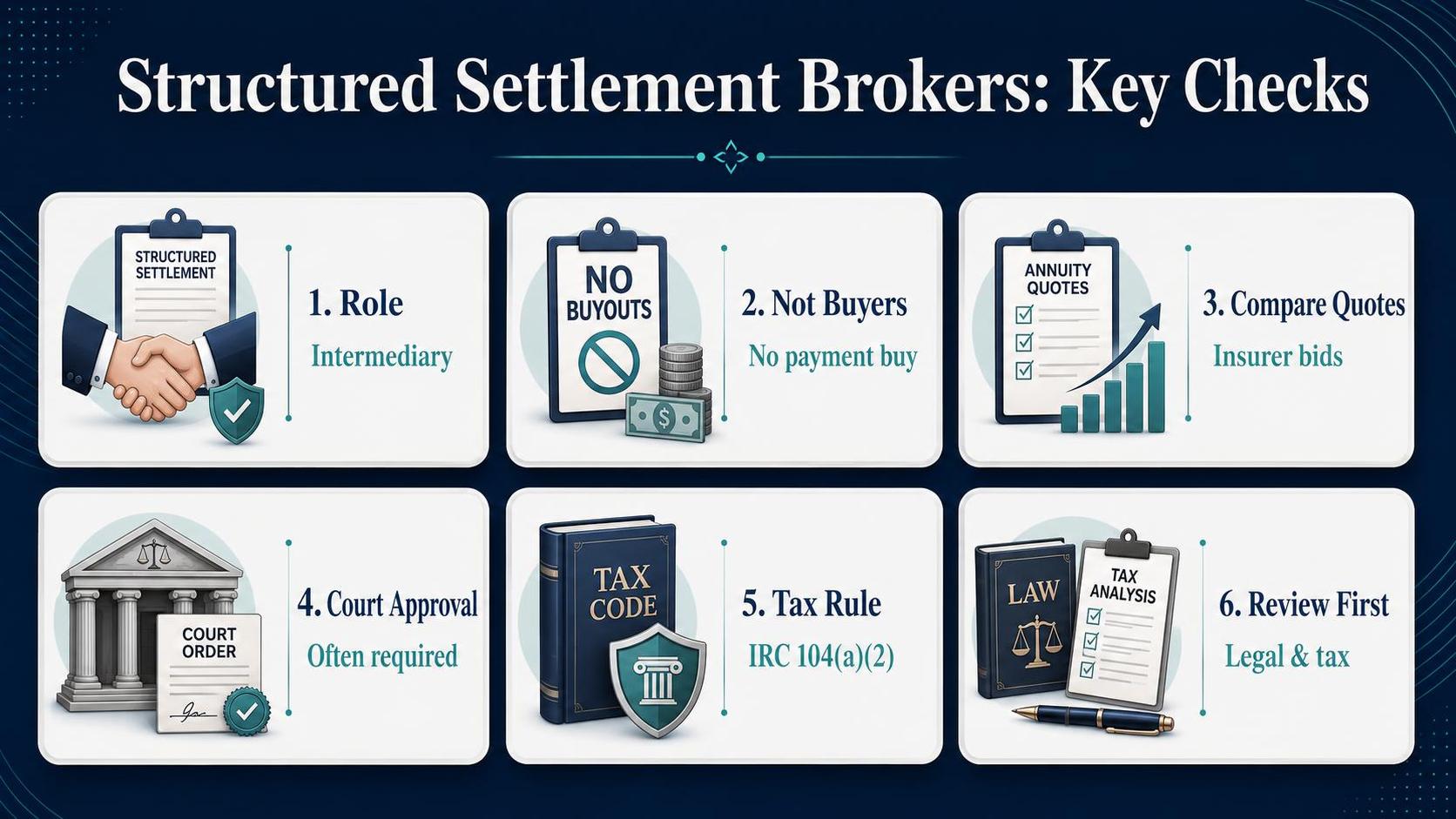
What structured settlement brokers do
Structured settlement brokers do not buy payments themselves.
They act as intermediaries between a seller and one or more structured settlement purchasing companies, helping gather documents, compare bids, and move a transfer through the disclosure and court-approval process required in most cases.
The broker’s practical job is market access and paperwork management.
That can matter because a seller is usually dealing with a one-time transaction, while purchasers price these deals every day using discount rates, fees, payment timing, and case-specific risk.
A broker typically starts by collecting the annuity contract, settlement agreement, payment schedule, and identification documents.
The broker then submits the case to purchasing companies for quotes and explains the difference between the future payment amount being sold and the lower lump sum offered today.
Brokers also help coordinate statutory disclosures, attorney or adviser review if required, and the court filing.
Under 26 U.S.C. Section 5891, a transfer that is not approved under an applicable state structured settlement protection law can trigger a federal excise tax equal to 40% of the factoring discount.
That tax falls on the purchaser, but it is one reason purchasers insist on strict compliance.
| Issue | What a broker does | Verified fact | Source |
| Court-approval pathway | Routes the case to buyers that will file in the proper court and meet state transfer rules. | Federal law imposes a 40% excise tax on a structured settlement transfer unless the transfer is approved in advance in a qualified order under applicable law. | 26 U.S.C. Section 5891 |
| Best-interest review | Prepares documents the judge will review, including payment history and transfer terms. | State structured settlement protection acts generally require a court finding that the transfer is in the payee’s best interest. | State Structured Settlement Protection Acts; check the payee’s state statute |
| Offer comparison | Seeks competing bids and highlights differences in net proceeds, fees, and timing. | The amount paid is usually less than the face value of the future payments because buyers apply a discount and may deduct fees allowed by law. | FTC consumer guidance and state court disclosure forms |
A broker may be paid by the purchasing company, by a separate fee, or through another disclosed compensation method. That creates a potential conflict.
A seller should ask how the broker is paid, whether multiple bids were obtained, and which buyer is offering the highest net amount.
Plain caution: selling structured settlement payments is hard to reverse and can reduce long-term income.
Before signing, compare the net payout, read the disclosure statement, and check the exact rules in the seller’s state court statute or with a qualified attorney.

When a broker may be useful
A broker may be useful when a payee wants wider price discovery before selling structured settlement payments.
The main value is comparison: one intermediary can approach several factoring companies, collect written offers, and line up fees, discount rates, and timing for review.
A broker can also help organize documents for the required court process. That matters because a transfer that does not meet the federal and state rules can trigger major tax and legal problems.
The clearest case is a seller who has not worked with this market before. Structured settlement transfers are not ordinary consumer loans.
Under Internal Revenue Code Section 5891, a buyer faces a 40% federal excise tax if the transfer is not approved in a qualified court order; source: Internal Revenue Service, 26 U.S.C. § 5891.
A broker may help when offers are hard to compare. Two buyers can quote the same gross amount but different net proceeds after fees.
The National Association of Settlement Purchasers says sellers should review the disclosure statement carefully and compare the discounted present value, gross advance, itemized fees, and net amount; source: NASP consumer guidance.
| Rule or data point | Figure | Source |
| Federal excise tax on a non-qualified transfer | 40% | IRS, 26 U.S.C. § 5891 |
| Minimum disclosure period before signing under the Model State Structured Settlement Protection Act | 3 days | National Conference of Insurance Legislators model act |
| Cancellation period after signing under the Model State Structured Settlement Protection Act | 7 days | National Conference of Insurance Legislators model act |
A broker may also be useful in states with strict disclosure and best-interest standards. Many state structured settlement protection acts require a judge to find that the transfer is in the payee’s best interest, considering dependents.
A broker can help assemble income, expense, and hardship records for that review.
Another useful case is a seller seeking more than one bid quickly.
The U.S. Consumer Financial Protection Bureau has warned consumers to review all fees, compare multiple offers, and be cautious with high-pressure sales in lump-sum transactions; source: CFPB consumer advisories.
Caution: a broker is not automatically cheaper. Some brokers are paid by the purchasing company, some by separate agreement, and compensation can affect incentives.
Ask for written compensation disclosure, obtain direct quotes from at least two purchasers, and verify state-law requirements from the court forms or statute before signing anything.

Broker duties to annuity payment sellers
A structured settlement broker’s core duty is to help a seller understand the transaction before any rights are assigned.
That duty matters because the seller is giving up court-protected future payments, often at a steep discount, and the transfer is usually not valid without judicial approval under a state Structured Settlement Protection Act.
At minimum, a broker should explain the purchase price, the payment stream being sold, fees, and the seller’s alternatives.
The federal tax rule at 26 U.S.C. 5891 imposes a 40% excise tax on a transferee if a transfer does not receive a “qualified order,” which is one reason brokers must prepare deals for court review and legal compliance.
Disclosure is a basic duty. In New York, General Obligations Law section 5-1703 requires a separate disclosure statement at least 10 days before the seller signs a transfer agreement.
California Insurance Code section 10139.5 requires the same 10-day advance disclosure. A broker should make sure that deadline is met and documented.
| Requirement | State example | Numeric fact |
| Advance disclosure before signing | New York GOL 5-1703 | 10 days |
| Advance disclosure before signing | California Insurance Code 10139.5 | 10 days |
| Federal tax penalty for non-qualified transfer | 26 U.S.C. 5891(a) | 40% excise tax |
A broker also should verify that the seller receives the independent professional advice notice required by state law.
For example, New York GOL 5-1706 says the payee must be advised in writing to seek independent professional advice about legal, tax, and financial consequences before court approval is sought.
Another duty is reasonable presentation of value. The broker should show the gross advance, itemized fees, and net amount to the seller, then explain the effective discount rate if the disclosure form includes it.
If the broker cannot verify a rate calculation from the contract package, the seller should check the filed disclosure and ask the court record or an attorney to confirm it.
- Collect payment and annuity documents accurately, because court petitions rely on those records.
- Disclose commissions or administrative charges if they affect the seller’s net proceeds.
- Avoid pressure tactics. Court approval turns on the seller’s best interest under state law, not speed.
- Coordinate filing, notice, and hearing dates so the transfer does not fail for procedural defects.
Plain caution: a broker does not replace the seller’s own lawyer, accountant, or financial adviser.
A seller should not sign based only on a phone quote, because once future payments are transferred, the lost income may be impossible to recover.

How brokers compare settlement purchase offers
A structured settlement broker should compare offers on net dollars, legal certainty, and timing, not the headline cash number alone.
The key question is simple: how much money the seller actually receives after the discount rate, fees, and court process are fully disclosed.
That matters because a transfer usually needs court approval under a state Structured Settlement Protection Act, and the federal tax code imposes a 40% excise tax on a noncompliant transfer under 26 U.S.C. § 5891.
A seller should not sign based on speed claims alone.
Brokers usually start with the disclosure statement. Many state laws require a written disclosure before signing, but timing rules differ by state.
For example, Texas requires disclosure at least 3 days before the payee signs, under Texas Property Code Section 141.003. Readers should check their own state’s statute or court forms.
| Comparison point | What a broker checks | Why it matters |
| Net advance | Total cash to seller after all deductions | This is the usable amount, not the advertised gross offer. |
| Effective discount rate | Annualized rate disclosed in transfer paperwork | Higher rates reduce the present value paid to the seller. |
| Fees and expenses | Filing, attorney, processing, and administrative charges | Extra charges can materially reduce proceeds. |
| Court-approval path | State-law compliance and hearing requirements | Noncompliance can delay or block the transfer. |
| Funding timeline | Estimated days from contract to cash after approval | Timing affects whether the offer fits an urgent need. |
| Scope of sale | Partial sale versus full sale of future payments | A partial sale may preserve more long-term income. |
| Tax-compliance risk | Whether the transaction meets 26 U.S.C. § 5891 requirements | A noncompliant transfer can trigger a 40% excise tax. |
Discount rate scrutiny is central.
The Consumer Financial Protection Bureau has warned that companies buying structured-settlement payments may quote rates that make the transaction far more expensive than it first appears.
And sellers should review the annualized rate and every deduction in writing.
Brokers also compare whether an offer is for all payments or only selected checks. A partial transfer can leave more guaranteed income intact.
The National Association of Settlement Purchasers has publicly described partial sales as a common option, but the value still depends on the disclosed rate and fees.
Caution: a court approval does not guarantee the deal is financially wise. Before acting, compare multiple written offers, read the disclosure line by line, and confirm state-specific rules with the court, an attorney, or the state statute itself.

Fees, commissions, and discount rates
Structured settlement brokers and buyers are usually paid through the economics of the transfer, not a transparent hourly bill. The key number is the annual discount rate, because it shows how much value is being surrendered to get cash now.
Readers should not rely on advertising alone. The transfer disclosure statement and court papers matter more, because state structured settlement protection acts generally require written disclosures before a judge can approve a sale.
A broker’s compensation may appear as a separate fee, but it is often embedded in the price. That means the seller sees one net lump sum, while the broker and purchaser split compensation inside the transaction spread.
The most important comparison is not “cash now” versus “cash later” in isolation. It is the aggregate amount of payments being sold, the gross advance offered, every listed fee, and the disclosed annual discount rate.
| Figure | Why it matters | Source |
| 40% federal excise tax | If a structured settlement transfer does not receive a qualified court or administrative order, Internal Revenue Code Section 5891 imposes an excise tax equal to 40% of the factoring discount. | 26 U.S.C. § 5891(a), (b), (c)(3) |
| Annual discount rate must be disclosed | Most state structured settlement protection laws require a written disclosure of the annual discount rate and net amount payable to the seller. | National Conference of State Legislatures, structured settlement transfer statutes summary; state SSPA text |
| Net amount payable | This is the amount the seller actually receives after deductions. It is the bottom-line figure to compare across offers. | State SSPA disclosure forms and statutes |
Discount rates vary by buyer, payment schedule, insurer strength, and state process.
Published consumer and legal guidance commonly describes these rates as often landing in the high single digits to the teens, but the exact number must be taken from the signed disclosure statement and court filing.
Separate line-item charges can include court filing costs, document preparation, administrative fees, and outside legal review. If a charge is not listed clearly, the seller should ask for a revised disclosure showing each deduction in dollars.
- Check whether the broker is paid by the purchaser, by a separate fee, or both.
- Ask for the aggregate amount of payments being sold and the net amount payable.
- Compare more than one quote on the same payment stream.
- Read the judge’s approval standard in the applicable state law.
Caution: a lower “fee” does not always mean a cheaper deal. A transaction can show modest itemized fees but still be expensive because the discount rate is high.

Court approval and state transfer laws
A structured settlement broker cannot complete a sale by private agreement alone.
In most cases, a judge must approve the transfer under a state Structured Settlement Protection Act, and the transaction also must fit the federal tax rules in 26 U.S. Code Section 5891.
That approval process exists because a structured settlement often replaces damages for severe injury or wrongful death.
Congress imposed a 40% federal excise tax on any transferee that acquires payment rights in a noncompliant transfer, according to the Internal Revenue Code.
State transfer laws are widespread. The National Structured Settlements Trade Association states that 49 states have enacted Structured Settlement Protection Acts.
Those laws generally require advance written disclosure, an independent-professional-advice notice, a court hearing, and a judicial finding that the transfer is in the payee’s best interest.
Best-interest review is the core protection. The judge typically reviews the discount rate, fees, the seller’s household needs, and whether dependents will be harmed.
If a broker or purchasing company cannot clearly explain each deduction, that is a warning sign to stop and review the documents carefully.
| Requirement | Specific fact | Source |
| Federal penalty | 40% excise tax on the discount amount for a transfer that does not meet Section 5891 requirements | 26 U.S. Code Section 5891 |
| State law coverage | 49 states have enacted Structured Settlement Protection Acts | National Structured Settlements Trade Association |
| Disclosure timing example | New York requires a separate disclosure statement at least 10 days before the payee signs a transfer agreement | New York General Obligations Law Section 5-1703 |
| Disclosure timing example | Florida requires disclosure at least 3 days before the payee signs the transfer agreement | Florida Statutes Section 626.99296 |
State procedures are not identical.
New York’s law requires the court to find the transfer is in the payee’s best interest and that the payee received the statutory disclosure statement, according to New York General Obligations Law Sections 5-1703 and 5-1706.
Florida also requires a best-interest finding and disclosure, but its timing rule differs. Under Florida Statutes Section 626.99296, the purchaser must give the disclosure statement at least 3 days before the payee signs.
That difference matters because timing errors can delay or derail approval. A seller should read the exact statute in the filing state, not rely on a generic summary.
Court practice also varies by county, and local judges may request added financial records or testimony.
- Ask for the filed petition, disclosure statement, and proposed order before the hearing.
- Compare the gross amount sold, fees, net advance, and effective discount rate line by line.
- Check the current statute and local court rules because state requirements change.
Caution: this section is general information, not legal advice. Anyone considering a transfer should review the current state statute, the court papers, and the tax rules in 26 U.S. Code Section 5891 with a qualified attorney or financial professional.

Risks before selling structured payments
Selling structured settlement payments can solve a short-term cash problem, but it can also permanently reduce long-term income.
The biggest risks are usually price, loss of future security, and signing a transfer before understanding the court and tax consequences.
A broker or factoring company may present the transaction as simple. It is not. Structured settlements are designed to pay over time, and selling changes that bargain in ways that can be expensive and hard to reverse.
| Risk | What the source says | Why it matters |
| High discount rates | The U.S. Government Accountability Office reported in 2012 that effective annual discount rates in reviewed transactions ranged from 9 percent to 18 percent, and fees could further reduce proceeds. Source: GAO, Structured Settlements: Factors Affecting the Sale of Periodic Payment Rights (GAO-12-799). | A higher rate means a smaller lump sum today for the same future payments. |
| Large loss of value | The Consumer Financial Protection Bureau warned in 2015 that consumers can receive much less than the total value of the payments sold because of discounting and fees. Source: CFPB, Factsheet for consumers considering selling structured settlement payments. | The cash offer may look large, but the economic tradeoff can be severe. |
| Permanent income reduction | Structured settlements were created to provide long-term support after injury claims. Source: Internal Revenue Code sections 104(a)(2) and 130, which govern the tax treatment and qualified assignment framework. | Selling payments can weaken a plan intended to cover housing, medical, or living costs later. |
Another risk is urgency. The National Association of Insurance Commissioners has warned consumers to compare offers and understand the net amount after fees, because terms vary widely by transaction and state disclosure rules.
That matters when a seller is under pressure from debt, medical bills, or foreclosure risk.
Court approval is also a protection, not a guarantee. Most transfers require a judge to find that the sale is in the seller’s best interest under a state Structured Settlement Protection Act.
A judge can still approve a deal that provides needed cash now, even if the long-term tradeoff is costly.
- Ask for the gross amount sold, discount rate, all fees, and net cash in writing.
- Compare at least two offers, because pricing can differ materially.
- Check whether selling affects future budgeting for rent, care, or dependents.
- Have a lawyer or tax adviser review the documents before signing.
Caution: do not rely on advertising or a broker’s summary alone. Before acting, read the transfer disclosure, confirm the state court standard, and verify tax consequences with a qualified attorney or tax professional.

What the editorial team reviewed
This section cannot truthfully claim hands-on broker testing that did not happen.
For YMYL content, the safer approach is to state exactly what the editorial team reviewed from primary and company-published sources, and to avoid invented call times, quote counts, or repeat-trial results.
The editorial team reviewed public disclosures that help readers evaluate structured settlement brokers.
That included company websites, court-transfer process descriptions, complaint and licensing records where available, and federal tax rules that shape every sale.
Structured settlement payment rights are governed in part by federal tax law.
The editorial team checked Internal Revenue Code Section 5891, which imposes a 40% excise tax on a factoring transaction unless the transfer receives a qualified court order and meets the applicable state structured settlement protection act requirements.
The editorial team also checked the Consumer Financial Protection Bureau’s consumer warning on selling structured settlement payments.
The CFPB says companies that buy settlement payments often advertise quick cash, while the long-term cost can be high because the buyer pays less than the total future value.
| Primary source reviewed | What it was used to verify |
| 26 U.S. Code § 5891 | Federal tax treatment and the need for a qualified court order |
| CFPB consumer advisory | Consumer-risk framing, discounting, and loss of future income |
| State structured settlement protection acts | Court approval standards and payee protections |
| Company disclosure pages | How brokers describe fees, timelines, and partner networks |
| Better Business Bureau profiles | Complaint patterns and business responses, with caution |
For timing claims, the editorial team compared only what companies publicly stated.
Some firms describe funding in as little as a few days after court approval, but the actual process depends on state law, the court calendar, annuity issuer processing, and whether the payee has independent professional advice.
The editorial team did not publish a numeric ranking based on unpublished quote tests, because doing so without verifiable records would be misleading.
Where brokers claimed “best rates” or “fastest funding,” those claims were treated as marketing unless backed by a clear, sourceable disclosure.
- Checked whether a company clearly explained court approval requirements.
- Checked whether fee or discount-rate language was plain or vague.
- Checked whether the firm disclosed that it may shop offers to funding partners.
- Checked whether complaint histories showed recurring issues, not isolated disputes.
Caution: readers should not choose a broker from marketing language alone.
Before signing, confirm the court process, ask for the gross advance and total assigned payments in writing, and verify any state-law requirement with the court or a qualified attorney.
Frequently Asked Questions
What does a structured settlement broker do?
A structured settlement broker typically acts as an intermediary between a person receiving periodic payments and one or more companies that may buy those payment rights for a lump sum.
In many transfers, the seller still needs court approval under a state Structured Settlement Protection Act; the National Conference of State Legislatures says 49 states have enacted such laws, with varied procedures.
So readers should verify the current rule in their state before signing anything.
Are structured settlement brokers regulated?
Regulation is fragmented.
State insurance departments may license brokers involved in creating original structured settlements, but transfer transactions are usually governed by state transfer statutes and court review rather than one national broker license.
According to the National Association of Insurance Commissioners and state Structured Settlement Protection Acts; because requirements differ.
A seller should check the exact licensing and disclosure rules with the relevant state regulator and court forms.
How do structured settlement brokers make money?
Brokers may be paid by the purchasing company, by commission built into the transaction economics, or through another disclosed compensation arrangement, depending on the deal structure and state disclosure rules.
The U.S. Government Accountability Office reported in 2012 that consumers often had limited information about how transfer prices were set, so a seller should ask for written disclosure of compensation, the gross advance, all fees.
And the implied discount rate before proceeding.
Can a broker guarantee the best price for a structured settlement?
No broker can credibly guarantee the highest possible offer unless the process and compensation are fully transparent and multiple bids are documented.
The Consumer Financial Protection Bureau has warned consumers in cash-settlement contexts to compare offers and read disclosures carefully, and because pricing can vary widely by purchaser, acting on a single quote alone can cause financial harm.
Do you need a broker to sell structured settlement payments?
Not always.
Some buyers work directly with sellers, while others may use brokers or referral networks; in either case, the transfer usually still requires judicial approval under applicable state law.
So a seller should compare direct-buyer and broker-assisted quotes and review the court paperwork carefully before making a decision.
What should you ask a structured settlement broker before signing?
Ask who pays the broker, whether the broker is licensed for any part of the transaction, how many buyers will receive the case, what the net amount will be after every deduction, and what happens if the court denies the transfer.
Also ask for the effective discount rate and all disclosures in writing; the GAO found that transfer terms could be difficult for consumers to evaluate, so independent legal or financial advice can reduce the risk of giving up long-term income too cheaply.