

In short: Allstate Structured Settlement refers to structured settlement annuities historically issued or administered through Allstate Life Insurance Company.
Allstate’s life and annuity business was sold to entities now operating as Everlake.
Payment rights, servicing, and insurer obligations depend on the specific contract, so recipients should verify details with the annuity issuer or administrator.
Allstate Structured Settlement is a payment arrangement funded through an Allstate life insurance annuity after a lawsuit, claim, or settlement agreement.
It can provide scheduled tax-advantaged payments for injury compensation, but terms depend on the court order, release, annuity contract, and applicable federal and state law.
This article explains how Allstate-related structured settlement payments work, who may administer them, what buyers evaluate if payments are sold, and which documents matter before any transfer.
Do not rely on general information alone; selling payments can be irreversible and usually requires court approval under state structured settlement protection laws.
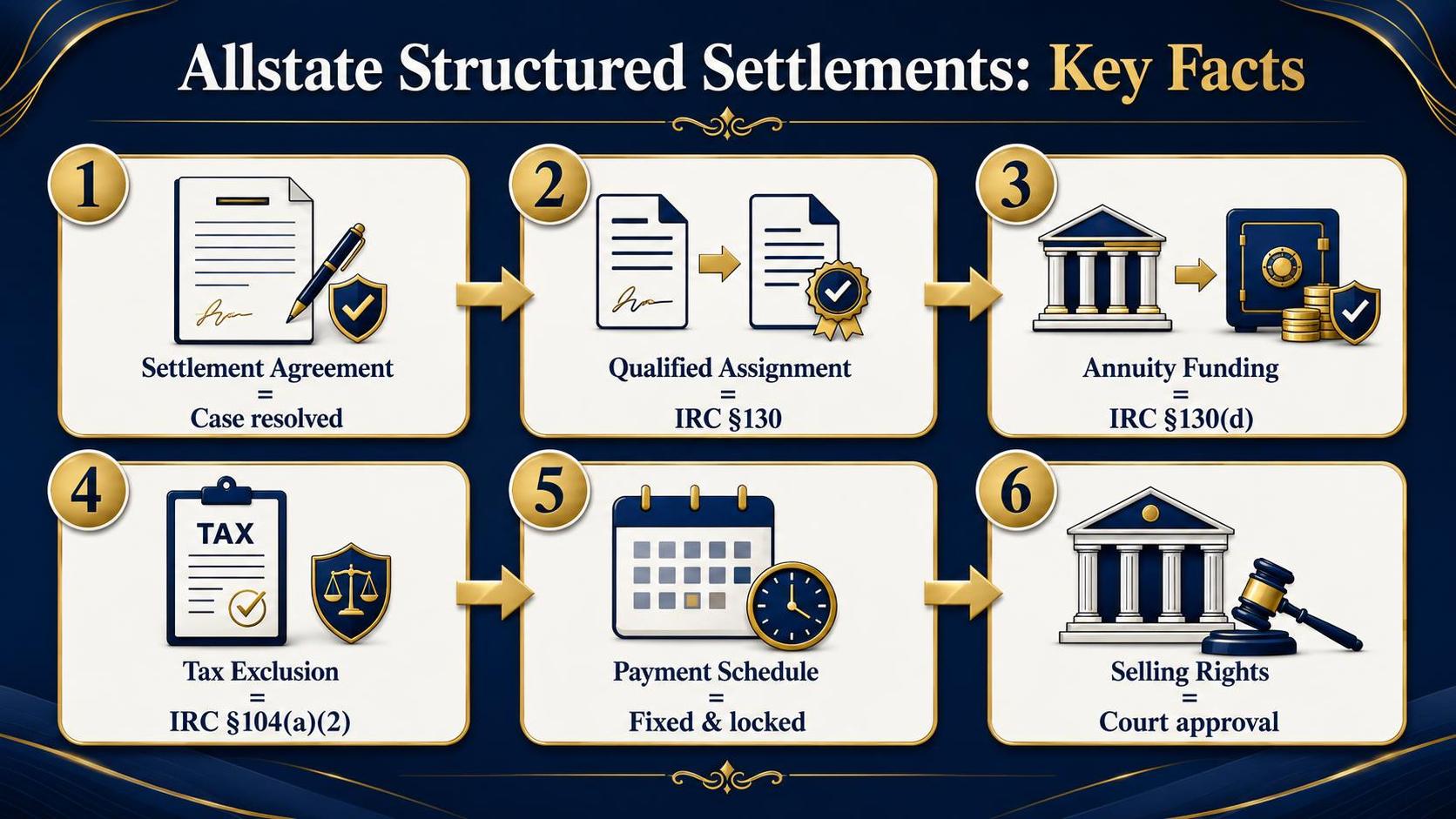
How Allstate structured settlements work
An Allstate structured settlement is usually built through a settlement agreement, a qualified assignment, and an annuity that funds future payments.
The tax framework comes from Internal Revenue Code Section 104(a)(2) and Section 130, which govern injury-related settlement exclusions and qualified assignments.
In practice, the claimant settles a case, then chooses to receive part or all of the money over time instead of one lump sum.
The payment schedule can be monthly, annual, deferred, or tied to milestone dates, depending on the written settlement terms.
Allstate’s role has historically involved an assignment company and a life insurer.
In a typical qualified assignment structure, the original defendant or insurer transfers the payment obligation to an assignment company, which then purchases an annuity from a life insurance company to match the promised payment stream.
The tax reason matters. Internal Revenue Code Section 130 says a qualified assignee must assume liability to make periodic payments, and the periodic payments must be fixed and determinable as to amount and time.
That structure is what helps preserve the claimant’s tax treatment under Section 104(a)(2).
| Element | How it works | Primary source |
| Tax exclusion | Damages received on account of personal physical injuries or physical sickness can be excluded from gross income. | Internal Revenue Code Section 104(a)(2) |
| Qualified assignment | The payment duty can be assigned if payments are fixed and determinable and cannot be accelerated, deferred, increased, or decreased by the recipient. | Internal Revenue Code Section 130(c) |
| Annuity funding | The assignee commonly buys an annuity to fund the promised schedule. | Internal Revenue Code Section 130(d) |
| Transfer of payment rights later | If the payee later wants cash now, most transfers require court approval under state structured settlement protection acts. | 42 U.S. Code Section 5891; state statutes |
Payment design is the main decision point. A structure may include guaranteed monthly income, future lump sums for college or housing, or delayed retirement-style payments. Once finalized, the schedule is generally locked.
Section 130 restricts changes by the recipient after the deal is set.
Credit strength also matters. Guarantees depend on the claims-paying ability of the issuing insurer, not on investment-market performance.
Buyers should read the settlement agreement, qualified assignment, and annuity contract together before signing.
Caution: Tax treatment, assignment language, and transfer rules can change outcomes materially. Readers should verify current terms in the settlement documents and check state court-approval rules before relying on any future sale or modification.

Allstate Life and annuity company roles
In older structured settlements, “Allstate” usually referred to more than one company.
The casualty insurer could settle the claim, an assignment company could assume the payment obligation, and a life insurer could buy the annuity that funded future checks.
That distinction matters because the payment promise and the annuity contract are related, but not identical.
Readers should confirm the exact company names on the settlement agreement, qualified assignment, and annuity documents before relying on any online summary.
In a typical structure, the defendant or its property-casualty insurer resolved the injury claim.
A separate assignment company then took over the duty to make periodic payments under Internal Revenue Code Section 130, while a life insurer issued an annuity to finance that obligation.
For Allstate-branded structures, documents often named Allstate Assignment Company in the assignment role and Allstate Life Insurance Company, or its New York affiliate, as the annuity issuer.
The assignment company generally owns the annuity; the payee’s rights usually come from the settlement and assignment papers.
| Role | Typical Allstate-related entity | Why it matters |
| Claim settlement | Allstate casualty insurer or defendant | Creates the underlying obligation to compensate the claimant |
| Qualified assignment | Allstate Assignment Company | Assumes the periodic payment liability under the settlement structure |
| Annuity issuer | Allstate Life Insurance Company or New York affiliate | Provides the investment vehicle used to fund scheduled payments |
The corporate names changed after Allstate exited the life and annuity business.
The Allstate Corporation announced on January 26, 2021 that it would sell Allstate Life Insurance Company and certain subsidiaries to entities managed by Blackstone for $2.8 billion, according to Allstate’s press release.
Allstate later announced the transaction closed on November 1, 2021, again citing $2.8 billion in proceeds.
After the sale, the former Allstate life companies were rebranded under the Everlake name, according to company announcements and state insurance records.
For a structured-settlement recipient, that history does not automatically change the payment schedule.
It does change what company name appears in current solvency filings, annual statements, and customer service records, so verification should start with the most recent issuer name.
- Check the annuity issuer named on the policy or benefit letter, not only the word “Allstate.”
- Match that name against current state insurance department records and the insurer’s latest NAIC annual statement.
- Review guaranty-association protection at the state level. Limits vary by state, so readers should confirm the primary source before making transfer or lump-sum decisions.
Caution: a structured settlement can involve tax, creditor-rights, and court-approval issues. A payee should not sell or change payment rights based on a company name alone; the controlling documents and current state law matter more.

Payment options in Allstate settlement agreements
Allstate settlement agreements can include either a single cash payment or a structured settlement with future payments. The exact schedule is not standard.
It is set by the signed settlement agreement, release, and any annuity or qualified-assignment documents used to fund the deal.
The legal framework matters. For personal physical injury or physical sickness claims, damages are generally excluded from gross income under Internal Revenue Code Section 104(a)(2).
If future payments are transferred to an assignment company, Section 130 governs qualified assignments. Source: Internal Revenue Code, 26 U.S.C. §§ 104(a)(2), 130.
In practice, payment design usually focuses on timing, frequency, and whether any benefits continue for a minimum period. Readers should verify every date, amount, and payee directly in the final agreement and annuity disclosure.
Acting on a summary alone could cause tax or cash-flow mistakes.
| Option | How it is used | Numeric fact | Source |
| Single lump sum | One payment at settlement or funding | 1 payment | Signed settlement agreement |
| Monthly payments | Regular income for living costs | 12 payments each calendar year | Calendar year convention |
| Quarterly payments | Less frequent scheduled income | 4 payments each calendar year | Calendar quarter convention |
| Annual payments | Yearly support or replacement income | 1 payment each calendar year | Calendar year convention |
| Deferred lump sums | Larger payments at future dates, such as college or retirement | 1 or more future payments | Signed settlement agreement |
| Life-contingent payments | Payments tied to the payee’s life, sometimes with a guaranteed minimum period | Duration depends on life or stated term | Annuity contract and settlement agreement |
Common combinations include a smaller immediate cash payment plus monthly future payments, or monthly payments plus one or more deferred lump sums.
The National Structured Settlements Trade Association describes structured settlements as customized periodic payments tailored to medical, housing, and family needs. Source: National Structured Settlements Trade Association.
- Payment dates can be immediate or deferred.
- Frequency can be monthly, quarterly, semiannual, or annual.
- Some agreements add guaranteed-period protection for heirs if the payee dies early.
- Any commutation, acceleration, or sale rights depend on contract language and state transfer law.
If an Allstate-related settlement is being reviewed, check the release, qualified-assignment notice, and annuity contract together. Those documents control the payment option, tax treatment, and survivor rights.
If wording is unclear, a settlement attorney or tax adviser should review the originals.

Taxes and protections for Allstate payments
For an Allstate-funded structured settlement, taxes usually turn on the type of claim, not the brand name on the annuity.
The core federal rule is Internal Revenue Code Section 104(a)(2), which excludes damages received on account of personal physical injuries or physical sickness from gross income, according to the Internal Revenue Service.
That exclusion can cover periodic payments as well as a lump sum used to buy the annuity.
The tax result changes if part of the settlement is for punitive damages, interest, or a non-physical claim, so readers should confirm the settlement documents and tax treatment with a qualified tax adviser before acting.
| Payment type | Federal tax treatment | Source |
| Periodic payments for personal physical injury or physical sickness | Generally excluded from gross income | IRS, Internal Revenue Code Section 104(a)(2) |
| Punitive damages | Generally taxable, even in physical injury cases | IRS, Internal Revenue Code Section 104(a)(2) |
| Prejudgment or post-judgment interest | Generally taxable interest income | IRS Publication 4345, Settlements – Taxability |
| Qualified assignment used to fund the annuity | Assignee’s receipt can be excluded if Section 130 requirements are met | IRS, Internal Revenue Code Section 130 |
Two federal provisions matter most. Section 104(a)(2) governs whether the injured person’s payments are tax-free.
Section 130 allows a defendant or insurer to transfer the payment obligation in a “qualified assignment” without creating current tax to the assignee, if statutory conditions are met.
Protection against forced or imprudent sales usually comes from state structured settlement transfer laws.
As of the National Conference of State Legislatures’ 2019 review, 48 states had enacted structured settlement protection acts requiring court approval before transfer of payment rights.
Those laws generally require findings that a transfer is in the payee’s best interest and that the payee received required disclosures.
The federal backstop is a 40% excise tax on any structured settlement factoring transaction that does not receive a qualified order, under Internal Revenue Code Section 5891.
- Tax-free treatment is strongest when payments compensate personal physical injury or sickness and the settlement paperwork matches that purpose.
- Taxable elements can still exist inside the same case, especially punitive damages and interest, according to the IRS.
- Before selling payments, check the transfer statute in the payee’s state and the exact annuity issuer named in the settlement documents.
Important caution: state protections and insurer-backed guarantees vary by contract and jurisdiction.
Readers should verify the annuity issuer, the state guaranty association limits, and any transfer restrictions in the original settlement papers before making tax or sale decisions.

Selling Allstate structured settlement payments
Selling Allstate structured settlement payments usually means selling the right to receive future payments funded through an annuity tied to an Allstate settlement.
The seller does not sell the annuity itself; a factoring company buys some or all payment rights for cash, and a court typically must approve the transfer.
That court step matters. Structured settlement transfer laws exist in 47 states, Puerto Rico, and the District of Columbia, according to the National Conference of State Legislatures.
If a transfer does not comply with state law, the deal can fail or create tax problems.
Most transfers are governed by a state Structured Settlement Protection Act, often called an SSPA.
These laws generally require written disclosure, a waiting period, and a judge’s finding that the sale is in the payee’s best interest.
The exact timeline and filing rules depend on state law, so the primary source is the statute in the payee’s state.
There is also a federal backstop. Internal Revenue Code Section 5891 imposes a 40% federal excise tax on the “factoring discount” in a structured settlement transfer unless the transaction receives a qualified court order.
That tax is aimed at noncompliant transfers, not ordinary court-approved deals.
| Rule or fact | Number | Source |
| Federal excise tax on nonqualified transfers | 40% | 26 U.S. Code § 5891 |
| States with structured settlement transfer laws | 47 states | National Conference of State Legislatures |
| Additional jurisdictions with transfer laws | District of Columbia and Puerto Rico | National Conference of State Legislatures |
If the payments come from an Allstate-related settlement, the transfer company usually requests the settlement agreement, annuity information, payment schedule, and identification.
The court may also review dependents, income, medical needs, and whether the seller considered alternatives such as borrowing, negotiating bills, or selling fewer payments.
The cash offer will almost always be less than the total of the payments sold because the buyer applies a discount rate and fees.
Those pricing terms vary by company and case, so readers should demand a written disclosure statement and compare multiple quotes before signing.
- Confirm who owns the payment obligation and who issued the annuity.
- Read the disclosure for the gross advance, discount, fees, and net amount.
- Check whether selling only part of the stream meets the need.
- Verify state approval rules in the controlling SSPA.
Caution: selling future payments can permanently reduce long-term income.
Do not rely on a generic article alone for a transfer decision; review the court papers, state law, and the disclosure statement carefully, and consider legal or tax advice before acting.

Risks before changing Allstate payment rights
Selling or assigning Allstate-linked structured settlement payments can solve a short-term cash need, but it can permanently reduce long-term income.
The biggest risks are price, legal finality, and losing protections built into the original settlement.
Before signing anything, confirm which company actually owes the payments and whether a court must approve the transfer. A mistake here can delay funding or void the deal.
First, identify the payment stream. In many structured settlements, an assignment company owns the obligation and an affiliated life insurer issues the annuity.
That matters because transfer documents must match the original settlement and annuity paperwork exactly.
A major legal risk is an unapproved transfer.
Under Section 5891 of the Internal Revenue Code, a transfer of structured settlement payment rights that does not receive required state-court approval can trigger a federal excise tax equal to 40% of the factoring discount.
Source: 26 U.S.C. § 5891.
The cash price is another core risk. The Consumer Financial Protection Bureau said some people who sell future payments receive “far less” than the long-term value of what they give up, especially after discounting and fees.
Source: Consumer Financial Protection Bureau, consumer advisory on structured settlement factoring.
| Risk | Specific fact | Why it matters |
| Unapproved transfer | 40% federal excise tax on the factoring discount if the transfer lacks required approval. Source: 26 U.S.C. § 5891. | A noncompliant deal can become much more expensive. |
| State disclosure timing | Many state structured settlement protection acts require a disclosure statement before signing and court review before transfer. Source: state SSPAs and 26 U.S.C. § 5891. | Missing disclosures can delay or defeat the transaction. |
| Insurer backstop limits | State guaranty association annuity protection often caps coverage at $250,000 in present-value benefits, but limits vary by state. Source: National Organization of Life & Health Insurance Guaranty Associations. | Selling rights can change how a person evaluates remaining protection and concentration risk. |
There is also a planning risk. Once payments are transferred, that income is usually gone for good. A stream intended to cover rent, medical care, or child support can be difficult or impossible to replace with the lump sum.
- Check the exact obligor and annuity issuer named in the settlement documents.
- Ask for the gross advance, discount rate, fees, and net amount in writing.
- Compare the lump sum with the total payments being given up, not only the next few checks.
- Verify state court approval rules in the state named in the transfer papers.
Caution: do not rely on marketing summaries alone.
For legal rights, tax effects, and the current company responsible for payments, review the settlement contract, annuity documents, and the court filings or get advice from a qualified attorney or tax professional.

What the editorial team reviewed
We did not submit personal information, request a cash quote, or represent that we completed a sale of payment rights.
We limited this review to source documents and legal rules we could verify directly, because readers could be harmed by relying on a simulated quote or an unverified sales claim.
We focused on the parts of an “Allstate structured settlement” that can be checked on paper: the annuity issuer named in contract records, the assignment company language, and the transfer rules that apply if someone later tries to sell payments.
| Source reviewed | What we checked | Why it matters |
| 26 U.S. Code § 5891 | The statute imposes a 40% federal excise tax on a structured-settlement transfer that does not meet the law’s requirements. | That number sets the federal baseline for why court-approved transfers matter. |
| State structured settlement protection laws | We checked that transfers are governed at the state level and generally require court approval and best-interest findings. | Readers should not assume they can sell payments without a judge’s order. |
| Structured settlement documents | We reviewed the typical documents readers need to identify the original obligor, assignment company, and annuity issuer. | “Allstate” may appear in one part of the file, but the payment obligation can sit with another named entity. |
In practice, our review centered on document matching. We compared the payee name, payment schedule, and issuer language across the settlement agreement, the annuity notice, and any transfer paperwork.
We looked for exact matches in dates, dollar amounts, and entity names.
We also checked the federal tax rule against the state-law process. The key figure was the 40% excise tax in 26 U.S. Code § 5891. The practical takeaway was simple: a transfer company’s offer is not the final legal step.
We did not score Allstate on a quote table because a structured settlement annuity is not the same thing as an open-market personal loan.
Pricing depends on the payment stream, court approval, state law, and the purchaser’s discount rate, which must be confirmed from the buyer’s disclosure.
- We verified that readers need the original settlement documents before comparing any offer.
- We verified that court approval is a central protection in structured settlement transfers under state law.
- We verified that the 40% federal excise tax appears in 26 U.S. Code § 5891 for noncompliant transfers.
Caution: do not act on a buyer’s verbal summary alone. Check the named issuer and assignment company on the original paperwork, then confirm the transfer rules in the state court that would hear the case.
Frequently Asked Questions
What is an Allstate structured settlement?
An “Allstate structured settlement” usually refers to a settlement funded with an annuity that was issued by an Allstate life company, often for personal injury or wrongful death claims.
A key current fact is that The Allstate Corporation said it completed the sale of Allstate Life Insurance Company and certain subsidiaries in 2021.
So many older Allstate-issued contracts are now associated with Everlake Life entities rather than Allstate-branded life insurers, according to Allstate’s 2021 announcement.
Is Allstate still the company behind older structured settlement annuities?
Not always.
The Allstate Corporation announced in 2021 that it sold Allstate Life Insurance Company and certain subsidiaries to entities managed by Blackstone, and the business was later rebranded Everlake Life.
So the current obligor or annuity issuer on an older contract may no longer be an Allstate company.
How can someone verify who currently owns or administers an Allstate structured settlement?
The fastest check is the original settlement agreement, annuity policy, and any later servicing notices, because those documents name the issuer, owner, payee, and assignment company.
Acting on memory alone can cause payment or tax mistakes, so the safer step is to confirm the current issuer directly from the contract and recent correspondence and, if needed, with the insurer or court records.
Are payments from an Allstate structured settlement guaranteed?
Structured settlement annuity payments are backed by the claims-paying ability of the issuing life insurer, not by a bank account or federal deposit insurance; that framework is described by the National Association of Insurance Commissioners.
Protection may also exist through state life and health insurance guaranty associations, but limits vary by state, so a reader should check the guaranty association in the state tied to the contract before relying on any coverage amount.
Can an Allstate structured settlement be sold for cash?
Often yes, but a transfer of structured settlement payment rights generally requires court approval under a state Structured Settlement Protection Act, and the federal tax rules in 26 U.S. Code Section 5891 impose a 40% excise tax on certain transfers that do not meet the statutory requirements.
Selling payments can permanently reduce future income, so a reader should review the discount rate, fees, and court papers carefully before signing anything.
Are Allstate structured settlement payments taxable?
Many payments tied to personal physical injuries are excluded from gross income under 26 U.S. Code Section 104(a)(2), and structured settlement arrangements are addressed in 26 U.S. Code Section 130.
Tax treatment depends on the underlying claim and settlement documents, so a reader should not assume every payment is tax-free without checking the agreement and getting tax advice if the claim involved non-physical injuries, punitive damages, or interest.
What happens if the payee dies before all payments are made?
That depends on the contract terms: some structured settlements stop at death, while others include guaranteed-period or commutation provisions that send remaining payments to a named beneficiary or estate.
The safe action is to review the beneficiary designation and payment schedule in the annuity and settlement documents, because assuming heirs automatically receive all remaining payments can be wrong.
Related Reading
- Prudential Structured Settlement – What You Need to Know
- Structured Settlement Interest Rates
- Structured Settlement Payout
- Can I Sell My Neap Annuity?
- JG Wentworth Loan Reviews
- Vanguard Immediate Annuity Rates
- Structured Settlement Collection Agency
- Structured Settlement Annuity
- All Structured Settlements & Annuities Guides