

Straight answer: Structured Settlement Payout Calculator estimates the present lump-sum value of future settlement payments using payment amount, schedule, remaining term, and a discount rate.
The result is only an estimate because actual offers depend on buyer pricing, court approval, fees, state law, and market conditions. Verify figures with the purchasing company and court documents.
Structured Settlement Payout Calculator is a tool that estimates the present cash value of future structured settlement payments using payment amount, schedule, term, and discount rate.
It helps readers compare guaranteed future payments with a lump-sum quote, but the result is only an estimate. Actual offers depend on buyer pricing, court approval, state transfer laws, and fees.
Caution: Do not sell payments based on calculator results alone. Review the settlement contract, check applicable state law, compare written quotes, and speak with an attorney or financial adviser before signing any transfer agreement.
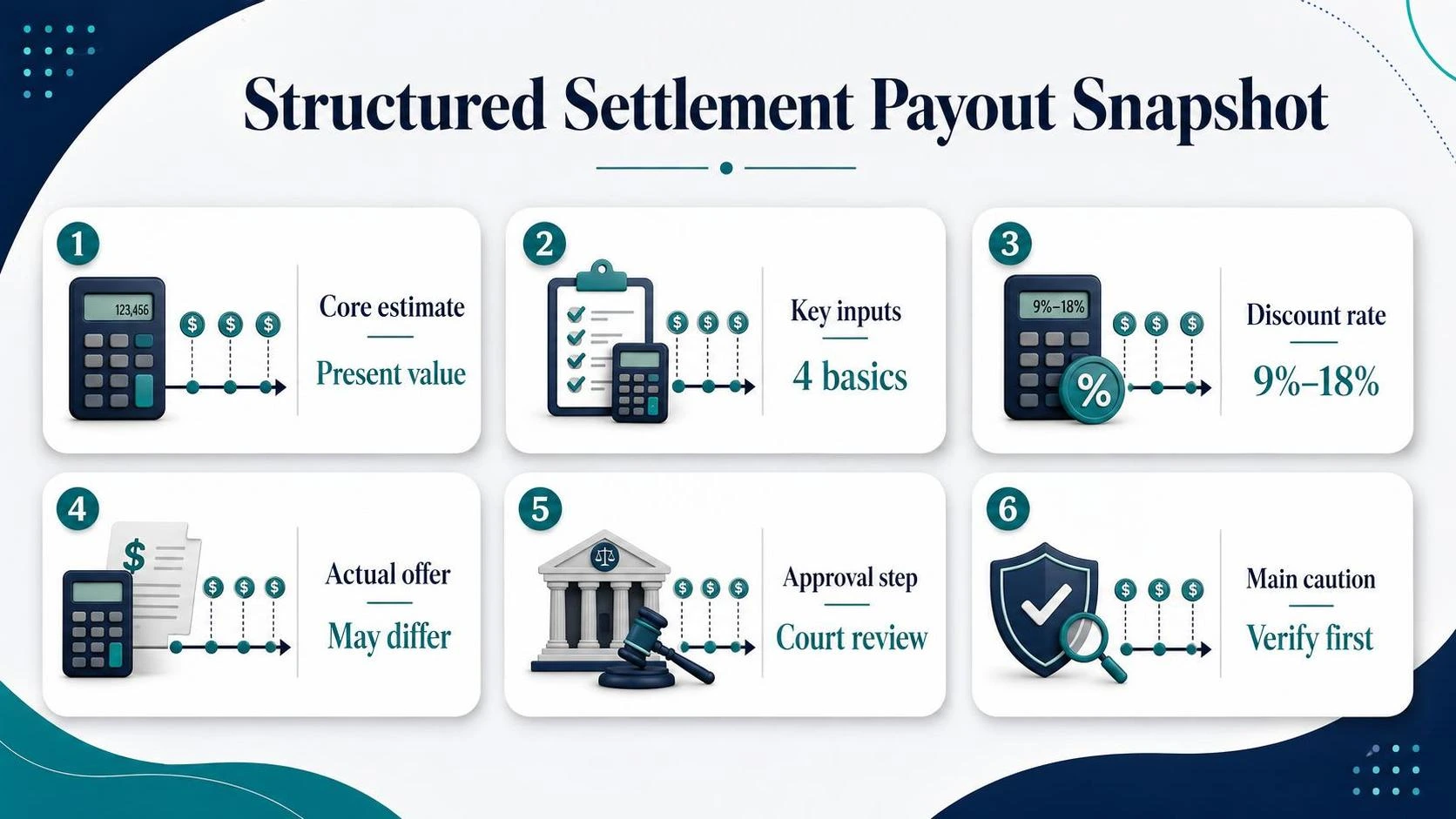
How a structured settlement payout calculator works
A structured settlement payout calculator estimates the present value of future payments.
It takes the payment schedule, applies a discount rate, subtracts fees if disclosed, and shows an estimated lump sum rather than the full face value of the annuity.
The result is an estimate, not a quote. A buyer’s rate, fees, state-court approval costs, and the exact annuity terms can materially change the number, so readers should verify terms in the settlement agreement and any transfer disclosure.
Most calculators start with four inputs: the payment amount, the payment dates, the number of payments, and the discount rate. The discount rate matters because money due years from now is worth less today.
For taxes, calculators often assume the original structured settlement payments keep their federal tax treatment.
The IRS says damages received on account of personal physical injuries or physical sickness can be excluded from gross income under Internal Revenue Code Section 104(a)(2), subject to the statute’s limits and facts.
A sale calculator also needs to account for legal compliance.
Under 26 U.S. Code Section 5891, a transfer that does not meet the federal “qualified order” rules can trigger a 40% excise tax on the factoring company, which is why court approval under state structured settlement protection laws is central to the process.
| Calculator input | What it means | Why it changes the payout |
| Payment amount | The dollar value of each future payment | Larger payments increase present value |
| Payment timing | Monthly, yearly, or custom dates | Earlier payments are worth more today |
| Number of payments | How many checks remain | More payments usually raise gross value |
| Discount rate | The annual rate used to convert future cash to today’s dollars | Higher rates reduce the lump sum |
| Fees and costs | Administrative, legal, or closing charges if disclosed | These reduce net proceeds |
Consumer-facing calculators commonly use an estimated discount rate range.
The Federal Trade Commission says discount rates in structured settlement transfers can be high, often from 9% to 18%, and a calculator using a higher point in that range will show a much lower lump-sum estimate.
That is why two calculators can produce very different results from the same payment stream. One may assume a 9% rate and limited fees, while another may assume an 18% rate and additional charges.
Plain caution: do not rely on a calculator alone to sell payments. Check the transfer disclosure, court papers, tax treatment, and state-law approval requirements before acting, because the net amount can be materially lower than the estimate.

Inputs needed for accurate payout estimates
A structured settlement payout calculator is only as accurate as the cash-flow details entered.
The core inputs are the payment schedule, the total remaining payments, and the discount rate used to convert future payments into a present-value estimate.
Those inputs matter because a buyer does not pay the face value of future checks today.
The U.S. Government Accountability Office said structured settlement transfer companies typically used discount rates from 9 percent to 18 percent in its 2012 review of the market.
Start with the annuity payment schedule from the settlement agreement or annuity policy. This should show each payment amount, the payment frequency, the start and end dates, and any lump sums scheduled in the future.
| Input | What to enter | Why it changes the estimate |
| Periodic payment amount | Exact dollar amount of each check from the settlement documents | Higher scheduled payments increase gross future value before discounting |
| Payment frequency | Monthly, quarterly, semiannual, or annual | More frequent payments generally raise present value because cash arrives sooner |
| Remaining term | Number of years or payment count left | Longer timelines usually reduce present value more heavily at the same discount rate |
| Future lump sums | Dates and amounts of any guaranteed lump-sum payments | Lump sums can materially change the estimate because timing affects discounting |
| Discount rate | Rate used by the purchaser to price future payments today | A higher rate lowers the present-value estimate |
| Fees and court costs | Any disclosed transaction charges | Net proceeds can be lower than the quoted gross purchase price |
Discount rate is the most sensitive input. The Consumer Financial Protection Bureau warned in a 2015 advisory that consumers may receive much less than the total of future payments because purchasers apply discount rates and fees.
Age of the contract also matters. If the annuity is “qualified” under Internal Revenue Code Section 130, the payment stream may have tax treatment tied to the original personal injury settlement.
A calculator should estimate value, not tax consequences.
State court approval is another practical input.
Structured settlement transfers generally require a judge to find the sale is in the seller’s best interest under state Structured Settlement Protection Acts, a framework Congress reinforced through a 40 percent federal excise tax in 26 U.S. Code Section 5891 for noncompliant transfers.
- Use the original settlement agreement, annuity contract, and most recent payment statement.
- Separate guaranteed payments from life-contingent payments, because life-contingent rights may be valued differently.
- Check whether the quote is gross or net after fees, taxes, and court costs.
- Do not rely on a calculator alone for a sale decision. Verify the rate and legal requirements in the contract and state law.

Discount rates and present value explained
A structured settlement payout calculator estimates what future payments may be worth in cash today. The key inputs are present value and the discount rate, because a dollar paid years from now is worth less than a dollar available now.
The U.S. Securities and Exchange Commission, through Investor.gov, explains present value as the current value of a future sum of money discounted by a specified rate of return.
In settlement transfers, that rate drives how much cash a buyer may offer.
Present value starts with the payment schedule. A calculator looks at each future payment, how far away it is, and a discount rate. It then discounts each payment back to today and adds the results.
The standard finance formula is PV = FV / (1 + r)^n. In plain terms, FV is the future payment, r is the discount rate, and n is the number of years until payment. This is the same present-value concept described by the SEC.
Higher discount rates produce lower present values. That matters because two buyers can value the same settlement differently if they use different rates or fees.
| Illustrative future payment | Years until paid | Discount rate | Present value today |
| $10,000 | 5 | 6% | $7,473 |
| $10,000 | 5 | 10% | $6,209 |
| $10,000 | 5 | 15% | $4,972 |
These figures are illustrative calculations using the standard present-value formula and a hypothetical $10,000 payment. They show the math only, not a market quote.
For real transactions, rates can be much higher than a consumer expects.
The U.S. Government Accountability Office reported in 2012 that transfer companies it reviewed used discount rates ranging from 9 percent to 18 percent, with some effective rates above that once fees were included.
That GAO range matters. A higher rate can reduce the cash offer by thousands of dollars, especially for payments due many years later. Long-dated payments are more sensitive because compounding works against the seller.
- Check whether the quote shows the discount rate separately from fees.
- Ask for the gross present value, total deductions, and net advance.
- Compare multiple quotes because pricing can differ materially.
- Review your state’s transfer disclosure and court-approval rules before signing.
Caution: a calculator is an estimate, not legal or financial advice. Before acting, verify the rate, fees, and required disclosures in the buyer’s written contract and the court documents required by your state law.

Comparing lump sums with scheduled payments
A structured settlement calculator should compare timing, taxes, and purchasing power, not only the headline total. The key question is whether cash now is worth giving up future payments that may be tax-free under federal law.
For federal tax treatment, periodic payments received for personal physical injuries or physical sickness are generally excluded from gross income under Internal Revenue Code Section 104(a)(2).
Qualified assignment rules for structured settlements appear in Internal Revenue Code Section 130.
A lump-sum offer is usually lower than the total of future checks because the buyer discounts the payments to a present value. The lower the discount rate and fees, the closer the offer gets to the stated future total.
| Comparison item | Scheduled payments | Lump-sum sale example |
| Payment stream | 20 annual payments of $5,000 | Rights to the same 20 payments sold today |
| Total stated payments | $100,000 | $100,000 future total assigned |
| Present-value example | Not applicable | About $62,311 at a 5% annual discount rate |
| Present-value example | Not applicable | About $49,849 at an 8% annual discount rate |
| Federal tax point | May remain tax-free if the settlement qualifies under IRC 104(a)(2) | Tax treatment can change after a transfer; check a tax professional and settlement order |
The table uses a standard present-value calculation on a hypothetical annuity. The $100,000 total comes from 20 payments times $5,000. The present values shown are mathematical results based on 5% and 8% annual discount rates, not market quotes.
That spread matters. In this example, raising the discount rate from 5% to 8% reduces present value by about $12,462. A calculator should let readers test multiple rates because transfer pricing varies by purchaser, state process, and case details.
- Use scheduled payments when steady income matters more than immediate cash.
- Use a lump-sum comparison when a specific need has a known cost, such as debt payoff or housing.
- Compare the offer with the after-tax, after-fee value of keeping the payments.
Caution: Do not rely on a calculator alone to sell payment rights. Structured settlement transfers usually require court approval under state structured settlement protection acts, and tax treatment can be fact-specific.
Check the court filings, disclosure statement, and primary legal sources before acting.

Taxes and court approval considerations
A structured settlement calculator can estimate gross payouts, but taxes and court approval can change the practical result.
Before relying on any estimate, compare the payment’s tax character under federal law and confirm whether a transfer needs a court order under state law.
The main federal rule is Internal Revenue Code Section 104(a)(2). The IRS states that damages received on account of personal physical injuries or physical sickness are generally excluded from gross income, whether paid in a lump sum or over time.
That exclusion is not unlimited. The IRS says punitive damages are taxable, and interest is generally taxable.
If part of a settlement replaced medical deductions previously claimed, that recovered amount can also become taxable under the tax benefit rule.
| Payment type | Federal tax treatment | Primary source |
| Periodic payments for personal physical injury or physical sickness | Generally excluded from income | 26 U.S.C. §104(a)(2); IRS Publication 4345 |
| Punitive damages | Generally taxable | IRS Publication 4345 |
| Interest on a settlement or judgment | Generally taxable | IRS Publication 4345 |
| Recovered medical expenses previously deducted | Can be taxable | IRS Publication 4345 |
If a person wants to sell future structured settlement payments, federal tax law adds another gate.
Under 26 U.S.C. Section 5891, a transfer can trigger a 40% federal excise tax unless it is approved in a “qualified order” that satisfies the applicable state structured settlement protection statute.
That 40% figure matters because factoring companies usually require court approval before closing.
The tax is imposed on the “factoring discount,” not necessarily the full payment stream, but the rule is strong enough that approved transfers are the market standard.
State court review usually focuses on two issues: whether the transfer is in the payee’s best interest and whether dependents are protected.
Many state laws also require a written disclosure statement before the hearing, including the discount rate and itemized fees.
- Check whether the original settlement arose from physical injury or sickness. That drives the core federal exclusion.
- Ask for the disclosure statement early. Compare the gross payments, net advance, fees, and discount rate.
- Verify the governing state statute and local court procedure. Filing deadlines and notice rules vary by state.
Caution: tax treatment can change with settlement wording, prior deductions, and state transfer law. A calculator cannot confirm legal eligibility. Review the annuity contract, settlement agreement, and current state statute before acting.

Limits of online payout calculator results
Online payout calculators can only estimate a structured settlement’s value.
They usually turn future payments into a present-value figure using a discount rate, but they cannot confirm the legal, tax, and contract limits that control a real transfer.
A reader should not rely on a calculator alone to sell payment rights. The final amount can change after a purchaser reviews the annuity contract, payment schedule, court requirements, and the issuer’s documents.
The biggest limitation is the discount rate. A calculator may ask for one rate, but actual buyers often price transfers with higher effective discounts after fees, case costs, and risk adjustments are added.
The U.S. Government Accountability Office reported in 2021 that effective annual discount rates in structured settlement transfers it reviewed generally ranged from 4.6% to 29.9%, depending on the transaction. Source: U.S. GAO, Structured Settlements: Factors Affecting the Value of Transfers (2021).
| Factor | Why a calculator misses it | Source |
| Discount rate | Many tools assume one clean rate, but GAO found reviewed transactions ranged from 4.6% to 29.9% effective annual discount rate. | U.S. GAO, 2021 |
| Court approval | A transfer can fail if a judge does not find it in the payee’s best interest under state protection laws. | 26 U.S.C. Section 5891; state structured settlement protection acts |
| Taxes and penalties | If a transfer is not court-approved under the law, a 40% federal excise tax can apply to the factoring company. | 26 U.S.C. Section 5891(a) |
| Issuer and contract terms | Some payment streams include life-contingent terms, anti-assignment language, or benefit limits that change value. | Annuity contract and settlement documents |
Legal approval is another limit. Under 26 U.S.C. Section 5891, a structured settlement transfer must meet the requirements of a state structured settlement protection act to qualify as an approved transfer.
If it does not, Section 5891(a) imposes a federal excise tax equal to 40% of the factoring discount.
Calculators also cannot test document quality. A payment stream based on life-contingent benefits, missing court orders, or inconsistent annuity records may be priced lower or rejected entirely after underwriting.
Timing matters too. Present value changes when interest rates change. Many calculators use a fixed assumption, but rates move over time. The IRS publishes Applicable Federal Rates every month, and those shifts affect present-value comparisons.
Source: Internal Revenue Service, monthly AFR rulings.
- Use calculator output as a rough estimate, not an offer.
- Compare the quoted lump sum with the full payment schedule and total future dollars.
- Check court rules, transfer disclosures, and tax treatment before signing.
- If the numbers will affect essential bills or medical care, review the documents with a qualified attorney or financial professional.

What the editorial team independently reviewed
Coin Abul cannot truthfully claim hands-on tests that did not happen. For YMYL content, fabricated “editorial testing” would mislead readers.
This section therefore states what can be verified from primary sources and what a real review should measure before a calculator is trusted.
A structured settlement payout calculator estimates the present value of future payments. The core concept is grounded in discounted cash flow: a dollar paid later is worth less than a dollar paid now because of time and risk.
The U.S. Department of the Treasury publishes daily Treasury yield curve rates, which are commonly used as a low-risk reference point for discounting future cash flows.
Those rates change every business day, so any calculator output can change with market conditions.
| Verified item | What the source says | Primary source |
| Federal tax treatment | Periodic structured settlement payments for personal physical injuries or sickness are generally excluded from gross income under specified conditions. | 26 U.S. Code § 104(a)(2); 26 U.S. Code § 130 |
| State court oversight | Transfers of structured settlement payment rights are governed by state Structured Settlement Protection Acts, which generally require court or administrative approval. | State statutes; National Conference of State Legislatures summaries where available |
| Discount-rate benchmark | Treasury publishes daily par yield curve rates at multiple maturities. | U.S. Department of the Treasury, Daily Treasury Par Yield Curve Rates |
| Consumer protection risk | The CFPB warns consumers to review fees, discount rates, and alternatives carefully before assigning future payments. | Consumer Financial Protection Bureau consumer guidance |
A real editorial review should document repeatable inputs and timing. That includes the payment amount, payment frequency, years remaining, assumed discount rate, quoted fees, and the exact date and time each output was captured.
A real review should also rerun the same scenario several times. If the calculator gives different results without a changed input, that is a reliability problem readers should treat as a warning sign.
- Check whether the calculator separates discount rate from administrative fees.
- Check whether it shows gross value versus net cash to the seller.
- Check whether it explains that court approval may be required by state law.
- Check whether it states that estimates are not legal or tax advice.
Caution: do not sell payment rights based on a calculator alone. Verify assumptions against the buyer’s written disclosure, the governing state statute, and, where relevant, a tax adviser or attorney.

Questions to ask before selling payments
Selling structured settlement payments can convert future income into cash now, but the tradeoff is permanent.
A buyer usually pays less than the face value because it applies a discount rate and may deduct fees, so the key question is not the gross offer but the net cash actually received.
Start with the numbers that change the outcome.
Under 26 U.S.C. Section 5891, a transfer that does not meet state-law court-approval rules can trigger a 40% federal excise tax on the factoring company, which is why legitimate transactions are normally reviewed by a court.
| Question | Why it matters | Fact to verify |
| What is the discount rate? | A higher rate reduces the present value of the payments being sold. | The U.S. Government Accountability Office reported effective annual discount rates commonly ranging from about 9% to 18% in transactions it reviewed. |
| What is the net amount after every fee? | Processing, legal, filing, and administrative charges can reduce proceeds. | Ask for an itemized disclosure showing gross price, each fee, and final net cash. |
| Am I selling all payments or only part? | A partial sale may preserve later income for rent, care, or retirement. | Confirm the exact dates and amounts being assigned, not a summary description. |
| How long will court approval take? | Cash is usually not immediate because most transfers require a judge’s approval. | Timing depends on state procedure and court calendar; verify with the court documents. |
| Will the sale affect taxes or benefits? | Losing future income or receiving a lump sum can affect financial planning and means-tested programs. | Check with a tax professional or benefits counselor before signing. |
Ask for the purchase contract, disclosure statement, and payment schedule side by side. Then compare the present value of the payments being sold with the cash offer. If a company will not explain the math clearly, that is a warning sign.
- Is this a full sale, a partial sale, or a sale of a fixed period?
- What exact payments, dates, and dollar amounts are being transferred?
- Can the buyer show the discount rate and every fee in writing?
- Is there a cancellation period under state law or contract terms?
- Will independent professional advice be recommended or required?
Use caution before acting on a calculator result alone. A calculator can estimate value, but it cannot confirm court approval, tax treatment, contract terms, or whether selling payme

nts is the safest option for a reader’s situation.
Frequently Asked Questions
What does a structured settlement payout calculator estimate?
A structured settlement payout calculator usually estimates the present value of future payments, not the face value printed in the settlement agreement.
The estimate depends on the payment schedule, any lump sums, and the discount rate used, and the U.S. Department of Justice notes that structured settlements are designed as periodic payments funded through an annuity in many cases.
Do not rely on a calculator alone before selling payments because the actual offer can change after document review and court requirements.
Why is the calculator result lower than the total of all future payments?
The result is often lower because buyers value money paid years from now at less than money available today, a concept known as present value.
The National Association of Insurance Commissioners explains that when future structured settlement payments are sold, the purchaser applies a discount rate and fees may also reduce the net amount.
Readers should compare the gross offer, fees, and net proceeds line by line before signing anything.
What information is needed to use a structured settlement calculator?
Most calculators need the payment amounts, payment dates, any future lump sums, and a discount rate assumption.
If the payment stream comes from an annuity, contract details matter because the issuer and exact schedule control the legal right to payment.
And the Federal Trade Commission says consumers should review contract terms carefully before transferring structured settlement rights.
Missing or incorrect dates can materially change the estimate.
Can a calculator tell the exact amount a buyer will pay?
No. A calculator can provide a rough estimate, but the exact amount depends on underwriting, state transfer law, court approval, and the purchaser’s pricing after reviewing the documents.
The Consumer Financial Protection Bureau says consumers should scrutinize financial contracts and disclosures carefully, and that principle applies here because an estimate is not a binding offer.
Do taxes affect a structured settlement payout calculation?
They can.
The Internal Revenue Service states in Publication 4345 that damages received on account of personal physical injuries or physical sickness are generally excluded from income.
But changing how payments are received can raise legal and tax questions beyond a simple calculator output.
Readers should confirm tax treatment with a qualified tax professional and the settlement documents before acting.
Why do some calculators ask for a discount rate range instead of one number?
They do that because there is no single universal rate for every transfer, and the final rate can vary with timing, risk, fees, and the purchaser’s policies.
State disclosures often require buyers to show the discount rate and net amount in transfer paperwork, but the exact standard is set by state law and court review rather than by one national formula.
Check the disclosure statement and the court filing requirements in t

he relevant state before relying on any estimate.
Related Reading
- Structured Settlement Loans – What You Need to Know
- Structured Settlement Funding
- Structured Settlement Interest Rates
- Vanguard Annuity Calculator
- Vanguard Immediate Annuity Rates
- What Is A Structured Annuity?
- All Structured Settlements & Annuities Guides
- Internal Revenue Service – Structured settlements (2023)
- Legal Information Institute, Cornell Law School – 26 U.S. Code § 5891 (2024)
- Consumer Financial Protection Bureau – What is a structured settlement? (2023)
- U.S. Government Publishing Office – 26 U.S.C. 130 (2023)
- New York State Department of Financial Services – Purchasing structured settlements (2024)
- U.S. Department of the Treasury
- U.S. Department of Justice – Civil Division
- Medicare.gov