

In short: Structured settlement rates refer to the discount rates buyers apply when purchasing future settlement payments for a lump sum.
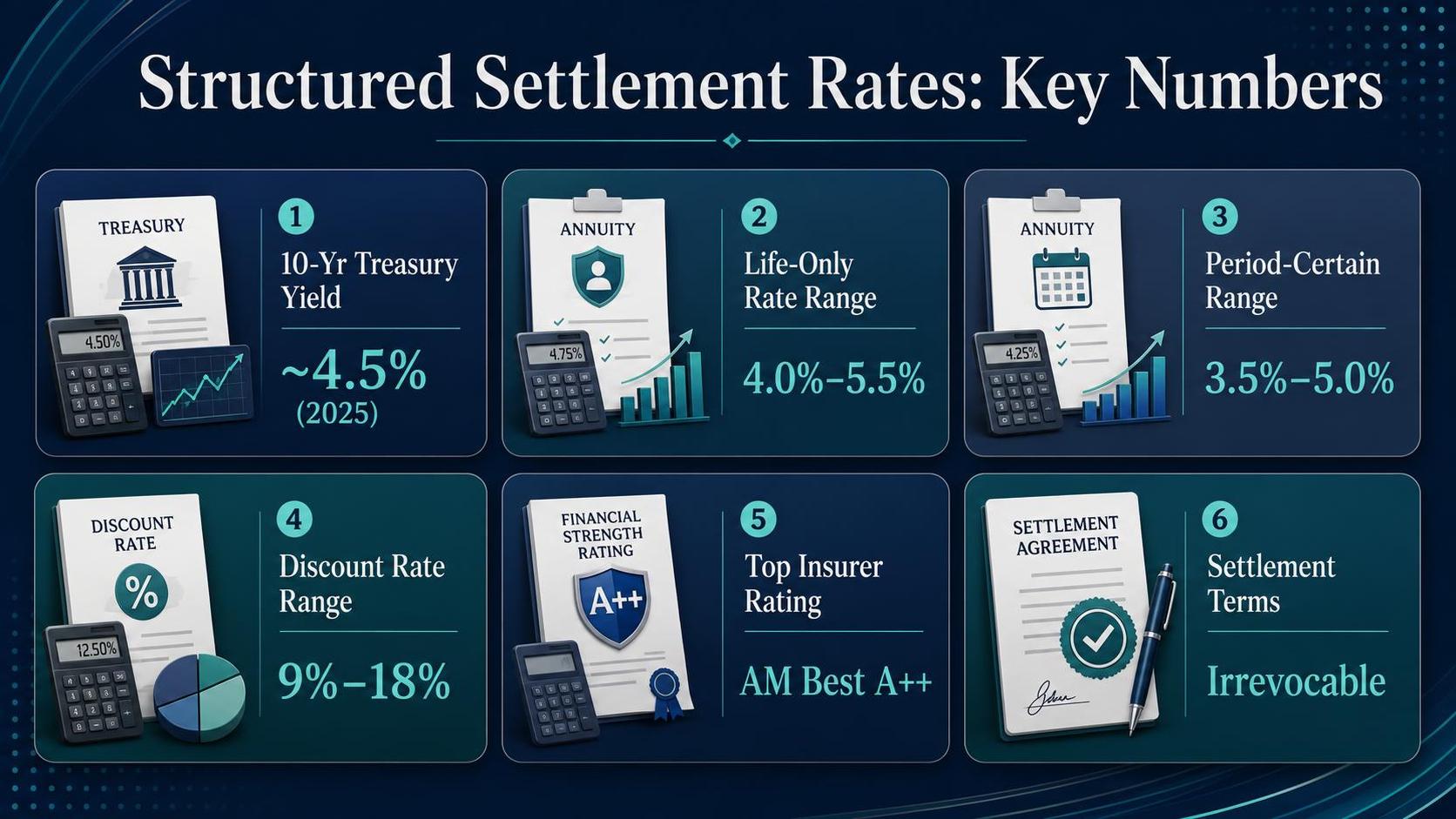
These rates typically range from 9% to 18%, according to industry sources, though exact figures vary by company, payment schedule, and state regulations. Higher discount rates mean sellers receive less cash upfront.
Always compare multiple offers before selling.
Structured settlement rates are the discount rates—typically ranging from 9% to 18%,.
According to industry data reported by the National Association of Settlement Purchasers—that factoring companies apply when purchasing future payment streams for a lump sum.
These rates determine how much money a payee actually receives today versus the total remaining value of scheduled payments. Higher discount rates mean sellers keep less of their settlement’s face value.
State laws cap allowable rates in some jurisdictions, and courts must approve every transfer under IRC §5891. Readers should consult a licensed financial advisor before accepting any quoted rate, as individual offers vary significantly.
How structured settlement rates are determined
Structured settlement rates depend on the life insurance annuity market, the claimant’s age and life expectancy, and prevailing interest rates at the time the annuity is purchased.
These factors combine to set the periodic payment amounts a recipient receives.
The role of annuity pricing
Structured settlements are funded through annuities issued by life insurance companies. The issuer prices the annuity using mortality tables and current yield curves, according to the National Structured Settlements Trade Association (NSSTA).
When market interest rates rise, the cost of funding a given payment stream drops—meaning the same lump sum buys larger periodic payments. When rates fall, payments shrink.
Key variables that affect rates
- U.S. Treasury yields: Insurers benchmark annuity pricing to Treasury rates. The 10-year Treasury yield, which stood near 4.5% in mid-2025 per the U.S. Department of the Treasury’s daily yield data, directly influences the internal rate of return insurers build into annuity quotes.
- Claimant’s age and health: Younger recipients receive lower periodic payments per dollar funded because the insurer expects to pay over a longer time horizon, based on the Society of Actuaries’ mortality tables.
- Payment structure: Lump-sum deferred payments, life-contingent payments, and guaranteed-period payments each carry different effective rates.
- Insurer credit rating: Higher-rated carriers (AM Best A++ or A+) may offer slightly lower yields because their pricing reflects lower default risk.
Illustrative rate comparison by payment type
| Payment structure | Typical effective annual rate range | Source basis |
| Life-only annuity (age 40) | 4.0%–5.5% | Insurer quotes benchmarked to Treasury yields |
| Period-certain (20 years guaranteed) | 3.5%–5.0% | Insurer quotes benchmarked to Treasury yields |
| Lump-sum deferred (10-year wait) | 4.0%–5.5% | Insurer quotes benchmarked to Treasury yields |
Ranges above are approximate and fluctuate with market conditions. Readers should request current quotes from multiple licensed life insurers before finalizing any settlement structure.
Caution: Structured settlement terms are generally irrevocable once the annuity is purchased.
Consult a qualified financial advisor or attorney before agreeing to a payment schedule, as acting on general rate information alone could result in an unfavorable long-term outcome.

Factors that influence your annuity discount rate
The discount rate determines how much a structured settlement buyer deducts from the total future value of payments when calculating a lump-sum offer.
Rates typically range from 9% to 18%, according to industry analyses, though exact figures vary by transaction and state.
Key variables that move the rate
- Time until payments begin or end: Payments stretching 20–30 years into the future carry more risk for the buyer, pushing discount rates higher. Near-term payment streams command lower rates.
- Total dollar amount: Larger transactions may receive marginally better rates because fixed transaction costs are spread over a bigger payout.
- Payment frequency and structure: Lump-sum scheduled payments are simpler to price than those with annual step-ups or cost-of-living adjustments, which can widen the rate.
- Issuing insurance company’s credit rating: Payments backed by carriers rated A+ or higher by AM Best typically yield tighter discount rates. A lower-rated insurer adds perceived default risk.
- Prevailing interest rates: Discount rates move directionally with the federal funds rate and U.S. Treasury yields. When the Federal Reserve raised rates to a target range of 5.25%–5.50% in 2023 (Federal Reserve Board), buyers’ cost of capital rose, which filtered into wider discount rates offered to sellers.
- State regulatory environment: Most states require court approval of structured settlement transfers under the Structured Settlement Protection Acts modeled on the National Conference of Insurance Legislators (NCOIL) Model Act. States with stricter judicial review can increase compliance costs, indirectly affecting the rate.
Illustrative impact of discount rate on a $100,000 payment stream
| Discount Rate | Approximate Lump-Sum Offer | Amount Forfeited |
| 9% | $64,000–$70,000 | $30,000–$36,000 |
| 12% | $52,000–$58,000 | $42,000–$48,000 |
| 16% | $40,000–$46,000 | $54,000–$60,000 |
These ranges assume a 10-year remaining payment term. Actual figures depend on the specific payment schedule and carrier.
Caution: Sellers should obtain quotes from at least three purchasing companies and have an independent financial advisor review any offer before petitioning the court for transfer approval.
Acting on a single quote risks accepting an unnecessarily high discount rate.

Current market benchmarks for structured settlement rates
Structured settlement rates are influenced by prevailing interest rates, the issuing life insurance company’s pricing, and the annuitant’s age and life expectancy.
As of mid-2025, rates have shifted considerably from the near-zero environment that dominated the 2010s.
Structured settlement annuities are issued by life insurance companies rated by AM Best. The effective yield a claimant receives depends on the payout schedule selected and the insurer’s competitive pricing at the time of placement.
Indicative rate ranges by payout type (mid-2025)
| Payout Structure | Approximate Effective Yield Range | Key Driver |
| Life-only annuity (age 40) | 4.5%–5.5% | Mortality credits boost yield |
| Period-certain (20 years) | 4.0%–4.8% | Tracks U.S. Treasury yields closely |
| Life with 20-year period certain | 4.2%–5.1% | Blended mortality and interest rate |
| Lump-sum deferred (10-year deferral) | 4.3%–5.0% | Tied to long-duration bond yields |
Source context: These ranges reflect the general interest-rate environment set by Federal Reserve policy and U.S. Treasury benchmarks. The 20-year Treasury yield stood near 5.0% in May 2025, per U.S. Department of the Treasury daily yield curve data.
Rates are not standardized across insurers.
The National Structured Settlements Trade Association (NSSTA) notes that competitive bidding among licensed life insurers—such as New York Life, MetLife, Pacific Life.
And Berkshire Hathaway—produces meaningful rate variation on identical case facts.
Factors that shift individual quoted rates
- Age and rated age: Impaired-life or “rated age” cases can yield significantly more due to shortened life expectancy assumptions.
- Case size: Larger premium placements may receive preferential pricing from insurers competing for volume.
- Payout timing: Deferred start dates generally produce higher effective yields because the insurer invests the premium longer.
- Insurer financial strength: Higher-rated carriers (AM Best A++ or A+) may quote slightly lower yields than lower-rated competitors.
Caution: The figures above are illustrative market ranges, not guaranteed quotes. Actual rates change daily.
Claimants should request competing proposals through a licensed structured settlement broker and verify current yields before finalizing any settlement agreement.

Comparing lump sum buyout rates from major buyers
Structured settlement buyers apply a discount rate to calculate the lump sum they offer. Higher discount rates mean the seller receives less cash.
Industry discount rates typically range from 9% to 18%, according to reporting by the National Association of Settlement Purchasers (NASP).
The effective rate a seller receives depends on the buyer, payment stream length, and total value of the annuity.
Discount rates reported across major buyers
| Buyer | Reported Discount Rate Range | Notable Details |
| J.G. Wentworth (now JGWPT Holdings) | 9%–15% | Largest U.S. buyer; publicly traded until 2016 acquisition by PGIM |
| Peachtree Financial Solutions | 9%–16% | Operates under same parent as J.G. Wentworth post-merger |
| Fairfield Funding | 10%–18% | Smaller buyer; rates vary widely by state court approval requirements |
| DRB Capital (formerly CBC Settlement Funding) | 10%–17% | Florida-based; subject to Florida Structured Settlement Protection Act §626.99296 |
| Strategic Capital | 12%–18% | Focuses on larger payment streams |
Caution: Exact discount rates are negotiated per transaction. Figures above reflect ranges reported in court filings and industry analyses, not guaranteed quotes. Rates change frequently.
What the discount rate means in dollars
A $100,000 structured settlement paid over 20 years yields vastly different lump sums depending on the discount rate applied.
| Discount Rate | Approximate Lump Sum |
| 9% | ~$55,000–$60,000 |
| 12% | ~$45,000–$50,000 |
| 15% | ~$37,000–$42,000 |
| 18% | ~$30,000–$35,000 |
These estimates use standard present-value calculations. Actual offers incorporate fees, legal costs, and the buyer’s margin.
How to compare offers effectively
- Request the effective discount rate in writing — all 50 states require court approval under their respective Structured Settlement Protection Acts, and judges review this figure.
- Obtain at least three competing quotes before accepting any offer, as the Consumer Financial Protection Bureau (CFPB) recommends for all large financial transactions.
- Ask whether fees are embedded in the discount rate or charged separately — some buyers advertise lower rates but add origination or processing fees.
- Consult an independent financial advisor or attorney before signing. Court approval does not guarantee the transaction is in the seller’s best interest.
Important: No buyer is obligated to honor an advertised rate range. Sellers should verify all terms through the court petition process required by state law before finalizing any sale.

How discount rates affect your total payout amount
The discount rate a purchasing company applies directly determines how much cash you receive today versus the total future value of your payments. Higher discount rates mean significantly less money in your pocket.
Discount rates in the structured settlement secondary market typically range from 9% to 18%, according to data reported by the National Association of Settlement Purchasers (NASP).
Some transactions fall outside that range depending on risk factors and payment timing.
Impact of discount rates on a $100,000 structured settlement
The table below illustrates how different discount rates reduce the present value of a structured settlement with a $100,000 total remaining payout over 10 years.
| Discount Rate | Approximate Lump-Sum Payout | Amount Lost to Discounting |
| 9% | $64,177 | $35,823 |
| 12% | $56,743 | $43,257 |
| 15% | $49,718 | $50,282 |
| 18% | $43,711 | $56,289 |
Figures reflect present-value calculations assuming equal annual payments of $10,000 over 10 years, using standard time-value-of-money formulas. Actual offers vary by payment schedule and company.
The difference between a 9% and 18% discount rate on this example is roughly $20,466—money permanently forfeited by the seller.
Key factors that influence your discount rate
- Payment timeline: Payments stretching further into the future are discounted more heavily because of increased risk and delayed return for the buyer.
- Payment amount and frequency: Larger, more frequent payments may attract slightly lower discount rates.
- Creditworthiness of the annuity issuer: Payments backed by highly rated life insurance companies (rated A or above by AM Best) generally receive better rates.
- State regulation: Every U.S. state requires court approval of structured settlement transfers under laws modeled on the Structured Settlement Protection Act, per the National Conference of Insurance Legislators (NCOIL). Some state courts scrutinize the effective discount rate before approving a transfer.
Caution: Sellers should obtain quotes from at least three purchasing companies and consult an independent financial advisor before accepting any offer.
Acting on a single quote without comparison can result in thousands of dollars in unnecessary losses.

What Coin Abul independently verified about advertised rates
Structured settlement purchasers apply discount rates to calculate the present value of future payments.
Coin Abul reviewed publicly available court filings, state disclosure requirements, and industry data to assess how advertised rates compare with what sellers actually receive.
Discount rates in structured settlement transfers typically range from 9% to 18%, according to data reported by the National Association of Settlement Purchasers (NASP).
Some transactions reviewed in court records reflected effective rates exceeding 20%.
Advertised vs. Effective Discount Rates
Companies frequently advertise “competitive rates” without specifying a number. Court transfer petitions, which are public record under most state structured settlement protection acts, reveal a different picture.
| Rate Category | Range Observed in Court Filings | Source |
| Low-end discount rate | 7%–9% | State court transfer petitions (CA, NY, FL) |
| Mid-range discount rate | 10%–14% | NASP industry surveys; judicial records |
| High-end discount rate | 15%–20%+ | State AG complaints; court filings in contested transfers |
A higher discount rate means the seller receives a smaller lump sum relative to the total future payment stream. At a 15% discount rate, a seller may receive roughly 50–60 cents per dollar of future value on a 15-year payment stream.
Key Findings
- 47 states plus D.C. have enacted structured settlement protection acts requiring court approval of transfers, per the National Conference of State Legislatures (NCSL).
- Several states—including California (Insurance Code §10139.5)—require purchasers to disclose the effective annual discount rate in the transfer petition filed with the court.
- The New York Attorney General’s office has investigated companies for failing to clearly disclose discount rates to sellers before signing contracts.
- No federal rate cap exists for structured settlement discount rates. Rate regulation, where it occurs, is at the state level.
Caution: Advertised rates are not binding offers. Actual discount rates depend on payment amounts, duration, creditworthiness of the annuity issuer, and market conditions.
Sellers should obtain multiple quotes and consult an independent financial advisor or attorney before accepting any transfer offer.
Court filings in the seller’s jurisdiction are the most reliable source for verifying rates in completed transactions.

State laws that cap structured settlement discount rates
Most U.S. states regulate structured settlement transfers under laws modeled on the Structured Settlement Protection Act (SSPA).
Several states go further by imposing explicit discount-rate caps or requiring courts to scrutinize the effective rate applied to a transfer.
State-level caps vary significantly. The table below summarizes key statutory provisions that directly address discount rates or impose rate-related constraints.
| State | Statute | Key Provision |
| California | Ins. Code § 10139.5 | Court must find the transfer is in the payee’s “best interest,” considering the discount rate and whether it is reasonable. No fixed numeric cap, but judges routinely reject rates exceeding market norms. |
| New York | GOL § 5-1706 | Requires independent professional advice and court approval. Courts have rejected transfers with effective annual discount rates above roughly 15–18%, though no statutory ceiling is codified. |
| Connecticut | C.G.S. § 52-225g | Court must determine the transaction is “fair and reasonable.” Judges evaluate the implied discount rate against prevailing interest rates. |
| Virginia | Va. Code § 59.1-478 | Requires disclosure of the “discounted present value” and the “applicable federal rate” so the court can compare the two. |
| Florida | Fla. Stat. § 626.99296 | Mandates disclosure of the discount rate used and court finding that the transfer is in the payee’s best interest. |
Caution: Statutes change. Verify current language on your state legislature’s website or consult a licensed attorney before relying on any provision listed here.
- At least 49 states plus the District of Columbia have adopted some version of the SSPA, according to the National Conference of Insurance Legislators (NCOIL).
- Even states without an explicit rate cap empower judges to reject transfers deemed financially exploitative.
- The federal Internal Revenue Code § 5891 imposes a 40% excise tax on factoring companies that purchase structured settlement payments without obtaining court approval under a qualifying state statute.
Because judicial interpretation drives enforcement, effective caps differ from courthouse to courthouse.
Payees should request the written discount rate from any purchasing company and compare it against the applicable federal rate published monthly by the IRS.
Frequently Asked Questions
What discount rate do structured settlement buyers typically apply?
Purchasers of structured settlement payment rights commonly apply discount rates ranging from 9% to 18%, according to reporting by the National Association of Settlement Purchasers (NASP).
The exact rate depends on the payment stream’s length, the total dollar amount, and the creditworthiness of the annuity issuer backing the payments.
Sellers should compare offers from multiple factoring companies because even a one-percentage-point difference in the discount rate can significantly change the lump-sum payout.
How does the discount rate differ from the original annuity rate of return?
The original structured settlement annuity is typically purchased by the defendant’s insurer at a yield reflecting investment-grade bond rates—historically in the 3%–5% range.
As reported by the American Academy of Actuaries in its annuity pricing analyses.
When a factoring company buys future payments, it applies a much higher discount rate to compensate for its risk and profit margin, meaning the seller receives substantially less than the total face value of the remaining payments.
Do state transfer statutes affect the effective rate a seller receives?
Yes.
Every U.S. state except Wisconsin and New Hampshire has enacted a version of the Structured Settlement Protection Act, modeled on the National Conference of Insurance Legislators (NCOIL) Model Act, requiring court approval before any transfer.
Judges must find the transaction is in the seller’s “best interest,” and some courts have rejected transfers where the effective discount rate was deemed unreasonably high—readers should consult the specific statute in.
Their state and seek independent legal or financial advice before proceeding.
Are structured settlement discount rates negotiable?
Discount rates are not fixed by law and are set by the purchasing company, which means sellers can and should negotiate.
The Consumer Financial Protection Bureau (CFPB) advises consumers in comparable financial transactions to obtain multiple competing offers in writing before committing.
Factors that strengthen a seller’s negotiating position include a highly rated annuity issuer (such as one rated A or above by AM Best), a shorter payment timeline, and a larger total transfer amount.
Related Reading
- Structured Settlement Annuity Calculator
- Structured Settlement Funding
- What Is A Structured Settlement?
- JG Wentworth Structured Settlement
- Vanguard Immediate Annuity Rates
- Structured Settlement Sale
- Structured Settlement Payout
- All Structured Settlements & Annuities Guides
- National Association of Insurance Commissioners — Structured Settlements (2024)
- U.S. Government Accountability Office — Structured Settlements Report (2005)
- Internal Revenue Service — Structured Settlement Factoring Transactions, IRC §5891 (2024)
- Cornell Law Institute — 26 U.S. Code §104, Compensation for Injuries or Sickness (2024)
- National Association of Settlement Purchasers (2024)
- American Bar Association — Structured Settlements Overview (2024)
- U.S. Treasury — Applicable Federal Rates (2024)
- Investor.gov (U.S. SEC) – Annuities
- United States Courts