

Straight answer: Structured settlement vs annuity: a structured settlement is a legal payment arrangement, usually from a lawsuit claim, that often uses an annuity to make scheduled payments.
An annuity is the financial product issuing those payments. Do not sell or change payments without legal and financial advice, because rights and taxes can be affected.
Structured settlement vs annuity is a comparison between claim-based periodic payments and the insurance contract that often funds those payments.
A structured settlement usually resolves a lawsuit or insurance claim, while an annuity is a financial product issued by an insurance company.
The practical difference matters because ownership, taxation, payment rights, transfer limits, and court approval rules can differ.
The IRS treats qualified structured settlement payments for personal physical injury or sickness differently from many commercial annuity payments.
Readers should not sell, assign, or borrow against future payments based on general information alone. Check the settlement agreement, annuity contract, state transfer law, and independent legal or tax advice before acting.
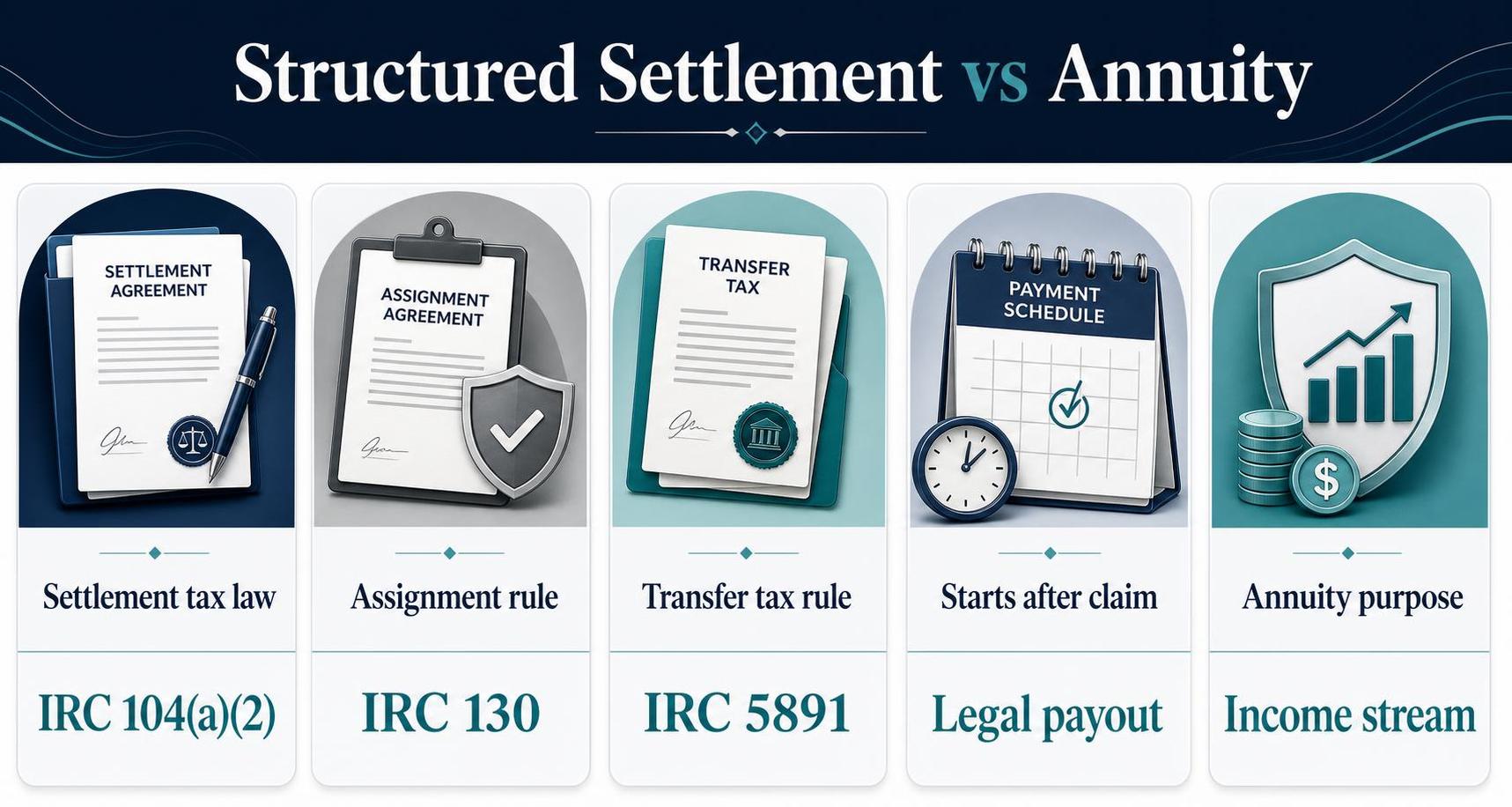
Structured settlement and annuity basics
A structured settlement is a legal settlement paid over time instead of in one lump sum.
In many injury cases, the payment stream is funded with an annuity issued by a life insurer, but the structured settlement and the annuity are not the same thing.
An annuity is a financial contract with an insurance company. The IRS and U.S. courts treat structured settlement payments differently from ordinary annuity income, so readers should not assume the tax rules match.
A structured settlement usually begins after a lawsuit or insurance claim resolves.
Under Internal Revenue Code Section 104(a)(2), damages received on account of personal physical injuries or physical sickness can be excluded from gross income, according to the IRS.
The defendant or insurer often transfers the payment obligation to a qualified assignment company.
Internal Revenue Code Section 130 allows that assignment when statutory conditions are met, and the assignee commonly buys an annuity to match the future payment schedule.
| Feature | Structured settlement | Annuity |
| Main purpose | Resolve a legal claim with scheduled payments | Provide income or accumulation through an insurance contract |
| Typical funding | Often funded by a life insurer’s annuity | Funded by premiums paid to an insurer |
| Key federal law | IRC Section 104(a)(2) and Section 130, IRS | General annuity tax rules under IRS rules for annuities |
| Payment changes | Usually fixed by settlement documents and hard to alter | Depends on contract terms; some allow options or riders |
| Transfer rights | Sale of payment rights often requires court approval under state structured settlement transfer laws | Contract ownership changes depend on insurer rules and tax law |
A plain annuity may be immediate or deferred.
The National Association of Insurance Commissioners says annuities are insurance products designed to turn premiums into a stream of income, while structured settlements are claim-resolution arrangements that may use annuities as the funding tool.
The difference matters most on taxes, flexibility, and legal protections.
Selling structured settlement payments usually triggers a separate transfer process under state law, and many courts review whether the transfer is in the payee’s best interest.
Insurer solvency protection also differs from a bank account.
Coverage comes from state guaranty associations, not FDIC insurance, and limits vary by state, according to the National Organization of Life & Health Insurance Guaranty Associations.
Check the insurer, settlement documents, and state rules before acting.

How structured settlements use annuities
A structured settlement is a legal payout arrangement, usually from a personal injury or wrongful death claim. The claimant agrees to receive part or all compensation over time instead of one lump sum.
In most cases, the payment stream is funded with an annuity bought from a life insurer. The annuity is the financing tool; the structured settlement is the legal settlement arrangement.
Congress created the core tax framework in the Periodic Payment Settlement Act of 1982.
Key rules appear in Internal Revenue Code Sections 104(a)(2), 130, and 5891, which govern tax treatment and later transfer penalties, according to the Internal Revenue Service and Congress.
After settlement, the defendant or insurer often assigns the payment obligation to a qualified assignment company. Under IRC Section 130, that assignee can accept liability and buy an annuity that matches the promised payment schedule.
The injured person usually does not own the annuity contract directly. Instead, the claimant has the right to the scheduled payments set in the settlement agreement, while the annuity sits behind the scenes as the funding asset.
This structure matters because qualified personal injury damages can be excluded from gross income under IRC Section 104(a)(2).
The IRS states the exclusion generally applies to damages received on account of personal physical injuries or physical sickness.
The National Structured Settlements Trade Association states that structured settlements can provide monthly payments, future lump sums, or lifetime benefits.
Those patterns are built by selecting annuity payment dates and amounts when the case settles.
| Fact | What it shows | Source |
| 1982 | Federal law established the modern structured settlement tax framework. | Period Payment Settlement Act of 1982; U.S. Congress |
| IRC 104(a)(2) | Tax code section commonly used for exclusion of qualifying physical injury damages. | Internal Revenue Service |
| IRC 130 | Tax code section allowing qualified assignments used to place payment liability with an assignee. | Internal Revenue Service |
| 40% | Federal excise tax imposed on many transfers of structured settlement payment rights that do not meet statutory rules. | IRC 5891; Internal Revenue Service |
Annuities are used because insurers can match long-term obligations with contractually fixed payments. That can reduce reinvestment risk for the payor and create predictable cash flow for the recipient.
Not every annuity is a structured settlement. Retail annuities are consumer investment or income products. Structured settlement annuities are typically custom-funded to satisfy a court case or claim resolution.
Caution matters here. Tax treatment, transfer rights, and beneficiary rules depend on settlement language, state law, and the annuity contract.
A reader should verify terms in the settlement documents and check the IRS or a qualified attorney before acting.
- The settlement agreement creates the payment obligation.
- The annuity funds that obligation.
- The schedule can include monthly income, deferred lump sums, or lifetime payments.
- Selling future payments later can trigger court review and federal tax consequences.

Payment rights, ownership, and control
A structured settlement and an annuity can both produce periodic income, but the legal rights are not the same.
The key difference is control: a structured settlement payee usually owns the payment stream, while an annuity owner usually controls the contract itself.
That distinction affects who can change terms, take cash early, name beneficiaries, or transfer rights. Acting on the wrong assumption can trigger taxes, lost protections, or a court process.
In a structured settlement, the injured person typically has the right to receive scheduled payments created by a settlement agreement.
In many cases, the defendant transfers that obligation through a qualified assignment under Internal Revenue Code Section 130, and the assignment company owns the annuity used to fund the payments, not the payee.
That means the payee often cannot rewrite the schedule, accelerate future payments, or surrender the annuity for a lump sum.
If the payee wants to sell payment rights, the transfer usually must go through a state structured settlement protection process and federal tax rules under Internal Revenue Code Section 5891.
Which imposes a 40% excise tax on a factoring transfer unless the transfer is approved in advance under a qualified court order.
With a standard nonqualified annuity, the contract owner usually keeps control rights defined by the insurer’s contract.
Those rights can include changing beneficiaries, taking withdrawals, surrendering the contract, or annuitizing later, subject to fees and tax rules.
FINRA states that annuity surrender charge periods often last six to eight years. The IRS also states that taxable distributions taken before age 59½ can face a 10% additional tax in many cases.
Those are owner-level control rights, but they come with contractual and tax limits.
| Issue | Structured settlement | Annuity |
| Who usually owns the annuity? | Defendant or qualified assignee under IRC Section 130 | Contract owner named in the policy |
| Who receives payments? | Payee named in settlement documents | Owner, annuitant, or beneficiary under contract terms |
| Can terms be changed freely? | Usually no; payment rights are fixed by settlement | Sometimes yes; depends on contract options |
| Can future payments be sold? | Usually only with court approval; IRC Section 5891 includes a 40% excise-tax rule | Usually handled as withdrawal or surrender, not a court-approved sale |
| Early-access cost | May require discounting and court review | FINRA: surrender periods often 6 to 8 years; IRS: 10% additional tax may apply before age 59½ |
Plain caution: ownership language varies by settlement documents and insurance contracts.
Before selling payment rights, surrendering an annuity, or changing beneficiaries, check the actual contract and get advice from a qualified attorney, tax professional, or insurer.

Tax treatment of settlement annuity payments
Structured settlement annuity payments can be tax-free, but only in specific cases.
The key rule is Section 104(a)(2) of the Internal Revenue Code, which excludes damages received on account of personal physical injuries or physical sickness from gross income, according to the Internal Revenue Service.
That exclusion often carries through to periodic payments funded by an annuity. The tax result depends on why the claimant received the settlement, how the agreement was written, and whether any part of the recovery represents taxable items.
For a qualifying personal injury case, both the original settlement amount and the investment growth inside the annuity are generally excluded from federal income tax when paid as part of a structured settlement.
The legal framework comes from IRC Section 104(a)(2) and IRC Section 130, which governs qualified assignments.
The IRS states in Publication 4345 that compensatory damages for physical injury or physical sickness are generally non-taxable.
By contrast, punitive damages are generally taxable, even when connected to a physical injury case, unless a narrow wrongful death exception under state law applies.
Emotional distress has a separate rule. Under the IRS explanation of Section 104(a)(2), damages for emotional distress alone are not treated as damages for physical injury or sickness.
Only amounts for actual medical care attributable to emotional distress may be excluded, and only to the extent allowed by tax law.
Interest is another common trap. The IRS states that interest on judgments or settlements is generally taxable. That means a settlement can be partly tax-free and partly taxable if it includes interest, punitive damages, or other taxable components.
| Payment type | Federal tax treatment | Primary source |
| Periodic payments for personal physical injury or physical sickness | Generally excluded from gross income | IRC 104(a)(2); IRS Publication 4345 |
| Punitive damages | Generally taxable | IRC 104(a)(2); IRS guidance on settlements |
| Interest on a judgment or settlement | Generally taxable | IRS Tax Topic and settlement guidance |
| Emotional distress not caused by physical injury | Generally taxable, except certain medical costs | IRC 104(a)(2); IRS Publication 4345 |
Attorney fees can also complicate reporting. In some cases, a claimant may owe tax on a taxable award even if part of the money was paid to counsel, as explained by the IRS and the U.S. Supreme Court in Commissioner v. Banks, 543 U.S. 426 (2005).
State taxation may differ from federal treatment. Before acting, review the settlement agreement, Form 1099 if issued, and current IRS instructions.
Tax mistakes in this area can be costly, so readers should confirm the treatment with a CPA or tax attorney using the actual settlement documents.

Selling structured settlement payments
A structured settlement can be sold, but the process is regulated and usually costs more than people expect.
In most cases, the seller transfers some or all future payments to a factoring company for a lump sum, subject to court or administrative approval under state law.
Federal law adds a strong control. Under 26 U.S. Code Section 5891, a purchaser owes a 40% federal excise tax on a structured settlement transfer unless the transfer is approved in advance under a qualified state structured settlement protection law.
That rule matters because every state has enacted some form of Structured Settlement Protection Act, according to the National Association of Settlement Purchasers.
These laws generally require a judge or other authorized decision-maker to find that the transfer is in the seller’s best interest.
| Rule or fact | What it means | Source |
| 40% excise tax | Applies to the purchaser if a transfer lacks required approval | 26 U.S.C. Section 5891 |
| State approval laws in all 50 states | Transfers are generally reviewed under state Structured Settlement Protection Acts | National Association of Settlement Purchasers |
| Tax-free treatment can continue | Periodic payments from a personal physical injury settlement are generally excluded from gross income | IRS Publication 4345; 26 U.S.C. Section 104(a)(2) |
The biggest economic issue is the discount rate. Factoring companies commonly advertise lump sums that are far below the total of future payments, because they apply a discount rate and fees.
The Consumer Financial Protection Bureau has warned consumers to compare the present value and total payout carefully before signing.
For example, a transfer of $100,000 in future payments does not mean a $100,000 cash offer. The actual offer depends on timing, risk, fees, and the buyer’s discount rate.
If a company does not clearly show the gross advance, fees, and net amount, the reader should stop and request written disclosures.
- Partial sales are possible. Some sellers transfer only selected payments instead of the entire stream.
- Court hearings can add time. Approval is not automatic, even if both sides sign a contract.
- Independent professional advice may be required or strongly encouraged under some state laws.
Caution: selling structured settlement payments can permanently reduce long-term financial security.
Anyone considering a transfer should review the contract, compare multiple quotes, and check the current state statute and court procedure in the primary source before acting.

Risks when comparing annuity options
Comparing a structured settlement annuity with a retail annuity is not only about payout size. The bigger risks are insurer protection limits, liquidity restrictions, inflation erosion, and tax mistakes.
A reader could be harmed by acting on marketing examples alone, so the contract and the state guaranty rules should be checked before any decision.
A structured settlement annuity is usually designed to pay a fixed schedule after a lawsuit settlement.
A retail annuity is usually bought with personal savings and may offer more optional features, but those features can add cost, complexity, or surrender penalties.
| Risk area | What the numbers show | Why it matters |
| Insurance protection | State guaranty association protection for annuities is commonly $250,000 per owner per member insurer, but limits vary by state. NOLHGA’s state coverage tables show some states at $100,000 and some at $500,000. | If the insurer fails, protection may be lower than the contract value. Compare the issuing insurer, not only the quoted payment. |
| Bank-style safety assumptions | The FDIC states it does not insure insurance products, including annuities. | A buyer who assumes an annuity has bank deposit protection may underprice insolvency risk. |
| Surrender risk | FINRA says surrender periods often last 6 to 8 years, and surrender charges typically decline over time. | A retail annuity can be costly to exit early. That matters if cash may be needed for medical bills, housing, or debt. |
| Inflation risk | The U.S. Bureau of Labor Statistics reported CPI-U rose 3.4% over the 12 months ending December 2023. | A fixed payment stream loses purchasing power when prices rise. A level $1,000 payment buys less over time. |
Tax and transfer risks
Structured settlement payments are often tax-free when they qualify under Internal Revenue Code Sections 104(a)(2) and 130.
By contrast, the IRS says earnings withdrawn from a nonqualified annuity are generally taxable as ordinary income, and withdrawals before age 59½ can face a 10% additional tax in many cases.
Selling future structured settlement payments creates another risk. Transfers are governed by state structured settlement protection acts and usually require court approval.
The discount rate, fees, and lost future income can make the cash offer much smaller than the payment stream’s long-term value.
- Check the insurer’s financial strength ratings and the exact legal entity issuing the annuity.
- Read the surrender schedule, rider fees, and payout formula before comparing quotes.
- Confirm tax treatment with a CPA or tax attorney before changing a settlement or annuity plan.
Caution: do not rely on a headline payout number alone. The safer comparison is contract terms, insurer strength, tax treatment, and state protection limits from the primary source documents.

What Coin Abul reviewed independently
Coin Abul reviewed primary tax rules, court-approved transfer rules, and insurance solvency backstops to compare structured settlements with annuities.
The review focused on how each product is created, taxed, and protected, using federal law, IRS guidance, and insurance-regulator sources.
Structured settlements are typically created to resolve a legal claim.
Their tax treatment is anchored in Internal Revenue Code Section 104(a)(2), which excludes qualifying damages for personal physical injuries or physical sickness from gross income, and Section 130, which governs qualified assignments.
Annuities are broader insurance contracts, usually bought with a lump sum or premiums.
IRS Publication 575 explains that annuity payments can be fully or partly taxable depending on whether the contract was purchased with pre-tax or after-tax money and whether an exclusion ratio applies.
| Point reviewed | Structured settlement | Annuity |
| How it starts | Usually funded after a lawsuit settlement; often paired with a qualified assignment under IRC Section 130 | Usually purchased directly from an insurer by an individual or retirement plan owner |
| Federal tax baseline | Qualifying injury payments may be tax-free under IRC Section 104(a)(2) | Tax treatment varies; IRS Publication 575 says part or all of payments may be taxable |
| Ability to sell payments | Transfer sales are regulated; 26 U.S. Code Section 5891 imposes a 40% excise tax unless a state court approves the transfer under a structured settlement protection act | Liquidity depends on contract terms; surrender charges and market value adjustments may apply |
| State protection | Backed by insurer claims-paying ability and state guaranty association limits if the issuer fails | Same general insurer and guaranty-association framework |
For insurer safeguards, Coin Abul checked the National Organization of Life & Health Insurance Guaranty Associations.
NOLHGA says coverage limits vary by state, but many states protect annuity benefits at up to $250,000 in present value. That limit is not universal and must be verified in the relevant state law.
Coin Abul also reviewed transfer-risk data. The U.S. Government Accountability Office reported in 2012 that factoring company discount rates in sampled structured settlement transfers ranged from 9% to 18%.
That affects how much cash a seller actually receives.
- Primary tax sources reviewed: IRC Sections 104(a)(2), 130, and 5891; IRS Publication 575.
- Insurance protection source reviewed: NOLHGA state guaranty association summaries.
- Transfer-market source reviewed: U.S. Government Accountability Office report on structured settlement factoring transactions.
Caution: tax treatment, transfer approval standards, and guaranty limits depend on the facts and the state. A reader should verify current rules with the IRS, the state insurance department, and the court-approved transfer statute before acting.
Frequently Asked Questions
What is the difference between a structured settlement and an annuity?
A structured settlement is a legal settlement arrangement that pays a claimant over time, usually after a personal injury or wrongful death case.
The future payments are often funded by an annuity issued by a life insurer, but the settlement itself is the legal agreement and the annuity is the financial product behind it; the U.S. Internal Revenue Service explains the tax rules for structured settlements in Internal Revenue Code Sections 104(a)(2) and 130.
Is every structured settlement an annuity?
No. Many structured settlements are funded with annuities, but the terms are created by the settlement agreement and court-approved documents, not by the annuity contract alone.
The National Structured Settlements Trade Association describes a structured settlement as a negotiated stream of payments, commonly funded through an annuity purchased from a highly rated life insurer.
Are payments from a structured settlement taxed the same way as annuity payments?
Not always.
Periodic payments received on account of personal physical injuries or physical sickness are generally excluded from gross income under IRS Section 104(a)(2).
While ordinary non-qualified annuity payments can have taxable earnings under general IRS annuity rules in Publication 575.
Tax treatment depends on the source of the claim and the contract terms, so readers should check settlement papers and current IRS guidance before acting.
Can a person cash out a structured settlement the same way they surrender an annuity?
No. A structured settlement payee usually cannot surrender the underlying annuity because the annuity is typically owned by an assignment company.
And selling payment rights generally requires a court process under state structured settlement protection laws; the National Conference of State Legislatures says 48 states have enacted such laws.
By contrast, the owner of a non-qualified annuity may be able to surrender the contract directly, though insurer surrender charges and tax consequences can apply.
Which one offers more flexibility: a structured settlement or a regular annuity?
A regular annuity purchased by an individual usually offers more owner-level control at purchase, such as selecting payout timing or riders, because the buyer owns the contract subject to insurer terms.
A structured settlement is usually less flexible after it is finalized because payment timing and amounts are set in the settlement documents, a design intended to preserve long-term income and protect injury claimants.
Are structured settlements safer than annuities?
Neither is risk-free, but the risks differ.
Structured settlements funded by annuities depend on the claims-paying ability of the issuing life insurer, and coverage backstops vary by state guaranty association limits, so readers should verify the insurer, the assignment company.
And their state guaranty association before making decisions.
How should someone choose between taking a structured settlement and buying an annuity later?
The decision depends on the legal claim, tax treatment, spending discipline, and need for guaranteed long-term income.
The U.S. Department of Justice notes that structured settlements are commonly used to provide stable future payments in injury cases, but anyone comparing a lump sum with later annuity purchase should review fees, taxes, inflation risk.
And court rules with a qualified attorney or tax adviser because mistakes can be costly and hard to reverse.
Related Reading
- Pacific Life Structured Settlement Phone Number
- Structured Settlement Sale
- Structured Settlement Annuity Calculator
- Structured Settlement Collection Agency
- Can I Sell My Neap Annuity?
- Best Structured Settlement Companies
- Structured Settlement Interest Rates
- JG Wentworth Structured Settlement
- All Blog Guides
- Internal Revenue Service (2022)
- U.S. Securities and Exchange Commission (2013)
- FINRA (2024)
- Cornell Law School Legal Information Institute (2022)
- California Courts Self-Help Guide (2024)
- Federal Trade Commission – Consumer Advice
- Investor.gov (U.S. SEC) – Annuities
- United States Courts
- MedlinePlus (U.S. National Library of Medicine)