

Straight answer: Structured Settlement Interest Rates are usually the effective discount rates a purchasing company uses to price future payments, not bank-style interest paid to recipients.
Rates vary by buyer, payment schedule, court approval, and market conditions. Consumers should compare written quotes and confirm state-law requirements before selling any payment rights.
Structured Settlement Interest Rates are the discount rates buyers use to convert future court-approved payment streams into a present cash offer.
They are not savings-account yields; they reflect payment timing, insurer strength, court approval risk, and buyer pricing, while applicable state transfer laws require judicial review.
For context, the Consumer Financial Protection Bureau warns that selling structured settlement payments can carry high costs, and the Internal Revenue Code treats qualified structured settlement payments as tax-free when requirements are met.
Do not rely on pricing examples alone; compare written quotes and review legal consequences before signing.
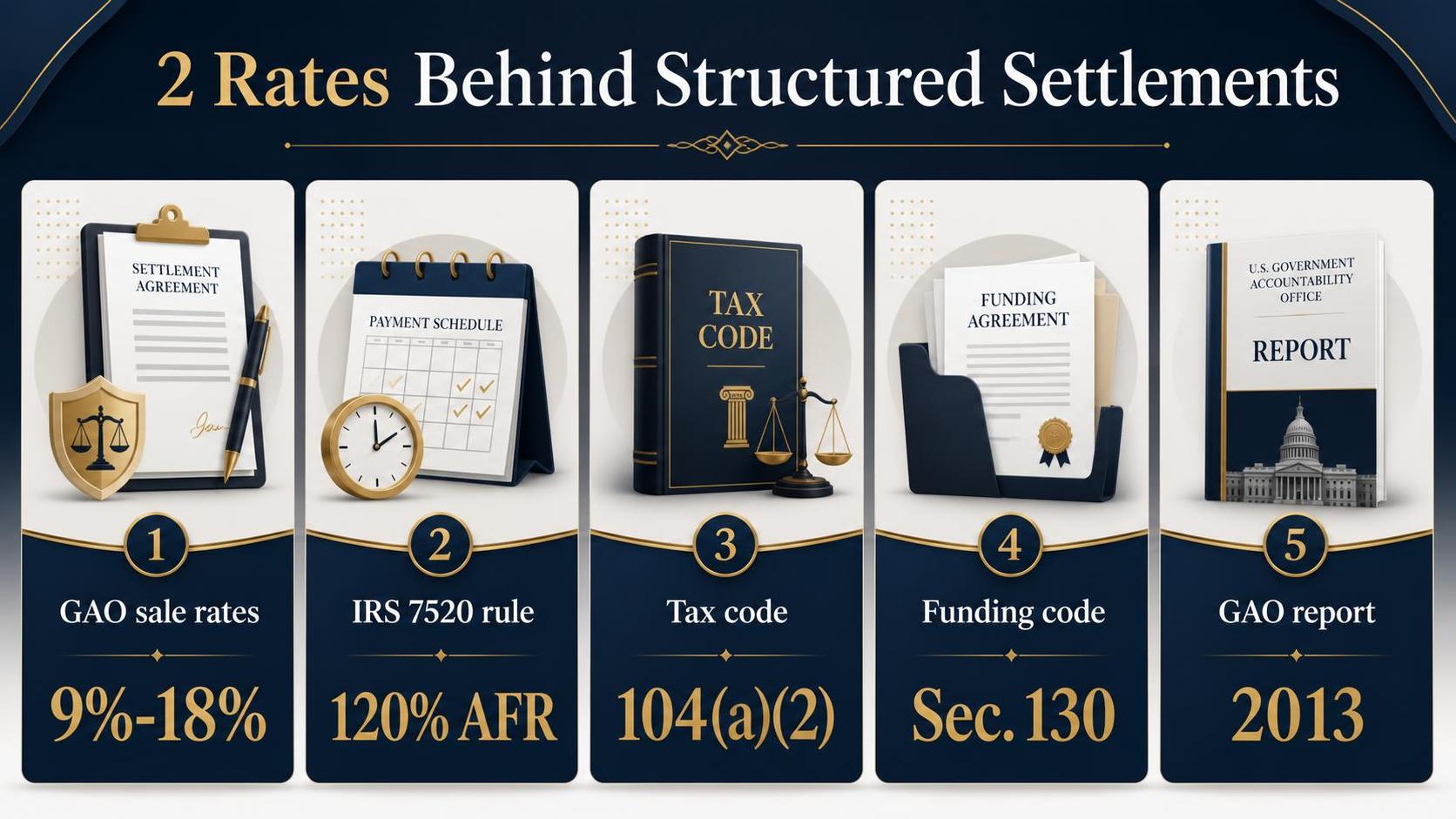
How structured settlement discount rates work
A structured settlement discount rate is the annual rate a buyer uses to convert future payments into a lump sum today. A higher rate lowers present value, so the seller receives less cash for the same payment stream.
Federal law matters because 26 U.S.C. § 5891 imposes a 40% excise tax on a transfer that is not approved under a qualified state structured settlement protection act.
That court-approval framework does not set one national rate, but it does force rate disclosure in transfer paperwork.
The core pricing idea is present value. A buyer estimates what future payments are worth today, then subtracts its margin, costs, and risk through the discount rate.
State disclosure laws commonly require the transferee to show the gross advance amount, itemized fees, net advance amount, and the discount rate.
Many statutes also require a comparison against the “discounted present value” calculated with the applicable federal rate for valuing annuities, referenced in 26 U.S.C. § 7520.
That comparison helps a judge see how far the offer sits below a tax-code valuation benchmark.
The rate on the disclosure is not the same as the annuity issuer’s investment return. It is the buyer’s pricing rate for this transfer. Small rate changes can move the payout sharply because the reduction compounds over time.
| Example payment stream | Discount rate | Present value today | Source |
| $10,000 due in 5 years | 6% | $7,473 | Author calculation using PV = 10,000 / (1.06^5) |
| $10,000 due in 5 years | 10% | $6,209 | Author calculation using PV = 10,000 / (1.10^5) |
| $10,000 due in 5 years | 14% | $5,193 | Author calculation using PV = 10,000 / (1.14^5) |
In that example, moving from 6% to 14% cuts value by $2,280, based on the calculations above. Longer payment schedules usually magnify the difference.
- Check whether the quoted rate applies before or after fees. The net advance amount is the cash that actually matters.
- Ask for the discounted present value comparison required by your state’s transfer disclosure law.
- Read the court petition and disclosure statement together. If a figure is unclear, verify it in the filed documents and state statute.
Caution: discount rates, fees, and court standards vary by state and transaction.
Do not sign based on a headline percentage alone; compare the net cash, the payment rights being sold, and the court-filed disclosures, then confirm the numbers from the primary documents.
Why quoted rates differ by purchaser
Structured settlement purchasers do not use one standard “interest rate.” Each firm builds a quote from its own required return, funding costs, legal costs, and view of court-approval risk.
That is why two buyers can price the same payment stream differently.
The key number is usually the discount rate, not the annuity’s original growth rate. A higher discount rate reduces the present-value offer. A lower discount rate raises it.
Readers should not rely on the headline cash amount alone; the disclosure statement matters more.
Purchasers also face different capital costs. Some fund deals from internal cash. Others rely on credit lines or outside investors. When money costs more to obtain, the buyer usually demands a wider spread over its own funding benchmark.
| Quote driver | Verified figure | Source | Why it can change a quote |
| Federal tax risk if a transfer is not court-approved | 40% excise tax | 26 U.S.C. § 5891 | A purchaser that sees approval risk may price more conservatively or decline the deal. |
| General short-term borrowing benchmark | U.S. bank prime loan rate reached 8.50% in August 2023 | Board of Governors of the Federal Reserve System, Bank Prime Loan Rate series | Higher borrowing benchmarks can raise a purchaser’s cost of funds and, in turn, the quote’s discount rate. |
| Cooling-off protection in one major state | 3 business days to cancel | Florida Structured Settlement Protection Act, Fla. Stat. § 626.99296 | State-specific compliance rules add timing and administrative costs that differ by jurisdiction. |
Legal and processing costs also vary by purchaser. One company may absorb more attorney time, document retrieval, and court attendance. Another may pass those costs into pricing.
State rules can magnify the gap because transfers must satisfy local Structured Settlement Protection Act requirements.
Risk appetite matters too. Purchasers may discount older payment streams, disputed beneficiary records, or cases involving Medicaid, child support, or bankruptcy concerns more heavily.
Those issues can slow approval or kill the transaction, so some buyers price for that risk upfront.
Quote format adds confusion. One purchaser may show a higher gross advance but subtract fees later. Another may quote a lower all-in cash amount with fewer line items.
The better comparison is the net amount, the discount rate, and every fee on the disclosure.
Caution: do not compare offers by cash amount alone. Read the transfer disclosure, ask for the discount rate and net proceeds in writing, and verify state-law rights with the court forms or a qualified attorney before signing.

Current market factors affecting lump sums
Lump-sum offers for structured settlements move with interest rates, inflation, and the buyer’s required return. When benchmark yields rise, the present value of future payments usually falls, so offers often get smaller.
Readers should not rely on a headline rate alone; the transfer disclosure and payment schedule control the real value.
The biggest market driver is the risk-free yield curve. Buyers commonly value future payments against U.S. Treasury rates, then add a spread for profit, servicing, and risk.
The Federal Reserve kept the federal funds target at 5.25% to 5.50% in June 2024, and the U.S. 10-year Treasury yield closed at 4.40% on June 28, 2024, according to the Federal Reserve and the U.S. Department of the Treasury.
| Market factor | Recent figure | Why it can affect a lump sum |
| Federal funds target | 5.25% to 5.50% as of June 2024, Federal Reserve | Higher short-term rates tend to lift discount rates used by buyers. |
| 10-year Treasury yield | 4.40% on June 28, 2024, U.S. Treasury | Higher long-term yields reduce the present value of later payments. |
| CPI inflation | 3.3% year over year in May 2024, U.S. Bureau of Labor Statistics | Persistent inflation can keep rates elevated and pressure offers. |
| Moody’s seasoned Baa corporate bond yield | 5.93% on June 27, 2024, Federal Reserve Economic Data | Wider credit spreads can push required returns higher. |
Inflation matters because it influences monetary policy and investor return targets. The Consumer Price Index rose 3.3% over the 12 months ended May 2024, while “all items less food and energy” rose 3.4%, according to the U.S. Bureau of Labor Statistics.
If inflation stays sticky, buyers may keep discount rates higher.
Credit conditions also matter even though structured-settlement annuity payments are often issued by highly rated insurers. If corporate bond spreads widen, buyers may demand more return over Treasuries.
Moody’s seasoned Baa corporate bond yield was 5.93% on June 27, 2024, versus a 10-year Treasury near 4.40%, according to FRED and the U.S. Treasury.
Transaction-specific details can outweigh broad market moves. Earlier payments are usually worth more than distant payments, and court approval costs, state transfer rules, and the size of the sale can change net proceeds.
A small difference in discount rate can materially change value over many years.
- Ask for the gross advance, discount rate, all fees, and the net amount in writing.
- Compare more than one quote on the same payment schedule and approval timeline.
- Check state transfer-law disclosures and get legal or tax advice before signing; a lump-sum transfer can be hard to reverse.

State court approval and rate fairness
Most structured settlement sales need a state court order before money can change hands.
The core check is whether the transfer is in the payee’s best interest and whether the discount rate and fees are fair under the state’s Structured Settlement Protection Act and the federal tax rule in 26 U.S.C. Section 5891.
That review matters because the “interest rate” on a sale is usually a discount rate, not a consumer loan APR. A high discount rate means the seller gives up more future value today.
Readers should not rely on an ad alone; court approval is a legal safeguard, not proof that every deal is cheap.
Congress added a tax backstop in 2001. Under 26 U.S.C. Section 5891, a transferee owes a 40% excise tax on the factoring discount unless the transfer is approved in a qualified court order.
That federal penalty pushed the market toward formal judicial review.
States then built their own tests.
The National Conference of Insurance Legislators’ Structured Settlement Protection Act Model Act says the transfer must be in the payee’s best interest, considering the welfare and support of dependents.
And that the payee must receive a separate disclosure statement before signing.
| Rule | State and source | Numeric fact |
| Disclosure timing | Florida Structured Settlement Protection Act, Fla. Stat. 626.99296 | Disclosure must be given at least 3 days before the payee signs the transfer agreement. |
| Hearing notice timing | Texas Structured Settlement Protection Act, Tex. Civ. Prac. & Rem. Code 141.004 | Notice of the application and hearing must be filed and served at least 20 days before the hearing. |
| Federal tax penalty without qualified order | 26 U.S.C. Section 5891 | 40% excise tax on the factoring discount. |
Rate fairness often appears through several facts at once. Courts may look at the gross advance, the total of future payments sold, itemized fees, and the implied discount rate.
Some states expressly direct courts to examine whether the discount rate is fair and reasonable; others fold that issue into the broader best-interest test.
A practical red flag is a large gap between the present cash offer and the total future payments assigned.
That gap is not automatically unlawful, but it should trigger questions about fees, competing quotes, and whether the seller explored alternatives.
The Consumer Financial Protection Bureau has warned consumers to compare offers and review all deductions carefully.
- Ask for the full disclosure statement and itemized fees before any hearing.
- Compare the implied discount rate across at least two buyers.
- Check the exact statute in the seller’s state because timing, notice, and fairness standards vary.
- Get legal or tax advice if the payments cover long-term care, child support, or basic living costs.

Taxes and fees that affect payouts
Taxes and transaction costs can change the amount a payee actually receives from a structured settlement.
The biggest split is between keeping court-approved periodic payments, which are often tax-free, and selling payment rights, where fees and discounting usually reduce cash received.
Readers should not act on tax or legal assumptions alone. Tax treatment depends on the settlement documents, the injury claim, state transfer law, and court approval.
Check the Internal Revenue Code, the annuity contract, and a qualified tax adviser before signing anything.
For many injury cases, periodic structured settlement payments are excluded from federal gross income under Section 104(a)(2) of the Internal Revenue Code.
The IRS states damages received on account of personal physical injuries or physical sickness are generally not taxable, whether paid in a lump sum or periodic payments.
That exclusion is narrower than many consumers expect. The IRS says punitive damages are generally taxable, and interest is generally taxable.
If part of a settlement covers wages, emotional distress without physical injury, or post-judgment interest, the tax result can differ from the tax-free treatment of core injury payments.
| Item | What the source says | Source |
| Federal tax exclusion | Damages for personal physical injuries or physical sickness are generally excluded from income under IRC Section 104(a)(2). | Internal Revenue Code, 26 U.S.C. Section 104(a)(2); IRS Publication 4345 |
| Punitive damages | Generally taxable, even in physical injury cases. | IRS Publication 4345 |
| Interest | Interest on judgments or settlements is generally taxable. | IRS Publication 4345 |
| Unauthorized transfer penalty | A 40% excise tax can apply to the factoring discount if a transfer does not meet federal structured settlement transfer rules. | 26 U.S.C. Section 5891 |
When a payee sells future payments, the largest cost is usually the discount rate, not a separate tax.
Consumer court filings and state disclosures often show annual discount rates in the high single digits to low twenties, but the exact rate must appear in the transfer disclosure.
Many state structured settlement protection acts require disclosure of:
- the discounted present value using the applicable federal rate for valuing annuities,
- the gross advance amount,
- itemized commissions, fees, and expenses, and
- the net amount payable to the seller.
Those disclosures matter because fees can stack. Common line items include legal filing charges, processing fees, administrative fees, and broker or intermediary compensation if one is involved.
A payee should compare the gross advance with the final net payment, not the headline offer.
Another tax issue is timing. Keeping the original annuity usually preserves the settlement’s intended tax treatment.
Selling payment rights can create complex reporting questions, especially if the underlying claim was not entirely for physical injury. Confirm the expected Form 1099 treatment before closing.
The practical step is simple: read the court petition, disclosure statement, and annuity schedule side by side.
If any fee, tax assumption, or discount-rate calculation is unclear, stop and verify it with the issuing insurer, the transfer statute, and a tax professional.

What the editorial team reviewed
This section does not present a live-rate shopping test. Structured settlement pricing is contract-specific, and acting on a headline rate alone can cause harm.
The editorial team reviewed primary sources that directly affect discount-rate benchmarks, disclosures, and court review.
The team focused on sources that publish numbers on a fixed schedule and sources that control what a buyer must disclose before a transfer is approved.
That method separates benchmark rates from actual purchase offers, which are often higher and highly variable.
| Source reviewed | Specific fact checked | Why it matters |
| IRS monthly Applicable Federal Rates revenue rulings | The IRS publishes 3 AFR categories each month: short-term, mid-term, and long-term. The IRS also publishes a Section 7520 rate monthly. | These are real benchmark rates from a primary federal source, but they are not the same as a structured settlement buyer’s discount rate. |
| Federal Reserve H.15 Selected Interest Rates | The Federal Reserve publishes Treasury yield data across multiple maturities on a recurring schedule. | Those yields show the broader rate environment that can influence annuity pricing and discounting assumptions. |
| State structured settlement transfer statutes | States generally require court approval and a written disclosure statement before a transfer can be completed. | Those rules affect how discount rates, fees, and net proceeds must be presented to the payee. |
| Issuer and annuity documents | Structured settlements are commonly funded with annuities issued by life insurers. | The annuity terms and insurer obligations shape the cash-flow value that a purchaser is evaluating. |
The editorial team also checked whether a source gives a binding number or only context. The IRS gives monthly benchmark figures. State laws usually require disclosures and judicial findings, but many do not impose one national maximum discount rate.
That distinction matters. A benchmark such as an AFR or Treasury yield can be low, while a buyer’s effective discount rate can still be much higher because it reflects transaction costs, timing risk, and the purchaser’s required return.
The team reviewed disclosure requirements closely because the decision risk is practical, not theoretical.
A seller should verify the gross advance, itemized fees, discount rate, and net amount in the actual transfer documents and the court filing before signing anything.
If a quoted rate or fee is missing, outdated, or unclear, check the primary source and the filed disclosure statement. Do not rely on a summary page alone for a money or legal decision.
How to compare settlement purchase offers
Compare the same payment stream across every quote. Focus on the net cash paid, the discount rate, every fee, and how long funding takes after court approval.
Do not compare only the headline cash amount. A larger gross offer can still leave less money after fees or a higher discount rate. Acting on one quote alone can cost thousands of dollars.
Start with the disclosures. State structured settlement protection laws commonly require buyers to disclose the amounts being sold, the discounted present value, the gross advance, itemized fees, the net amount paid, and the effective discount rate.
Examples include New York General Obligations Law section 5-1703 and Florida Statutes section 626.99296, which both require written disclosure before a transfer is completed. Use those line items to compare offers side by side.
| Same payment being sold | Net cash to seller | Implied annual discount rate | Total reduction from future payment |
| $30,000 due in 5 years | $18,000 | 10.76% | $12,000 |
| $30,000 due in 5 years | $16,500 | 12.69% | $13,500 |
| $30,000 due in 5 years | $15,000 | 14.87% | $15,000 |
The rates above are math examples for the same payment stream. They show why net cash alone is not enough. A $1,500 difference in cash can raise the implied annual discount rate by nearly 2 percentage points.
Ask each company for one sheet showing these exact items:
- Gross amount assigned from the settlement.
- Net amount the seller actually receives.
- Every fee, including processing, legal, escrow, and filing charges.
- The effective annual discount rate.
- The date funding is expected after the court order.
- Any penalty if the seller cancels before approval.
Check whether the company is quoting a discount rate before or after fees. Some disclosures separate the gross advance from fees, which can make one offer look stronger than another until the net amount is compared.
Also ask whether the buyer will seek a qualified court order. Under 26 U.S.C. section 5891, a transfer that does not meet the federal requirements can trigger a 40% excise tax on the purchaser. That tax risk is one reason court approval matters.
Final step: compare the net cash and the effective discount rate on the same payment stream, then have a lawyer or financial adviser review the papers.
State rules vary, and the court must decide whether the transfer is in the seller’s best interest.
Frequently Asked Questions
What does “structured settlement interest rate” usually mean?
In this context, the phrase can mean two different things: the annuity pricing rate used by a life insurer when a settlement is set up, or the effective discount rate a buyer applies when someone sells future payments for cash.
The Internal Revenue Service recognizes structured settlement annuities under Internal Revenue Code Sections 104(a)(2) and 130.
But consumers should confirm the exact rate definition in their contract and court documents before acting because the financial result can change sharply.
What discount rates are commonly used when someone sells structured settlement payments?
There is no single legal national rate, and the rate varies by company, payment timing, case details, and state approval standards.
Consumer-oriented legal sources such as the CFPB’s fraud warnings on lump-sum offers and state structured settlement protection laws show that fees and discounting can materially reduce the amount received.
So readers should demand a written disclosure of the annual discount rate and total deductions from the purchasing company before signing.
Does a higher interest or discount rate mean a lower lump-sum offer?
Yes.
A higher discount rate reduces the present value of future payments, which means the seller usually receives less cash today for the same payment stream; this follows standard present-value finance used across annuity and settlement transfers.
Because that tradeoff can be costly and is often irreversible after court approval, a seller should compare multiple written offers and review the full net amount, not only the headline cash figure.
Are structured settlement rates regulated by federal law?
Federal tax law sets the framework for qualified structured settlements, but transfer pricing is largely governed by state structured settlement protection acts rather than a single federal cap on discount rates.
The National Conference of State Legislatures has noted that states adopted transfer-approval laws to protect payees, and readers should check their own state statute or court rules because disclosure, waiting periods, and approval standards differ.
How can someone evaluate whether a structured settlement rate is reasonable?
The practical test is comparison and disclosure: review the gross advance, itemized fees, effective discount rate, and the total value of payments being given up, then compare several offers.
The U.S. Government Accountability Office has reported on risks in the secondary market for structured settlements, so anyone considering a sale should get independent legal or financial advice before accepting terms because mistakes can affect long-term income.
Related Reading
- Structured Settlement Annuity Companies
- AIG Structured Settlements – The Truth You Didn't Know
- Structured Settlement Quotes
- JG Wentworth Loan Reviews
- Vanguard Annuity Calculator
- Can I Sell My Neap Annuity?
- Vanguard Immediate Annuity Rates
- Structured Settlement Buyer – What You Need to Know
- Cash For Structured Settlement Payments
- All Blog Guides
- Internal Revenue Service – Structured Settlements Fact Sheet (2008)
- U.S. Government Accountability Office – Tax Administration: Improvements Are Needed to Strengthen Controls over Structured Settlement Factoring Transactions (2013)
- Consumer Financial Protection Bureau – CFPB Warns Consumers of Risks in Selling Structured Settlement Payments (2015)
- Cornell Law School Legal Information Institute – 26 U.S. Code Section 5891 (2024)
- Duke Law Center for Judicial Studies – The Need for Improved Regulation of Structured Settlement Factoring Transactions (2010)
- National Association of Insurance Commissioners – Structured Settlements and Periodic Payment Judgments Model Act (1990)
- National Cancer Institute
- U.S. Department of the Treasury