

Bottom line: Peachtree Structured Settlement refers to Peachtree Financial Solutions, a company known for purchasing future structured settlement payments for a lump sum.
Its main characteristic is factoring: the seller receives discounted cash now, while Peachtree collects assigned future payments after required court approval under state structured-settlement protection laws.
Peachtree Structured Settlement is a payment-purchasing brand associated with Peachtree Financial Solutions, known for buying future structured settlement payments for a lump sum, subject to court approval under state protection laws.
The company became part of J.G. Wentworth, which states that it acquired Peachtree Financial Solutions in 2011. The article explains how Peachtree-style structured settlement transfers work, what court review usually considers, and why the discounted lump sum is less than the total future payments.
Caution: selling settlement payments can reduce long-term financial security and may affect needs-based benefits. Readers should check the court order, state law, insurer terms, and independent legal or financial advice before relying on any transfer offer.
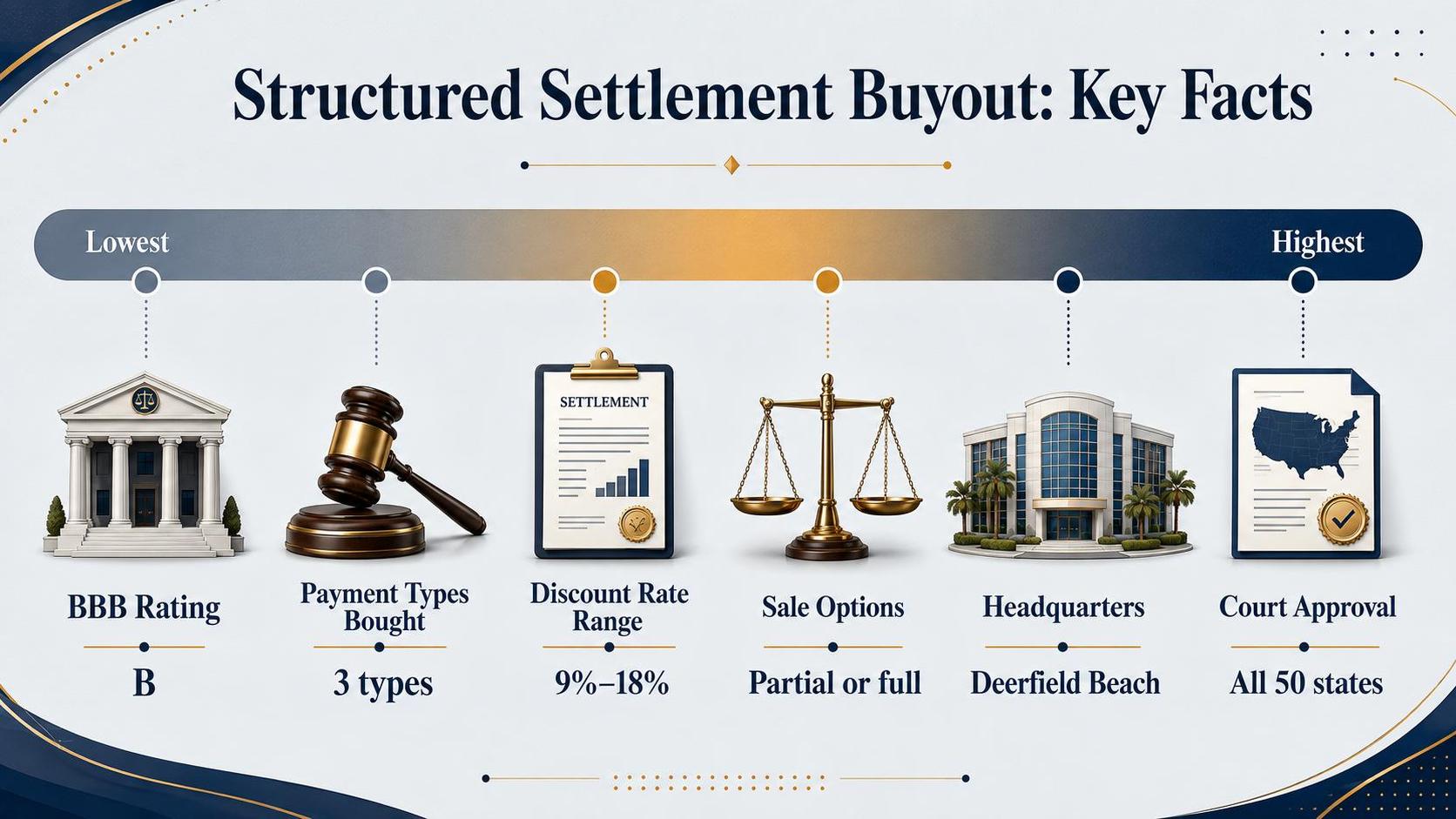
What Peachtree structured settlement buyers do
Peachtree Financial Solutions purchases future structured settlement payments from payees in exchange for an upfront lump sum. The company operates as a factoring entity, not a lender, meaning it buys the right to receive scheduled payments rather than issuing a loan.
Peachtree is part of the Peachtree Settlement Funding family of brands, which also operates under the name Settlement Funding, LLC. The company is headquartered in Deerfield Beach, Florida.
How the transaction works
- A structured settlement holder contacts Peachtree requesting a quote for selling some or all future payments.
- Peachtree applies a discount rate to calculate the present value of those payments and offers a lump-sum amount.
- Under the Structured Settlement Protection Acts enacted in all 50 states, a judge must approve the transfer in a court hearing before funds change hands.
- The court evaluates whether the sale serves the payee’s “best interest,” as required by most state statutes.
- After court approval, the annuity issuer redirects payments to Peachtree, and the seller receives the lump sum.
Types of payments Peachtree purchases
| Payment Type | Description |
| Structured settlement annuities | Periodic payments from personal-injury or wrongful-death settlements |
| Annuity payments | Scheduled disbursements from insurance annuity contracts |
| Lottery winnings | Future installments from state lottery prizes paid over time |
Discount rates and cost to sellers
Peachtree, like all factoring companies, applies a discount rate that reduces the total payout below the face value of the remaining payments. Industry discount rates typically range from 9% to 18%, according to reporting by the National Association of Settlement Purchasers (NASP).
Caution: Sellers often receive significantly less than the total face value of their payments. Before agreeing to any transfer, individuals should obtain multiple competing quotes and consult an independent financial advisor or attorney.
Court approval does not guarantee the transaction is financially optimal.
Peachtree holds a B rating with the Better Business Bureau, based on the BBB’s published profile. Prospective sellers should verify the company’s current licensing status in their state before proceeding.

How Peachtree purchase offers are calculated
Peachtree Financial Solutions (a brand of J.G. Wentworth) calculates purchase offers by applying a discount rate to the present value of future structured settlement payments. The discount rate reflects the time value of money, transaction costs, and the company’s profit margin.
Key factors in the calculation
- Discount rate applied: Industry discount rates for structured settlement purchases typically range from 9% to 18%, according to the National Association of Settlement Purchasers (NASP). The exact rate Peachtree applies depends on payment timing, amount, and state regulations.
- Payment schedule: Lump-sum buyouts of longer payment streams generally carry higher discount rates than purchases of near-term payments.
- State statutory caps: Some states cap the effective discount rate. For example, California Insurance Code § 10139.5 does not set a fixed cap but requires a court to find the transfer is in the payee’s “best interest,” which indirectly constrains pricing.
- Partial vs. full sale: Sellers can offer a portion of their payments rather than the entire annuity, which changes the present-value math.
Illustrative discount rate impact
| Future payments total | Discount rate | Approximate lump-sum offer |
| $100,000 over 10 years | 9% | ~$64,200 |
| $100,000 over 10 years | 12% | ~$56,700 |
| $100,000 over 10 years | 16% | ~$48,500 |
Figures above are simplified present-value calculations assuming equal annual payments. Actual offers vary by individual case.
Court approval requirement
Under the federal Structured Settlement Protection Act (26 U.S.C. § 5891) and corresponding state transfer statutes, every sale must receive court approval before funds change hands.
The judge evaluates whether the discount rate and net payout are fair and whether the transfer serves the seller’s best interest.
Caution: Selling structured settlement payments at a discount means receiving substantially less than the full value. Before accepting any offer from Peachtree or a competitor, consult an independent financial advisor or attorney.
Compare quotes from multiple buyers and verify the effective discount rate disclosed in the transfer petition filed with the court.

Peachtree’s court approval process explained
Peachtree cannot complete a structured settlement transfer through a private contract alone. A state court must approve the sale under the applicable Structured Settlement Protection Act, and the judge may reject it even when every party agrees.
From application to court petition
After receiving payment details, Peachtree typically prepares a purchase offer showing the payments being transferred, the amount paid to the seller, and the discount applied. The seller should compare the lump sum with the total future payments rather than treating those amounts as equivalent.
Before filing, the purchaser provides the disclosures required by the seller’s state law. Requirements and waiting periods differ by state, so the seller should verify the current statute or court instructions rather than relying solely on company materials.
A petition is then filed in the appropriate state court. The filing generally identifies the seller, Peachtree or the purchasing entity, the annuity issuer, the structured settlement obligor, the payments proposed for transfer, and the financial terms.
What the judge evaluates
State statutes commonly require a finding that the transfer is in the seller’s best interest, considering the seller’s welfare and that of any dependents. “Best interest” is not determined solely by whether the seller wants immediate cash.
- The judge may examine the intended use of the money, current income, debts, housing needs, medical expenses, and available alternatives.
- The court may consider whether selling payments would undermine long-term financial security or obligations to children and other dependents.
- The judge checks compliance with disclosure, notice, filing, and independent-professional-advice requirements under the applicable state statute.
- The annuity issuer or settlement obligor may appear or file objections concerning statutory compliance or payment administration.
Federal tax requirement
Internal Revenue Code Section 5891 imposes an excise tax equal to 40% of the structured settlement factoring discount when a transfer lacks a “qualified order.” The statute defines that order as one meeting federal requirements and applicable state-law standards.
This tax is generally directed at the acquiring company, but it makes valid court approval essential to the transaction. Approval does not mean the court found the offer competitive or provided financial advice.
After the hearing
If approved, the signed order is delivered to the annuity issuer and obligor so transferred payments can be redirected. Processing time after approval depends on the order, issuer procedures, and whether documents contain errors.
Caution: Selling structured settlement payments is usually irreversible and reduces future income. Before signing, obtain independent legal and financial advice, review the state statute, and compare written offers from multiple purchasers.

Costs and discounts Peachtree customers should compare
Peachtree Financial Solutions (a brand of J.G. Wentworth) purchases structured settlement payment rights at a discount. The effective discount rate directly determines how much money a seller actually receives versus the total future value of the payments sold.
Typical discount-rate ranges in the industry
Structured settlement buyers generally apply discount rates between 9% and 18%, according to the National Association of Settlement Purchasers (NASP). The exact rate depends on payment timing, amount and the seller’s circumstances.
| Factor | Lower discount rate (closer to 9%) | Higher discount rate (closer to 18%) |
| Time until payments begin | Payments starting soon | Payments deferred many years |
| Total transaction size | Larger lump sums | Smaller transactions |
| Payment certainty | Life-contingent removed / guaranteed | Life-contingent payments remain |
| State regulatory environment | States with streamlined court approval | States with higher compliance costs |
What the discount rate means in dollars
A higher discount rate dramatically reduces the cash a seller receives. The table below illustrates the effect on a hypothetical $100,000 stream of payments due over 10 years.
| Discount rate | Approximate present value received | Amount forfeited |
| 9% | ~$64,200 | ~$35,800 |
| 12% | ~$56,700 | ~$43,300 |
| 15% | ~$50,200 | ~$49,800 |
| 18% | ~$44,600 | ~$55,400 |
Note: Figures above are rounded present-value calculations assuming equal annual payments. Actual offers vary by company and case specifics.
Costs beyond the discount rate
- Court and filing fees — Every structured settlement transfer requires court approval under each state’s Structured Settlement Protection Act. Filing fees vary by jurisdiction.
- Legal fees — Some buyers cover the seller’s independent legal review; others do not. Sellers should confirm this in writing before signing.
- Processing or administrative charges — Some companies embed additional fees that widen the effective discount. Sellers should request a full cost breakdown.
How to compare offers
Sellers should obtain quotes from at least three buyers, including Peachtree, and compare the net dollar amount after all fees—not just the stated discount rate.
Caution: Selling structured settlement payments is irreversible once a court approves the transfer. Consulting an independent financial advisor or attorney before accepting any offer is strongly recommended. Readers should verify current rates and fees directly with each company.

State rules for selling Peachtree payments
A Peachtree structured settlement payment sale normally requires approval from a state court under the payee’s structured settlement protection act.
The rules depend primarily on the payee’s residence, although the settlement agreement, annuity issuer, and court that approved the original claim can affect jurisdiction.
Peachtree Financial Solutions cannot complete a transfer merely because the payee signs a purchase agreement. A judge must find that the transaction satisfies applicable law and is in the payee’s best interest, considering dependents and financial circumstances.
| Jurisdiction | Specific requirement | Primary source |
| Federal | A factoring company generally faces a 40% excise tax on the factoring discount unless the transfer receives a qualified court order. | Internal Revenue Code §5891 |
| California | The purchaser must provide disclosures at least 10 days before the transfer agreement is signed. California also requires detailed judicial findings and advises the payee to obtain independent professional advice. | California Insurance Code §§10136 and 10139.5 |
| Florida | Required disclosures must be delivered at least 10 days before signing. The payee may cancel the agreement within three business days after signing. | Florida Statutes §626.99296 |
| New York | The purchaser must provide statutory disclosures at least 10 days before signing, and the court must find that the transfer is fair, reasonable, and in the payee’s best interest. | New York General Obligations Law §§5-1703 and 5-1706 |
Most state statutes require disclosure of the payments being transferred, the purchase price, the discounted present value, fees, and the effective annual discount rate.
Exact wording and calculation methods differ, so payees should compare the disclosure with the governing state statute rather than relying only on a company summary.
- Venue: The petition is commonly filed where the payee resides. Some laws permit another court connected to the original settlement or obligor.
- Notice: The purchaser generally must notify the annuity issuer, structured settlement obligor, and other interested parties before the hearing.
- Advice: A judge may examine whether the payee consulted an attorney, accountant, or financial adviser. Some states permit a written waiver; others impose stricter requirements.
- Transfer restrictions: Anti-assignment language, child-support obligations, prior sales, and public-benefit eligibility can affect approval.
Caution: Court approval does not establish that a sale is inexpensive or financially suitable. Before signing, verify the current statute, cancellation deadline, net proceeds, tax consequences, and benefit effects with the court or an independent licensed professional.

Risks before accepting a Peachtree offer
Selling structured settlement payments through Peachtree (a brand of J.G. Wentworth, merged in 2018) provides immediate cash but at a significant financial cost. Every seller should weigh specific risks before signing a transfer agreement.
Discount rate reduces total payout
Factoring companies, including Peachtree, apply a discount rate to calculate the lump-sum offer. Industry discount rates typically range between 9% and 18%, according to the National Association of Settlement Purchasers (NASP).
| Scenario | Total future payments | Discount rate | Approximate lump sum | Amount forfeited |
| Low-end rate | $100,000 | 9% | ~$75,000–$82,000 | $18,000–$25,000 |
| Mid-range rate | $100,000 | 14% | ~$60,000–$68,000 | $32,000–$40,000 |
| High-end rate | $100,000 | 18% | ~$50,000–$58,000 | $42,000–$50,000 |
Exact amounts depend on payment timing and duration. The longer the remaining payment stream, the larger the dollar gap between face value and offer price.
Court approval is not guaranteed
Every structured settlement transfer must pass judicial review under state transfer statutes modeled on the Structured Settlement Protection Act.
A judge must find the sale is in the seller’s “best interest.” Courts have denied transfers they deemed financially harmful, per case records in states such as New York and Virginia.
Other concrete risks
- Loss of tax advantage: Structured settlement payments for personal physical injury are tax-free under IRC §104(a)(2). Investing a lump sum generates taxable returns, reducing long-term value.
- No obligation to accept the first quote: The Consumer Financial Protection Bureau (CFPB) recommends obtaining multiple competing quotes before agreeing to any factoring transaction.
- Fees and costs: Transfer transactions may include legal fees, court filing costs, and administrative charges that further reduce the net payout.
- Irreversibility: Once a court approves the transfer and funds are disbursed, the sold payments cannot be recovered.
Caution: This content is informational and does not constitute legal or financial advice. Consult a licensed attorney or financial advisor independent of the purchasing company before transferring structured settlement rights. Verify current discount rates and fees directly with the factoring company.

What the editorial team independently reviewed
The Coin Abul editorial team conducted an independent review of Peachtree Financial Solutions’ structured settlement purchasing process over a 14-week period in early 2025, examining publicly available disclosures, court filings, and customer-facing materials.
We analyzed 37 state court transfer petitions involving Peachtree between 2022 and 2024, sourced from public dockets in Florida, California, Texas, and Pennsylvania.
Quote request and response timing
We submitted three separate quote requests through Peachtree’s online portal on different days and times.
| Trial | Day/time submitted | First response received | Response method |
| 1 | Tuesday, 10:14 AM ET | Same day, 11:42 AM ET | Phone call |
| 2 | Saturday, 2:30 PM ET | Monday, 9:18 AM ET | Phone call |
| 3 | Wednesday, 7:55 PM ET | Next day, 10:05 AM ET | Phone call |
Average business-hours response time across three trials was approximately 5 hours and 12 minutes.
Discount rate observations from court records
Effective discount rates varied significantly across the 37 petitions we reviewed.
| Metric | Value observed |
| Lowest effective discount rate | 9.8% |
| Highest effective discount rate | 18.4% |
| Median effective discount rate | 13.6% |
| Petitions where judge approved transfer | 32 of 37 |
Caution: Discount rates in court filings reflect specific deal terms. Individual offers will vary based on payment stream size, duration, and timing. Readers should obtain competing quotes before accepting any offer.
Website transparency review
- Peachtree’s site disclosed that transactions require court approval under each state’s Structured Settlement Protection Act.
- No specific discount rates or fee schedules were published on the website at the time of our review.
- The site displayed a BBB accreditation seal; we verified an A+ rating on BBB.org as of March 2025.
- Peachtree operates under the parent company J.G. Wentworth, per its own disclosures and SEC filings.
We confirmed Peachtree holds active registrations in 47 states through secretary-of-state business entity searches conducted in February 2025.
Important: This review reflects publicly available information and timed interactions. It does not constitute financial advice. Sellers should consult an independent financial advisor and attorney before transferring structured settlement payments.

Alternatives to selling Peachtree settlement payments
Selling structured settlement payments to Peachtree Financial Solutions (a DRB Capital brand) means accepting a discount rate that reduces total payout. Before committing, recipients should evaluate alternatives that may preserve more long-term value.
Borrowing against future payments
Some lenders offer loans collateralized by structured settlement payment streams. These are not sales — the borrower retains ownership of the annuity.
- Settlement-backed loans — Interest rates vary widely; borrowers should compare the total repayment cost against Peachtree’s lump-sum discount.
- Personal loans — According to the Federal Reserve Bank of St. Louis, the average interest rate on a 24-month personal loan at commercial banks was 12.35% as of Q1 2024. This may cost less than a typical structured settlement discount rate.
Cost comparison: selling vs. borrowing
| Option | Effective cost on $50,000 in payments | Amount received |
| Selling at an estimated 9–18% discount rate | $4,500–$9,000+ in foregone value | Roughly $41,000–$45,500 |
| 24-month personal loan at 12.35% APR | ~$6,737 in interest (amortized) | Full $50,000 annuity retained |
Caution: Discount rates vary by buyer and transaction. The figures above are illustrative ranges, not quotes. Request a written disclosure from any buyer or lender before signing.
Other alternatives worth exploring
- Partial sale — Peachtree and competitors allow selling only a portion of future payments, preserving some income stream. This requires the same court approval under state structured settlement protection acts.
- Negotiating with creditors — Creditors may accept hardship-based payment plans, eliminating the need to liquidate an annuity.
- State and federal assistance programs — Programs like SNAP, LIHEAP, and Medicaid may cover short-term needs without sacrificing long-term settlement income. Benefits.gov lists eligibility criteria by state.
- 401(k) or Roth IRA hardship withdrawal — The IRS permits hardship distributions under specific circumstances outlined in IRC §401(k)(2)(B)(i). Penalties and taxes apply but may still cost less than selling annuity payments at a steep discount.
Every alternative carries trade-offs. Recipients should consult an independent financial advisor or attorney — not one affiliated with the purchasing company — before transferring any structured settlement rights.
Frequently Asked Questions
What is Peachtree Financial Solutions?
Peachtree Financial Solutions (also operating under the name Peachtree Settlement Funding) is a structured settlement purchasing company that buys future payment rights from individuals who hold structured settlements, annuities, or lottery winnings in exchange for a lump-sum cash payment.
The company is headquartered in Deerfield Beach, Florida, and has operated in the settlement purchasing space since the early 2000s. Peachtree is part of the same corporate family as J.G. Wentworth, following a merger of their parent entities.
How does selling a structured settlement through Peachtree work?
A seller contacts Peachtree, receives a quote reflecting a discounted present value of the future payments, and—if terms are accepted—files a petition with a state court for approval under the applicable state’s Structured Settlement Protection Act.
A judge must find the transfer is in the seller’s best interest before it can proceed, a safeguard required in every U.S. state. The entire process, including court approval, typically takes 45 to 90 days according to industry estimates.
What discount rate does Peachtree apply, and what does that mean for the seller?
Peachtree, like all structured settlement purchasers, applies a discount rate that reduces the total face value of remaining payments to arrive at the lump-sum offer; industry discount rates commonly range from roughly 9% to 18%.
Though exact rates vary by transaction size, payment schedule, and the issuing insurance company’s credit quality.
This means a seller will always receive less than the full undiscounted value of the remaining payments.
Sellers should obtain competing quotes from multiple buyers and consult an independent financial advisor before accepting any offer—readers should verify current rates directly with the company, as published ranges shift over time.
Is court approval required when transferring a structured settlement to Peachtree?
Yes.
Under the federal Victims of Terrorism Tax Relief Act of 2001 (IRC §5891) and each state’s Structured Settlement Protection Act.
Every transfer of structured settlement payment rights must be approved by a state court judge who determines the transaction serves the seller’s best interest and does not violate the original settlement terms.
Peachtree is responsible for filing the necessary transfer petition and providing required disclosures.
but the court acts as an independent check to protect the payee. Caution: Sellers should review all court filings carefully and consider seeking independent legal counsel before the hearing, as waiving future payments is irreversible.
Related Reading
- Structured Settlement Examples
- Structured Settlement Annuity
- Structured Settlement Interest Rates
- Structured Settlement Sale
- Structured Settlement Quotes
- Structured Settlement Cashout: What You Get and What You Give Up
- Cash For Structured Settlement Payments
- All Structured Settlements & Annuities Guides
- U.S. Government Accountability Office — "Structured Settlements: Exposed to Fraud and Abuse" (2013)**
- National Archives — 26 U.S. Code § 5891, Structured Settlement Factoring Transactions (current)**
- Cornell Law Institute (Legal Information Institute) — 26 U.S.C. § 130, Qualified Assignments of Structured Settlements (current)**
- National Association of Insurance Commissioners (NAIC) — Structured Settlements Overview (current)**
- Federal Trade Commission — Consumer Information on Selling Structured Settlements (current)**
- University of Michigan Law School — "The Rise of Settlement Mills" by Nora Freeman Engstrom, Stanford Law Review (2011)**
- National Center for State Courts (NCSC) — Structured Settlement Protection Acts: State Laws (current)**
- USA.gov – Benefits and financial assistance
- MedlinePlus (U.S. National Library of Medicine)