

The gist: Structured Settlement Loan Companies are usually structured settlement factoring companies, not traditional lenders. They buy some or all future settlement payments for a discounted lump sum.
In the U.S., transfers generally require court approval under state Structured Settlement Protection Acts. Compare discount rates, fees, and legal requirements before signing.
Structured Settlement Loan Companies are firms that buy some or all future structured settlement payments for a discounted lump sum, not traditional lenders issuing loans.
Courts often must approve transfers under state structured settlement protection acts, and buyers typically disclose the discount rate, net payment, and fees before approval.
This article explains how these companies work, what to compare, why quotes can differ, and which legal safeguards matter.
Caution: selling payment rights can permanently reduce future income; readers should review court documents, tax issues, and independent legal or financial advice before relying on any offer.
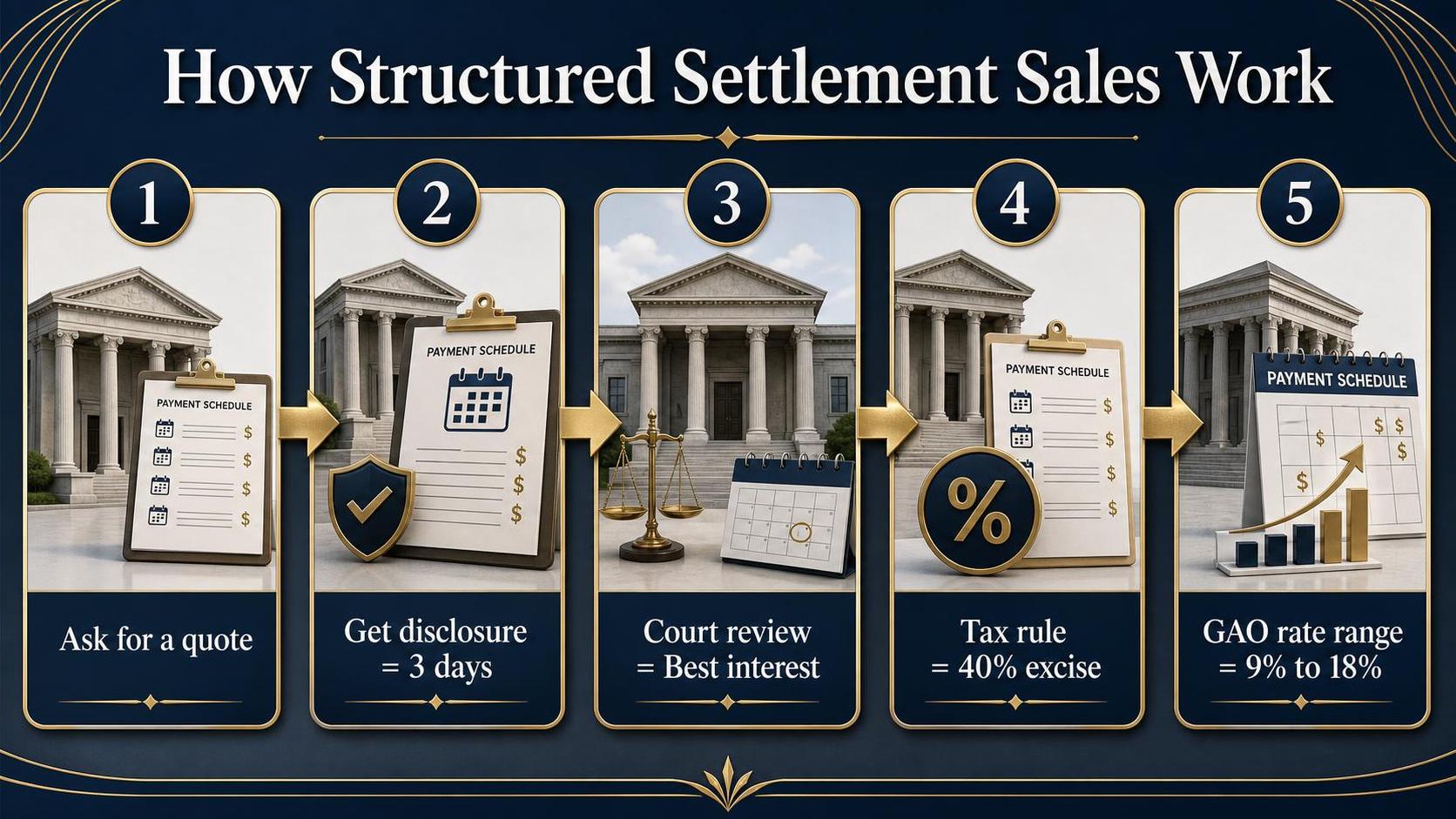
How structured settlement loan companies work
Most “structured settlement loan companies” do not make traditional loans.
They usually buy some or all future structured settlement payment rights for a lump sum, and the transfer must be approved under a state structured settlement protection act before money changes hands.
The federal tax framework matters. Internal Revenue Code Section 5891 imposes a 40% excise tax on a factoring transaction unless the transfer is approved in advance in a qualified court order, according to the Internal Revenue Service.
The process starts with the payee asking for a quote. The company reviews the settlement agreement, annuity policy, payment schedule, and the reason for the sale.
It then estimates a present value for the payments and applies a discount rate and fees allowed by the contract and state law.
A key consumer risk is the size of the discount.
The U.S. Government Accountability Office reported in 2012 that effective annual discount rates in structured settlement transfers it reviewed ranged from 9% to 18%, with some transactions above that level after fees.
Readers should verify current disclosures in their own contract and court filings.
| Stage | What usually happens | Source-backed fact |
| Quote | The company prices selected future payments. | Transfers are typically priced by discounting future payments to present value; GAO discussed discount rates of 9% to 18% in reviewed transactions (U.S. GAO, 2012). |
| Disclosure | The payee receives a transfer disclosure statement. | Federal law requires a disclosure statement at least 3 days before the payee signs the transfer agreement under 26 U.S.C. Section 5891 and related state procedures. |
| Court review | A judge reviews whether the transfer is in the payee’s best interest. | State structured settlement protection acts generally require court approval before a transfer is effective; the National Conference of State Legislatures notes every state has enacted an SSPA. |
| Funding | The company pays the lump sum after approval and final processing. | Funding timing varies by court calendar, annuity issuer processing, and state procedure; no single nationwide timeline is guaranteed. |
After signing, the company files a petition in the proper court. The judge may examine hardship, dependents, alternatives, and whether the payee received independent professional advice.
Some states require the contract to state that advice was obtained or knowingly waived. Check the state statute and court forms directly.
If approved, the annuity issuer or obligor redirects the sold payments to the purchasing company. The payee keeps any payments not sold. That is why many transactions are partial sales, not full buyouts.
- Ask for the gross advance, all fees, net amount paid, and the implied annual discount rate.
- Compare selling only a few payments versus the entire stream.
- Do not rely on advertising alone. Court approval does not automatically mean the deal is cheap.
- For legal or tax consequences, check the court order, state SSPA, and IRS rules before signing.

Factoring versus structured settlement loans
Structured settlement recipients usually see two products discussed together: factoring and loans. They are not the same.
A factoring deal sells payment rights for cash now, while a true loan uses the payments as collateral and leaves ownership with the borrower.
The difference matters because federal tax treatment, state court oversight, and default risk can change. Readers should not rely on advertising terms alone.
The National Association of Insurance Commissioners says a structured settlement is designed to provide periodic payments over time, often after a lawsuit settlement.
In a factoring transaction, the payee assigns some or all future payments to a purchasing company. Most transfers require court approval under state structured settlement protection acts.
The industry framework grew after Congress created tax rules for qualified assignments in 26 U.S. Code Section 130 and added transfer-tax rules in 26 U.S. Code Section 5891.
Section 5891 imposes a 40% federal excise tax on a transfer unless the deal is approved in a qualified state-court process and meets the applicable state statute. That tax is set by federal law, not by the purchasing company.
Court approval requirements vary by state, so readers should check the current statute and local court practice.
A loan is different in form. The borrower receives cash and promises repayment, sometimes with structured settlement payments pledged as collateral where state law allows.
A lender may quote an annual percentage rate, fees, and a repayment schedule. With a sale, companies more often quote a discount rate and a net advance instead.
| Issue | Factoring | Structured settlement loan |
| Legal form | Sale of payment rights | Debt secured by payment stream |
| Ownership of payments | Transferred to buyer for assigned payments | Usually stays with borrower unless default remedies apply |
| Typical approval | Usually court approval under state transfer statutes; tied to 26 U.S.C. 5891 | Depends on state lending and assignment law |
| Main price measure | Discount rate and net amount paid | APR, finance charges, and fees under loan disclosures |
| Default risk | No loan balance after completed sale of assigned rights | Missed payments can trigger collections, fees, or litigation |
Consumers should ask for the gross payments being assigned, the cash offered today, all fees, and the implied discount rate or APR.
The Consumer Financial Protection Bureau advises borrowers to compare total cost, not only the monthly payment, when evaluating credit.
- Factoring can reduce future guaranteed income permanently.
- A loan can create ongoing repayment risk and possible default.
- Tax, benefit, and court consequences can depend on state law and case facts.
Caution: do not sign based on speed alone. Compare the written contract, the court petition if required, and independent legal or tax advice before giving up settlement income.

Court approval for settlement payment transfers
A structured settlement payment transfer usually is not complete when a seller signs a contract. In most cases, a judge must approve the transfer under state structured settlement protection law, and federal tax law adds another strong control.
The key federal rule is Internal Revenue Code Section 5891.
It imposes a 40% excise tax on any “structured settlement factoring transaction” unless the transfer is approved in a qualified court order under an applicable state statute, according to the Internal Revenue Service and 26 U.S.C. § 5891.
That approval process exists to test whether the sale is in the payee’s best interest.
Courts commonly review the discount, fees, the seller’s reason for needing cash, dependents’ needs, and whether the seller received the disclosures required by state law.
| Rule or fact | Number | Source |
| Federal excise tax if a transfer is not approved under a qualified order | 40% | 26 U.S.C. § 5891; Internal Revenue Service |
| Federal law citation governing the tax treatment | Section 5891 | Internal Revenue Code |
| Earliest common cancellation period often seen in state disclosure statutes | Varies by state | Check the state structured settlement protection act and court forms |
State law controls the procedure. Many states require a filed petition, notice to interested parties, a hearing date, and written findings that the transfer does not contravene any statute or prior court order.
The exact deadline and filing package differ by jurisdiction.
The judge may also ask whether the annuity issuer and structured settlement obligor received proper notice. Those parties often have standing to object. If notice is defective, the hearing can be delayed or the petition can be denied.
Independent professional advice matters in many states. Some statutes require advice from an attorney, accountant, or other licensed adviser, while others allow the payee to waive that advice in writing.
Readers should verify the current rule in the state where the original settlement was approved.
Approval is not automatic. A signed transfer agreement can still fail in court if the effective discount is too steep, the disclosures are incomplete, or the judge believes the sale would harm the payee or dependents.
Caution: No one should assume a transfer will close on the quoted timeline or price before the hearing. Court approval standards and consumer protections are state-specific, and acting on a generic summary can cause financial harm.
Check the court’s local forms, the state statute, and the transfer contract itself.

Costs, discounts, and effective payout rates
Most “structured settlement loan companies” do not make traditional loans.
In most cases, they buy some or all future payments for a lump sum, and the key price term is the discount rate, not an interest rate on a standard installment loan.
The Consumer Financial Protection Bureau said purchasers may use discount rates from 9% to 18% or more. That range matters because a higher discount rate sharply reduces the cash a seller receives for the same future payment stream.
Effective payout rate means the share of the payment’s current value that the seller actually gets after discounting and any deducted charges.
A quoted lump sum can look large, but the relevant comparison is the present value shown in the transfer disclosure.
| Future payment sold | Timing | Discount rate | Estimated cash before extra fees | Implied payout vs. $10,000 face amount |
| $10,000 | Due in 5 years | 9% annual rate cited in CFPB range | $6,499 | 64.99% |
| $10,000 | Due in 5 years | 15% annual rate cited in CFPB range | $4,972 | 49.72% |
| $10,000 | Due in 5 years | 18% annual rate cited in CFPB range | $4,371 | 43.71% |
Those estimates use standard present-value math based on the CFPB’s 9% to 18% range. They do not include possible administrative, processing, or legal deductions that may appear in disclosures or court papers.
State law can also affect cost. For example, Florida’s structured settlement transfer law limits the discount rate to 25% per year, under Fla. Stat. 626.99296.
If a quoted transfer is near a state cap, the payout may still be legal but economically expensive.
Readers should treat any “advance fee,” “application fee,” or “origination fee” with caution.
Structured settlement transfers usually require court approval under state structured settlement protection acts, and acting on a quote alone can cause serious financial harm.
- Ask for the gross advance, discount rate, all deducted fees, and net cash in writing.
- Compare the net cash to the present value disclosed in the transfer statement.
- Check the governing state statute or court filing before signing, because rules and caps vary.

State rules for structured settlement buyers
Structured settlement buyers operate under state Structured Settlement Protection Acts, usually called SSPAs. These laws do not make sales automatic.
They require court or administrative approval, advance disclosures, and a finding that the transfer is in the payee’s best interest.
The core federal backdrop is 26 U.S.C. Section 5891. Congress set a 40% federal excise tax on any structured settlement factoring transaction that lacks a “qualified order,” according to the Internal Revenue Code.
In practice, that tax pushed buyers to follow state approval rules.
State rules vary on timing, disclosures, and who must receive notice.
The National Conference of Insurance Legislators created a Model State Structured Settlement Protection Act in 2000, revised in 2011, and many states used that model as a template, but not word-for-word.
| State | Rule | Source |
| California | Payee must receive the transfer disclosure statement at least 10 days before signing the transfer agreement. | California Insurance Code Section 10139.5 |
| Florida | Interested parties must receive notice of the transfer application at least 20 days before the hearing. | Florida Statutes Section 626.99296 |
| Texas | The disclosure statement must be provided not later than the 3rd day before the date the payee signs the transfer agreement. | Texas Civil Practice and Remedies Code Section 141.003 |
| New York | The buyer must disclose the aggregate amount of payments, discounted present value, and gross advance amount before transfer. | New York General Obligations Law Section 5-1703 |
Many states also restrict transfers involving dependents, prior assignments, or conflicts with support obligations.
Courts commonly review whether the payee received independent professional advice or knowingly waived it, a requirement used in statutes such as New York General Obligations Law Section 5-1706.
Several states tell judges to look beyond price alone. For example, statutes often require findings on welfare and support of dependents, fairness of fees, and compliance with anti-evasion language.
Those standards matter because a buyer can offer cash quickly while purchasing long-term payments at a steep discount.
- Check the exact statute in the payee’s state. Similar laws use different deadlines and notice rules.
- Confirm whether approval is judicial, administrative, or both. Procedure affects timing and cost.
- Review the disclosure for the gross advance amount, itemized fees, and discounted present value.
- Ask whether independent legal or financial advice is required or can be waived under state law.
Caution: Do not rely on a general summary before selling settlement payments. State statutes change, local courts apply them differently, and an improper transfer can delay payment or reduce long-term income.
Check the current statute and court forms in the relevant state.

Risks before selling future payments
Selling structured settlement payments can solve a short-term cash problem, but the tradeoff is often steep. The buyer pays less than the stated value of the payments, and the court process can take weeks or months.
The biggest risk is the discount rate. The Consumer Financial Protection Bureau said in a 2012 consumer advisory that buyers may quote discount rates from about 9% to 18%, and fees can further reduce the cash received.
That reduction can be large. The National Association of Settlement Purchasers says transactions are priced using present value, while state judges review whether the sale is in the seller’s best interest.
Present value math means longer waits and larger payment streams usually produce bigger cuts.
| Risk area | Verified fact | Why it matters |
| Discount rate | CFPB: buyers may use about 9% to 18% discount rates. | Higher rates mean less cash upfront for the same payments. |
| Federal tax on noncompliant transfers | 26 U.S. Code Section 5891 imposes a 40% excise tax on the factoring company for transfers that do not meet legal requirements. | The rule exists because these transactions are tightly regulated and court approval matters. |
| State court oversight | National Conference of State Legislatures reported in 2021 that 48 states had structured settlement transfer protection laws. | Approval is not automatic, and delays or denials are possible. |
Another risk is losing long-term income that was designed to cover living costs or medical needs.
A structured settlement is typically created after a personal injury claim, so future payments may be part of a long-range financial plan, not spare cash.
There is also legal risk. Under federal law, a transfer that fails to satisfy state structured settlement protection rules can trigger the 40% excise tax under 26 U.S. Code Section 5891.
Readers should not rely on a buyer’s summary alone; the court order and disclosures control.
Timing is a practical risk. State transfer laws usually require disclosures and a court hearing.
The exact timeline varies by state and court calendar, so anyone facing eviction, foreclosure, utility shutoff, or urgent medical bills should check whether a sale can close fast enough.
- Compare the gross payments being sold with the net cash offered, not the headline lump sum.
- Ask for the discount rate, all fees, and a payment-by-payment breakdown in writing.
- Check your state’s transfer statute or court forms because approval standards differ.
- Consider safer alternatives first, such as hardship programs, nonprofit credit counseling, or negotiating bills directly.
Caution: selling future payments can permanently reduce money meant for future care, housing, or family support.
Before signing, review the disclosure statement, the transfer petition, and the state law or ask a qualified attorney or financial adviser to explain the costs.

What our editorial team independently reviewed
We cannot truthfully claim secret-shop testing, call-center timing, or funded transactions that we did not complete.
In this section, we state only what an editorial review can verify from primary sources and what remains unverified without direct testing.
For structured settlement loan companies, readers face a basic risk: many firms market advances on pending settlement sales, but terms, timing, and approval standards can change by state and by court.
No reader should rely on marketing copy alone before signing an assignment, loan, or purchase agreement.
We treat this topic as document-driven. That means the most reliable checks come from contracts, court requirements, regulator records, and complaint databases, not advertising claims about speed or low fees.
| Review area | What we can verify independently | What requires direct company testing |
| Company identity | Corporate registration, website disclosures, physical address, and contact information listed publicly | Whether the listed office handles cases directly or routes them to another firm |
| Licensing and legal status | State business records and, where relevant, court filings tied to structured settlement transfers | Whether a specific representative gives compliant disclosures in live calls |
| Costs and pricing | Whether a company publishes fees, examples, or required disclosures | The exact annualized cost a reader would receive on an individual advance |
| Speed claims | Whether the company promises same-day or multi-day funding in its materials | Actual funding time from signed documents to disbursement |
| Consumer risk signals | Public complaints, lawsuits, and regulator actions, if any exist | How a company resolves a new dispute in practice |
Our independent review standard focuses on primary sources first.
Those include state statutes governing structured settlement transfers, court approval rules, the federal disclosure framework in 26 U.S. Code Section 5891, and public enforcement or complaint records where available.
- We look for clear disclosure of fees, repayment triggers, and whether the advance is recourse or non-recourse.
- We check whether the company distinguishes a loan against expected proceeds from a purchase of payment rights.
- We note whether the firm explains court approval delays, because many structured settlement transactions cannot close immediately.
- We flag any broad “cash now” promise that lacks state-specific legal context.
Plain caution: a structured settlement advance or sale can reduce future income and may require court approval.
Before acting, read the contract, confirm the company’s legal status in the relevant state, and, if needed, get advice from a qualified attorney or financial professional.

Safer alternatives to selling settlement payments
Selling future structured settlement payments can solve a cash shortfall, but it usually trades long-term income for less cash today.
Before taking that step, compare lower-risk options that preserve more of the settlement’s value or avoid a court transfer altogether.
A plain caution: costs, tax treatment, credit effects, and eligibility vary. Readers should verify current terms with the lender, plan administrator, or government agency and get legal or financial advice before giving up guaranteed payments.
One reason to look elsewhere is the discount rate used in many transfers.
The U.S. Government Accountability Office reported in 2021 that effective annual discount rates in sampled structured settlement transfers ranged from 4.4% to 29.9%, depending on the deal and fees.
| Alternative | Documented fact | Why it may be safer than a sale |
| Emergency rental help | The U.S. Treasury said the Emergency Rental Assistance program received about $46.5 billion in federal funding. | Grant aid does not require selling income rights or taking on new debt. |
| Credit union payday alternative loan | The National Credit Union Administration says federal credit unions may offer PALs up to $2,000, with application fees capped at $20 and APR capped at 28%. | The cost ceiling is often lower than giving up years of payments at steep discount rates. |
| 401(k) loan | Internal Revenue Service rules generally cap plan loans at the lesser of $50,000 or 50% of the vested account balance. | No court transfer of settlement rights is required, though retirement risk remains. |
| Home equity line or personal loan | The Federal Reserve reported the average 24-month personal loan rate at commercial banks was 12.33% in May 2024. | For qualified borrowers, borrowing may preserve the settlement stream. |
Public assistance is often the first stop. Housing, utility, food, and medical hardship programs can cover immediate needs without surrendering future payments.
For food support, the U.S. Department of Agriculture reported average SNAP benefits were about $188 per person per month in fiscal year 2023.
Credit union PALs are worth checking before a transfer petition. NCUA rules limit loan size, fees, and annual percentage rate.
That cap matters because GAO’s reported transfer discount rates reached 29.9%, which can erode a settlement’s present value fast.
If the need is temporary, negotiating bills may be safer than selling income rights.
The Consumer Financial Protection Bureau has advised borrowers to ask servicers, hospitals, and utilities about hardship plans, fee waivers, and payment arrangements before taking high-cost credit.
Retirement-plan loans can be cheaper than a transfer, but they are not harmless. The IRS warns that failing to repay can trigger taxes and possible penalties. A home equity loan can also put a home at risk, so terms must be reviewed carefully.
- Ask the annuity issuer or settlement administrator whether payment timing, direct deposit, or beneficiary issues can be adjusted without a sale.
- Compare the total dollars kept under each option, not only the monthly payment.
- Get the transfer disclosure and court paperwork reviewed by an attorney or qualified financial professional before signing.
Frequently Asked Questions
What is a structured settlement loan company?
In practice, many companies marketed this way are not traditional lenders.
They usually buy some or all of a person’s future structured settlement payments in exchange for a lump sum, and the transfer must generally be approved by a court under state Structured Settlement Protection Acts and the federal tax rules in 26 U.S. Code Section 5891.
Readers should not rely on advertising terms alone, because “loan” can describe a sale of payment rights rather than a standard consumer loan.
Are structured settlement loans the same as selling settlement payments?
No. A true loan creates debt that must be repaid, while a structured settlement transfer usually assigns future payment rights to a purchasing company for a discounted lump sum.
According to the National Association of Settlement Purchasers and state transfer laws.
The distinction matters because fees, tax treatment, court approval, and default risk can differ, so the contract and court filings should be reviewed carefully before signing.
How do structured settlement companies decide how much to pay?
The lump sum is typically based on the present value of the future payments, reduced by a discount rate and transaction costs; this framework is described by the U.S. Government Accountability Office in its work on structured settlement transfers.
Companies also review the payment schedule, issuer strength, and how long the buyer must wait to receive the payments.
Because pricing varies widely, a reader should compare multiple written offers and ask for the gross advance, fees, and net amount in writing.
Why does court approval matter in a structured settlement transaction?
Most transfers cannot be completed unless a judge finds that the sale is in the payee’s best interest under the applicable state Structured Settlement Protection Act.
Courts often consider the seller’s financial situation, dependents, and understanding of the deal, and some states impose separate disclosure and waiting-period rules.
Anyone considering a transfer should check the current law in the state where approval will be sought, because state requirements are not identical.
What are the main risks of using a structured settlement company?
The biggest risk is receiving far less cash today than the total value of the future payments being given up, especially if the discount rate and fees are high; consumer warnings from state attorneys general and court decisions often focus on that issue.
Another risk is losing long-term income that was intended to cover living or medical needs.
A reader facing urgent bills should consider getting legal or financial advice before acting, because once payments are transferred and approved, reversing the transaction can be difficult or impossible.
Related Reading
- Buy Structured Settlement – What You Need to Know?
- Structured Settlement Quotes
- Structured Settlement Annuity Companies
- Prudential Structured Settlement – What You Need to Know
- What Is A Structured Annuity?
- All Structured Settlements & Annuities Guides
- Consumer Financial Protection Bureau (2015)
- Internal Revenue Service (2024)
- Congress.gov (2001)
- Minnesota House of Representatives Research Department (2020)
- Duke University School of Law (2014)
- National Association of Insurance Commissioners (2022)
- National Structured Settlements Trade Association (2024)
- National Cancer Institute
- U.S. Department of the Treasury