

Bottom line: Settlement Funding Companies provide cash advances against potential lawsuit proceeds, often with repayment contingent on recovery.
They differ from structured settlement purchasers, which buy future payments from completed settlements. Costs and contract terms vary.
Compare the total payoff, not just advertised rates, and have your attorney review the agreement before signing.
Settlement Funding Companies are businesses that advance money against potential lawsuit proceeds, typically collecting repayment from a successful recovery.
The New York Attorney General describes this arrangement as an advance against an expected settlement. Funding can cover immediate expenses, but fees can substantially reduce the money a claimant keeps.
Compare repayment terms, accumulated charges, and what happens if the case produces no recovery before signing. This guide explains how companies operate and what to examine in an agreement.
Have your attorney review any offer; lawsuit funding differs from selling structured settlement payments, which generally requires court approval.
What settlement funding companies do
Settlement funding companies provide cash advances to plaintiffs who have pending lawsuits. These advances are repaid from the eventual settlement or verdict — if the plaintiff loses, repayment is typically not required.
This arrangement is legally classified as non-recourse funding in most states, not a traditional loan. The distinction matters for regulatory and tax purposes.
Core function
A plaintiff applies for a cash advance, and the funding company evaluates the strength of the underlying case. Approval depends on the expected settlement value, not the applicant’s credit score or employment status.
The company purchases a portion of the future settlement proceeds at a discount. If the case resolves favorably, the funder collects its principal plus fees. If the case is lost, the plaintiff owes nothing.
Typical funding amounts and case types
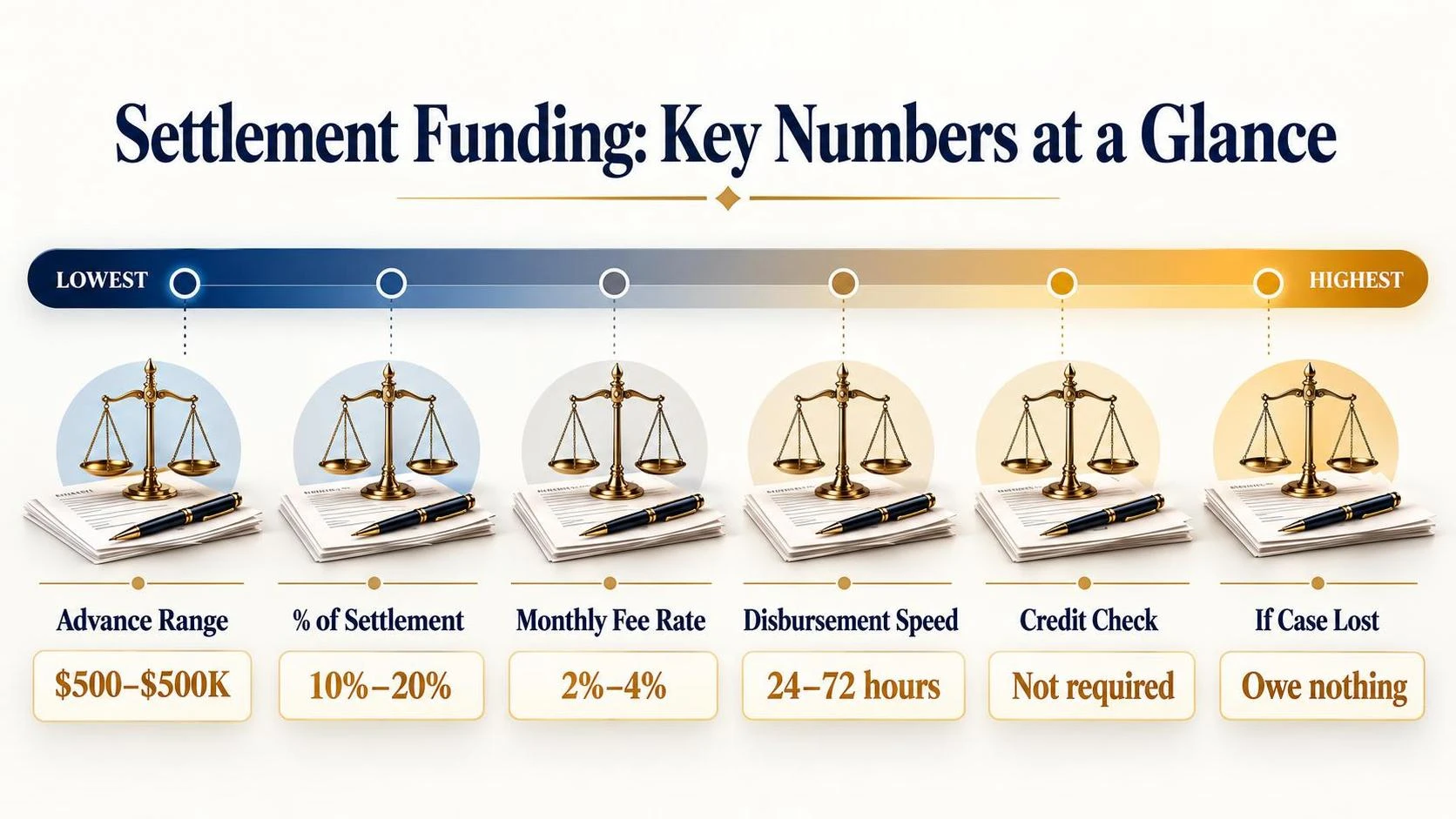
Funding amounts generally range from 10% to 20% of the estimated settlement value, according to the American Bar Association. Common case types include:
- Motor vehicle accidents
- Slip-and-fall and premises liability
- Medical malpractice
- Workers’ compensation disputes
- Employment discrimination and wrongful termination
- Product liability
Fee structures
Settlement funding companies charge fees that vary widely. Rates are typically expressed as monthly compounding percentages rather than annual percentage rates (APRs).
| Fee structure type | Typical range | Effective cost example (12 months) |
| Simple interest (non-compounding) | 2%–4% per month | $2,400–$4,800 on a $10,000 advance |
| Compounding interest | 2%–4% per month | $2,682–$6,010 on a $10,000 advance |
| Flat fee per period | Varies by company | Set at contract signing; no compounding |
Some states cap these rates. Arkansas limits non-recourse funding fees under its usury statute (Ark. Code § 4-57-104). Several other states, including Oklahoma and Nevada, have enacted specific pre-settlement funding disclosure laws.
Caution: Fees can multiply significantly on cases lasting multiple years. Plaintiffs should request a full payoff schedule before signing and have their attorney review all contract terms.

How pre-settlement funding works
Pre-settlement funding provides cash advances to plaintiffs awaiting lawsuit resolution. The transaction is non-recourse: if the plaintiff loses, repayment is typically not required. This distinguishes it from traditional loans.
The application process
Most funding companies follow a similar sequence from application to disbursement.
- Application: The plaintiff submits basic case details — case type, attorney information, and estimated settlement value.
- Attorney cooperation: The funder contacts the plaintiff’s attorney to review case documents, medical records, and liability assessments.
- Underwriting: The funder evaluates case merit, projected settlement size, and time to resolution. Creditworthiness and employment status are generally not considered, according to the American Bar Association.
- Offer and agreement: If approved, the company presents a funding contract specifying the advance amount and fee structure.
- Disbursement: Funds are typically delivered within 24–72 hours of signing, per industry disclosures from companies such as Oasis Financial and USClaims.
Typical funding ranges and costs
Advance amounts and fee structures vary widely by company, case type, and state regulation.
| Factor | Typical range |
| Advance amount | $500–$500,000 (source: USClaims, Oasis Financial published ranges) |
| Advance as % of expected settlement | 10%–20% (source: American Bar Association, 2020 report) |
| Annualized fee rates | 27%–60% non-compounding, per Consumer Financial Protection Bureau commentary |
| Typical repayment timeline | 12–36 months, depending on case duration |
Repayment mechanics
Repayment comes directly from the settlement proceeds. The attorney disburses the funder’s agreed-upon portion before paying the plaintiff.
If the case is lost or dismissed, the plaintiff generally owes nothing. This non-recourse structure shifts financial risk to the funding company.
Caution: Fee structures vary significantly among providers and are regulated differently by state. Plaintiffs should have their attorney review any funding agreement before signing and compare offers from multiple companies.
Rates cited above are general industry observations — verify current terms directly with the funder and check applicable state law.

Who qualifies for settlement funding
Settlement funding companies typically require applicants to have a pending legal claim and active attorney representation. Qualification hinges on case merit rather than credit history, distinguishing pre-settlement funding from conventional lending.
Core eligibility requirements
- Pending lawsuit or claim: The applicant must have an active, filed lawsuit or a documented insurance claim in progress.
- Attorney representation: Nearly all funders require the plaintiff to be represented by a licensed attorney who agrees to cooperate with the funding company.
- Minimum expected settlement value: Most companies set a floor—commonly $5,000 to $10,000 in anticipated recovery—before advancing funds, according to the American Legal Finance Association (ALFA).
- No prior liens consuming full value: If existing medical liens, prior funding advances, or attorney fees exhaust the projected recovery, funders will decline.
Factors that do not typically affect approval
Because pre-settlement funding is non-recourse—repaid only if the case succeeds—funders evaluate the claim, not the plaintiff’s finances.
| Factor | Traditional loan | Pre-settlement funding |
| Credit score | Required (typically 580+) | Generally not checked |
| Employment status | Required | Not required |
| Income verification | Required | Not required |
| Collateral | Often required | Claim proceeds serve as collateral |
| Repayment if case loses | Still owed | Nothing owed (non-recourse) |
Case types most commonly approved
Personal injury claims represent the largest share of funded cases. The U.S. Government Accountability Office (GAO) noted in a 2023 report that motor vehicle accidents and slip-and-fall cases dominate the consumer legal funding market.
- Motor vehicle accident lawsuits
- Premises liability (slip-and-fall)
- Medical malpractice claims
- Product liability cases
- Workers’ compensation disputes (where state law permits)
- Wrongful death claims
Caution: Qualification criteria vary by company and state. Some states regulate or restrict legal funding transactions. Applicants should consult their attorney before signing any funding agreement to understand fees, effective rates, and how an advance affects net recovery.

How settlement funding companies calculate costs
Settlement funding companies use a factor rate or compounding interest model rather than traditional APR-based lending. Understanding these cost structures helps plaintiffs evaluate whether an advance makes financial sense before signing a contract.
Factor rates vs. compounding fees
Most pre-settlement funding companies charge monthly rates typically ranging from 2% to 4% on a non-compounding basis, according to the American Bar Association. Some companies compound monthly, which significantly increases the total repayment amount over time.
| Funding Amount | Monthly Rate | Structure | Owed After 12 Months | Owed After 24 Months |
| $10,000 | 3.0% | Simple (non-compounding) | $13,600 | $17,200 |
| $10,000 | 3.0% | Compounding monthly | $14,258 | $20,328 |
| $10,000 | 2.0% | Simple (non-compounding) | $12,400 | $14,800 |
| $10,000 | 2.0% | Compounding monthly | $12,682 | $16,084 |
The difference between simple and compounding structures grows dramatically as case duration increases. A case lasting three or more years can result in the plaintiff owing double or triple the original advance.
Additional fees to examine
Beyond the stated rate, funding companies may add charges that raise the effective cost. Common fees include:
- Origination or processing fees — often 5% to 10% of the funded amount, deducted upfront
- Underwriting or case-evaluation fees — flat charges ranging from $250 to $500 at some companies
- Broker or referral fees — passed through when a third party connects the plaintiff to the funder
- Wire transfer or delivery fees — smaller charges typically under $50
These fees are not always disclosed prominently. The Consumer Financial Protection Bureau has noted that non-recourse funding agreements often fall outside standard lending disclosure requirements like the Truth in Lending Act (TILA).
Why costs vary by case type
Funders price risk based on case strength, expected duration, and settlement size. Personal injury cases with clear liability typically receive lower rates than complex litigation such as medical malpractice or employment discrimination claims.
Caution: Always request a full fee schedule and a written payoff table showing total amounts owed at 6-month intervals. Have your attorney review any funding agreement before signing. Rates and fee structures cited here are representative ranges — verify current terms directly with each company.

Settlement funding risks and repayment obligations
Settlement funding carries significant financial risks that plaintiffs must weigh before signing any agreement.
The non-recourse structure eliminates repayment if the case loses, but the cost of that protection is steep — effective annual rates often exceed 40%, according to the American Bar Association.
Compounding fees are the primary risk. Most funding contracts use compound interest, causing balances to grow rapidly over time.
| Funding Amount | Duration | Effective Rate (Typical Range) | Approximate Repayment Owed |
| $10,000 | 12 months | 27%–60% annually | $12,700–$16,000 |
| $10,000 | 24 months | 27%–60% annually | $16,129–$25,600 |
| $10,000 | 36 months | 27%–60% annually | $20,484–$40,960 |
Source: Rate ranges cited by the National Association of Consumer Advocates and Consumer Financial Protection Bureau complaint data. Exact rates vary by company and state.
Key risks to understand
- Balance can exceed the settlement. If a case takes three or more years and the award is modest, the funding payoff may consume most or all of the proceeds.
- Limited fee caps in most states. Only a handful of states — including Arkansas, Indiana, Maine, Nebraska, Oklahoma, Tennessee, and Vermont — have enacted statutes specifically regulating pre-settlement funding rates, per the National Conference of State Legislatures.
- Contract complexity. Some agreements layer origination fees, underwriting fees, and monthly maintenance charges on top of the stated rate, inflating the true cost.
- Reduced attorney leverage. A lien on the settlement can pressure attorneys to accept lower offers to clear the funding obligation, as noted by the New York City Bar Association in its 2020 report on litigation funding.
- No standardized disclosure. Unlike consumer loans governed by the federal Truth in Lending Act, most pre-settlement funding agreements are not required to disclose an APR, making comparison shopping difficult.
Repayment structure
Repayment comes exclusively from the settlement or judgment. If the plaintiff loses, the funder absorbs the loss entirely — this is the defining non-recourse feature.
If the plaintiff wins, the funder is paid from the gross settlement before the plaintiff receives any remaining balance, typically through the attorney’s escrow account.
Caution: Readers should have an attorney review any funding contract before signing. Request a written payoff schedule showing the total amount owed at six-month intervals so the compounding cost is transparent.

State rules for settlement funding companies
Settlement funding regulation varies dramatically by state. Some states impose strict disclosure requirements, fee caps, and licensing mandates, while others have minimal oversight. Understanding local rules is essential before signing any funding agreement.
States with dedicated settlement funding statutes
Several states have enacted laws specifically governing pre-settlement and post-settlement funding transactions. These statutes typically address disclosure, court approval, and consumer protections.
| State | Key Statute | Notable Requirement |
| New York | Judiciary Law §§ 489, General Obligations Law § 13-101 | Court approval required for transfers of structured settlement payment rights |
| California | Insurance Code § 10134 et seq. | Court must find transfer is in the consumer’s best interest; mandatory disclosures |
| Illinois | Structured Settlement Protection Act (215 ILCS 153) | Court approval required; payee must receive independent professional advice |
| Virginia | Code of Virginia § 59.1-200 (Consumer Protection Act) | Unfair or deceptive practices in funding transactions are prohibited |
| Ohio | R.C. § 2323.58 | Funding companies must register with the state; written disclosure of fees required |
| Oklahoma | Title 36 § 3662 et seq. | Mandatory 3-day right of rescission after signing |
Common regulatory requirements across states
- Disclosure obligations: Most states with funding statutes require companies to disclose the total dollar cost, effective annual rate, and amount the consumer will receive.
- Court approval: At least 47 states and the District of Columbia require court approval before structured settlement payment rights can be transferred, per the National Conference of Insurance Legislators (NCOIL) model act framework.
- Right of rescission: Multiple states mandate a cancellation window—commonly 3 to 5 business days—after the consumer signs the agreement.
- Attorney involvement: States such as Illinois and Maine require the consumer to obtain independent legal counsel before completing a transfer.
States with limited regulation
Some states lack statutes addressing pre-settlement funding directly. In those jurisdictions, general consumer protection and contract laws apply, offering fewer specific safeguards.
Caution: State laws change frequently. Readers should verify current statutes through their state legislature’s website or consult a licensed attorney before entering any settlement funding agreement. This article is informational and does not constitute legal advice.

What editors independently checked about settlement funding companies
Editors reviewed public filings, state regulatory databases, and consumer complaint records to evaluate major settlement funding companies. The findings below reflect data available as of early 2025.
Key metrics compared across major funders
| Company | Year Founded | BBB Rating | States Operated In | Typical Funding Range |
| Oasis Financial | 2003 | A+ | 39+ | $500–$100,000 |
| Peachtree Financial Solutions | 1996 | A+ | Nationwide (where permitted) | Varies by structured settlement value |
| USClaims | 1996 | A+ | 30+ | $500–$500,000 |
| Baker Street Funding | 2018 | A+ | Nationwide (where permitted) | $1,000–$500,000+ |
BBB ratings listed above were sourced directly from the Better Business Bureau’s online directory. Ratings can change; readers should verify current status at bbb.org.
What state regulation revealed
At least 30 states have enacted statutes regulating pre-settlement funding transactions, according to the American Legal Finance Association (ALFA). Most require court approval before structured settlement transfers proceed.
- States like Arkansas, Kentucky, and West Virginia have restricted or heavily regulated pre-settlement funding, per ALFA disclosures.
- The federal Structured Settlement Protection Act framework requires judicial review of structured settlement transfers in every state that has adopted it—currently all 50 states plus D.C., according to the National Structured Settlements Trade Association (NSSTA).
- Disclosed effective rates on pre-settlement funding can range widely. The New York Attorney General’s office has noted annualized rates exceeding 100% in some investigated cases.
Consumer complaint patterns
The Consumer Financial Protection Bureau (CFPB) does not directly regulate pre-settlement funding. However, state attorneys general have brought enforcement actions against companies charging undisclosed fees.
Editors found that companies with ALFA membership generally disclosed fee structures more consistently than non-members, based on a review of publicly available contract samples.
Caution: Effective costs vary dramatically by case duration. A funding advance held for 36 months will cost significantly more than one resolved in 6 months. Consumers should request a written total-cost disclosure before signing and consult an independent attorney.

How to compare settlement funding offers
Comparing settlement funding offers requires examining more than the upfront cash amount. The total repayment cost, fee structure, and contract terms vary significantly between companies and determine the true price of funding.
Focus on these critical comparison factors:
Effective rate and total repayment
Settlement funding uses non-recourse advances, not traditional loans. Companies typically charge rates expressed as monthly or annual percentages that compound over time.
| Rate Type | Typical Range | How It Works |
| Simple monthly rate | 2.0%–4.5% per month | Interest calculated only on principal |
| Compounding monthly rate | 2.0%–3.5% per month | Interest accrues on principal plus accumulated interest |
| Effective annualized cost | 27%–60% or higher | Total yearly cost after compounding, per the American Bar Association’s consumer-litigation-funding overview |
Caution: A lower monthly rate with compounding can cost more than a higher simple-interest rate. Always request the total payoff amount at 12, 18, and 24 months in writing before signing.
Fee transparency
Some funders add origination fees, processing fees, broker fees, or attorney-liaison charges that inflate the effective cost. The National Association of Settlement Purchasers (NASP) recommends full written disclosure of all charges before contract execution.
- Origination fees: Can range from $250 to $500 or a percentage of the advance
- Broker fees: Third-party brokers may add 5%–15% to total cost, according to reporting by the Consumer Financial Protection Bureau
- Case-monitoring fees: Monthly charges some companies assess while the case is pending
Contract terms to scrutinize
- Non-recourse confirmation: Verify in writing that you owe nothing if the case loses
- Cap on total repayment: Some contracts cap the maximum owed; many do not
- Attorney-acknowledgment requirement: Reputable funders require your attorney to review the agreement
- Right to rescind: Some states, including Arkansas and Indiana, mandate a cooling-off period — check your state’s statute directly
Caution: Rates, fees, and regulations vary by state. Readers should consult an attorney before signing any pre-settlement funding agreement to confirm current legal protections in their jurisdiction.

Alternatives to using settlement funding companies
Settlement funding is not the only option for plaintiffs who need cash before a case resolves. Several alternatives may carry lower costs or fewer risks, depending on the borrower’s circumstances and creditworthiness.
Personal loans from banks or credit unions
Traditional personal loans typically charge far less than pre-settlement funding. The table below compares approximate cost ranges.
| Funding type | Typical APR or effective annual cost | Requires credit check? |
| Bank/credit union personal loan | 8%–36% APR (Federal Reserve, 2024 average ~12% for 24-month loans) | Yes |
| Pre-settlement funding | 27%–60% annualized (varies by state; American Bar Association has noted rates exceeding 100% in some contracts) | No |
| Credit card cash advance | 20%–30% APR (Bankrate, 2024) | Existing account required |
| 401(k) hardship withdrawal | No interest; 10% early-withdrawal penalty + income tax (IRS rules) | No |
Borrowing from family or friends
Interest-free personal loans from relatives avoid compounding fees entirely. The IRS requires lenders to charge at least the Applicable Federal Rate—2.27% for short-term loans as of April 2025—or imputed interest rules apply.
Attorney fee deferral or attorney lending
Some plaintiffs’ attorneys advance litigation costs and defer fee collection until resolution. Bar ethics rules in most states permit this under Model Rule 1.8(e). Attorneys cannot charge interest on these advances in many jurisdictions.
Negotiating with creditors
Medical providers, landlords, and utilities sometimes accept hardship payment plans. Hospitals receiving federal funds are required under the Affordable Care Act (Section 501(r)) to offer financial assistance policies.
Government and nonprofit assistance
- SNAP and Medicaid — income-based federal programs that reduce living expenses during litigation.
- Low Income Home Energy Assistance Program (LIHEAP) — covers utility costs; funded at $4.1 billion for FY 2024 (HHS).
- Local legal aid societies — may connect plaintiffs with emergency grants.
Caution: Each alternative carries its own eligibility requirements and risks. Readers should consult a financial advisor or attorney before committing to any funding source, as individual circumstances vary significantly.

Frequently Asked Questions
What is a settlement funding company?
A settlement funding company purchases a portion of a plaintiff’s expected settlement or judgment in exchange for a lump-sum cash advance before the case resolves.
This transaction is technically a non-recourse purchase, not a loan, meaning the recipient owes nothing if the case loses—a distinction recognized by courts in states such as New York under the Echeverria v.
Estate of Lindner ruling (2005). Fees and effective annual rates vary widely, so applicants should request a full disclosure of all charges before signing.
How do settlement funding companies determine how much to advance?
Companies typically advance between 10% and 20% of the estimated gross settlement value, according to the American Legal Finance Association (ALFA).
The evaluation considers case type, defendant’s insurance coverage, liability strength, and estimated time to resolution. Attorneys are usually contacted to verify case details before an advance is approved.
Are settlement funding transactions regulated at the state level?
Yes, but regulation varies significantly.
As of 2024, states including Arkansas, Indiana, Maine, Nebraska, Nevada, North Carolina, Ohio, Oklahoma, Tennessee, Vermont, Virginia, and West Virginia have enacted consumer-protection statutes specifically governing pre-settlement funding.
Often requiring fee disclosures, a right-of-rescission period, and court or attorney approval.
Consumers should check their state attorney general’s office for current rules, because the regulatory landscape changes frequently.
What types of cases qualify for settlement funding?
Most companies fund personal-injury claims such as motor vehicle accidents, slip-and-fall incidents, medical malpractice, and product liability suits.
Workers’ compensation and employment-discrimination cases may also qualify at some firms. Cases with clear liability and adequate insurance coverage on the defendant’s side are generally considered the strongest candidates.
What fees should applicants watch for when choosing a settlement funding company?
Common charges include compounding interest or “use fees” that can produce effective annual rates ranging from roughly 27% to over 60%, according to a 2020 report by the Government Accountability Office (GAO-20-212).
Additional charges may include origination fees, underwriting fees, broker fees, and document-preparation costs.
Applicants should insist on a written contract showing the total repayment amount at multiple future dates so the true cost is transparent.
Does a plaintiff’s attorney need to approve a settlement funding transaction?
In most cases, yes.
Nearly all settlement funding companies require a letter of acknowledgment from the applicant’s attorney, and several state statutes—such as those in Indiana (IC 24-12) and Ohio (ORC §1349.55)—mandate attorney involvement or disclosure before the transaction can proceed.
Plaintiffs should discuss any proposed funding arrangement with their attorney to understand how the repayment obligation will reduce their net recovery at settlement.
Caution: Settlement funding costs can substantially reduce a plaintiff’s final payout. This article is for informational purposes only and does not constitute legal or financial advice. Readers should consult a licensed attorney and compare multiple funding offers before entering any agreement.