

The short answer: Lawsuit settlement funding provides cash against an expected legal recovery. Often structured as nonrecourse funding, it generally requires repayment only if you recover money, subject to contract terms.
Fees can substantially reduce your proceeds. Before signing, ask your attorney to review repayment conditions, total costs, and applicable state law.
Lawsuit Settlement Funding is a cash advance against a potential legal recovery, typically repaid from settlement proceeds. It can help plaintiffs cover living expenses while a case remains unresolved. Many agreements make repayment contingent on recovering money, but the contract determines the obligation.
The tradeoff is a smaller net payout if the case succeeds. Fees and charges can accumulate as litigation continues, and protections vary by state.
Before signing, ask your attorney to review repayment terms, explain what happens if you lose, and compare alternatives that could preserve more of your settlement.
What lawsuit settlement funding means
Lawsuit settlement funding provides cash advances to plaintiffs awaiting resolution of legal claims. The transaction is technically a non-recourse purchase of a portion of a future settlement, not a loan—meaning the plaintiff owes nothing if the case loses.
This distinction matters legally and financially. Because repayment depends on case outcome, most state regulators classify the transaction separately from consumer lending.
How the structure works
A funding company purchases an interest in a plaintiff’s pending settlement at a discount. The plaintiff receives immediate cash; the funder collects a larger sum when the case resolves.
The American Bar Association has noted that the non-recourse feature shifts financial risk from plaintiff to funder, which is why effective rates run higher than conventional credit products.
| Feature | Lawsuit Settlement Funding | Traditional Personal Loan |
| Repayment obligation | Only if case wins | Required regardless of outcome |
| Credit check required | Typically no | Yes |
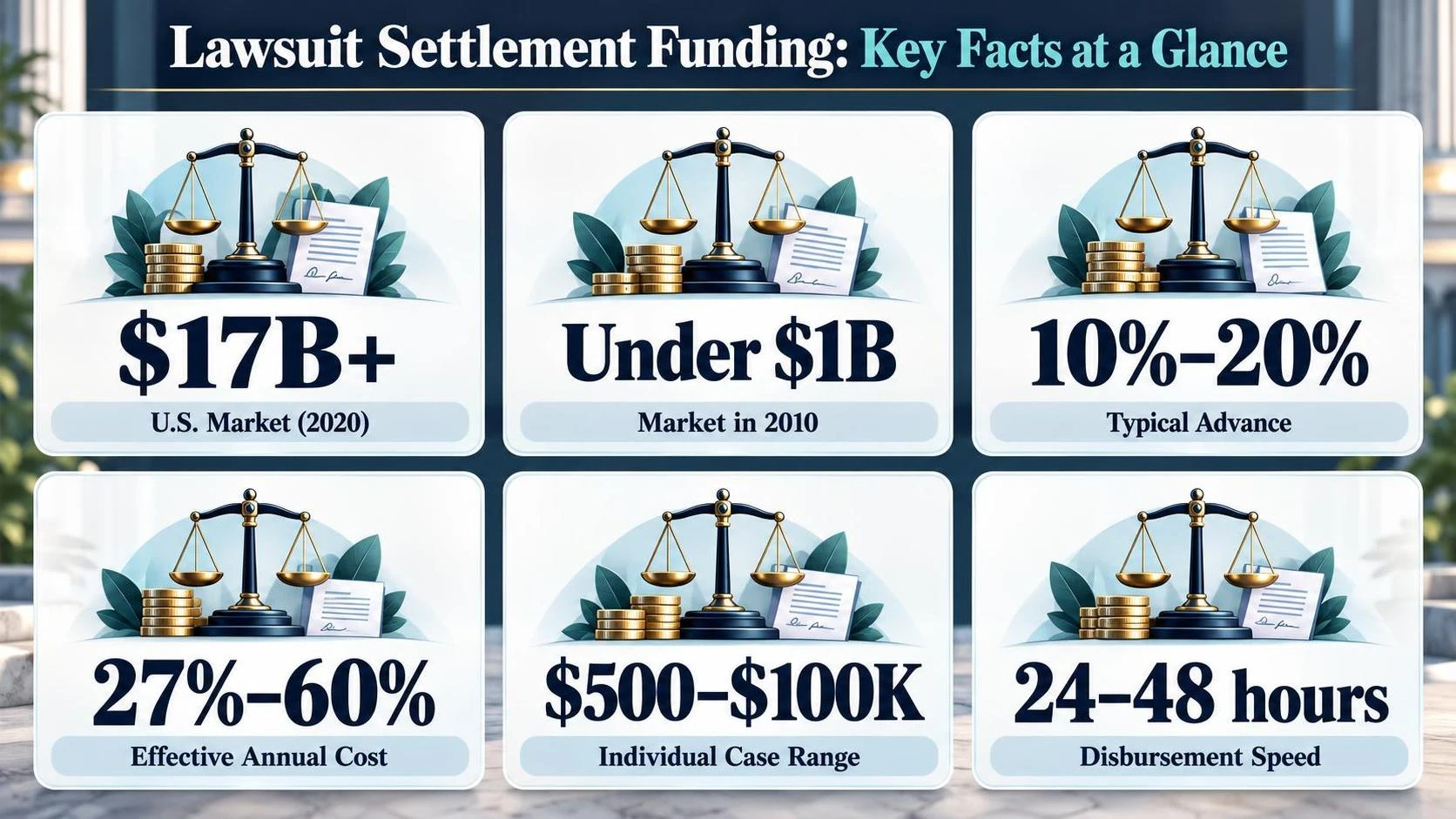
| Effective annual cost | Often 27%–60% annually (varies by state and funder) | 6%–36% APR (Federal Reserve data, 2024) |
| Collateral | Pending legal claim | Unsecured or asset-backed |
| Regulatory framework | State-specific; no uniform federal statute | TILA / state usury laws |
Common case types funded
- Personal injury (auto accidents, slip-and-fall, medical malpractice)
- Workers’ compensation claims
- Employment discrimination and wrongful termination
- Product liability
- Civil rights litigation
According to a 2020 report by Swiss Re, the U.S. litigation funding market exceeded $17 billion in deployed capital, reflecting rapid growth from under $1 billion in 2010.
Funding amounts typically range from $500 to $100,000 for individual consumer cases, though commercial litigation funding can reach millions, per industry data from the American Legal Finance Association (ALFA).
Caution: Effective costs vary dramatically between funders and states. Some states cap rates while others impose no limits. Plaintiffs should review the funding agreement with their attorney and verify total repayment amounts before signing.
Do not rely solely on this article—consult your attorney and your state’s consumer protection office.

How lawsuit settlement funding works
Lawsuit settlement funding provides plaintiffs a cash advance against the expected proceeds of a pending legal claim. The transaction is technically a non-recourse purchase of a portion of the future settlement, not a loan — meaning the plaintiff owes nothing if the case loses.
The application process
Most funding companies follow a similar sequence from application to disbursement:
- Application: The plaintiff submits basic case details — case type, attorney name, and estimated settlement value.
- Attorney cooperation: The funder contacts the plaintiff’s attorney to review case documents, medical records, and liability assessments.
- Underwriting: The funder evaluates the likelihood of a successful outcome and the probable settlement range. Approval hinges on case merit, not the applicant’s credit score or employment status.
- Funding offer: If approved, the company offers an advance — typically 10% to 20% of the estimated settlement value, according to the American Bar Association.
- Disbursement: Funds are usually delivered within 24 to 48 hours after the plaintiff signs the funding agreement.
Repayment structure
Repayment occurs only when the case resolves. The funder receives its principal plus fees directly from the settlement proceeds, disbursed through the plaintiff’s attorney.
| Feature | Lawsuit Settlement Funding | Traditional Personal Loan |
| Repayment trigger | Case settlement or verdict | Fixed monthly schedule |
| Recourse if case loses | None — plaintiff keeps the advance | Full repayment still required |
| Credit check required | No | Yes |
| Typical effective annual cost | 27%–60% (varies by state and provider) | 6%–36% APR (Consumer Financial Protection Bureau data) |
| Advance amount | 10%–20% of expected settlement | Based on creditworthiness |
Key cost consideration
Because cases can take years to resolve, compounding fees can consume a large share of the final settlement. Some states cap these rates — for example, Arkansas caps non-recourse funding costs under its usury laws — but many do not.
Caution: Effective costs vary widely by provider and jurisdiction. Plaintiffs should have their attorney review any funding agreement before signing, and compare multiple offers to understand total repayment obligations.

Who qualifies for lawsuit settlement funding
Lawsuit settlement funding—also called pre-settlement funding or lawsuit loans—is available to plaintiffs with pending lawsuits who have retained an attorney. Funding companies evaluate the merits of the case, not the applicant’s credit score or employment status.
Core eligibility requirements typically include:
- An active, pending lawsuit (not yet settled or dismissed)
- Legal representation by a licensed attorney
- A case with demonstrable liability and expected compensation
- The plaintiff must be 18 years of age or older
Credit history, income level, and employment status are generally irrelevant. The American Legal Finance Association (ALFA) confirms that funding decisions rest on case merit, not personal financial standing.
Case types that commonly qualify
| Case Type | Typical Qualification Rate |
| Motor vehicle accidents | High — clear liability documentation |
| Slip-and-fall / premises liability | High — when property owner negligence is evident |
| Medical malpractice | Moderate — requires expert medical review |
| Product liability | Moderate — depends on defect documentation |
| Workers’ compensation | Varies by state; some funders exclude these |
| Employment discrimination | Lower — harder to quantify expected damages |
Personal injury cases represent the largest share of funded lawsuits. Motor vehicle accident claims are the most frequently approved category, according to industry data reported by ALFA.
Common disqualifiers
- Cases without attorney representation
- Criminal matters (funding applies to civil litigation only)
- Class-action lawsuits where the plaintiff is not the lead party
- Cases with weak or disputed liability
- Claims in states that prohibit or heavily restrict litigation funding
Approval timelines vary. Many funding companies advertise decisions within 24–48 hours, though complex cases such as medical malpractice may take longer due to required documentation review.
Caution: Lawsuit settlement funding is non-recourse in most arrangements—meaning the plaintiff repays only if the case succeeds—but fees and interest-like charges can significantly reduce the final settlement amount.
Plaintiffs should review all contract terms with their attorney before accepting funds. State regulations on litigation funding vary; readers should verify current rules in their jurisdiction.

Lawsuit settlement funding fees and compounding costs
Lawsuit settlement funding costs significantly more than conventional borrowing. Because most providers use non-recourse agreements—repayment depends on winning the case—they charge higher rates to offset the risk of total loss on unsuccessful claims.
Rates typically range from 2% to 4% per month on a compounding basis, according to the American Bar Association. Some funders charge simple interest; others compound monthly, which dramatically increases the total repayment amount over time.
The following table illustrates how compounding affects a $10,000 advance at a 3% monthly compounding rate:
| Time Elapsed | Amount Owed | Effective Annualized Cost |
| 6 months | $11,941 | ~42.6% |
| 12 months | $14,258 | ~42.6% |
| 18 months | $17,024 | ~42.6% |
| 24 months | $20,328 | ~42.6% |
| 36 months | $28,983 | ~42.6% |
At 3% monthly compounding, a plaintiff could owe nearly three times the original advance after three years—a common timeline for complex litigation.
Beyond the interest rate, funders may charge additional fees:
- Origination or processing fees: Typically 1%–5% of the funded amount, deducted upfront from proceeds.
- Underwriting or case-evaluation fees: Some companies charge $250–$500 for reviewing case merits, though many have eliminated this fee to remain competitive.
- Broker fees: When a middleman connects the plaintiff to the funder, a separate commission may apply, further reducing net proceeds.
Several states have enacted rate caps. Arkansas limits rates to 17% per year under its constitutional usury provision. Oklahoma requires funding companies to register and cap rates at 3% per month simple interest, per 14A O.S. § 3614.
Consumer advocates, including the National Association of Consumer Advocates, recommend requesting a full fee schedule in writing before signing any agreement. Plaintiffs should compare at least three providers and confirm whether interest is simple or compounding.
Caution: Rates, fee structures, and state regulations vary widely. Readers should consult a licensed attorney before entering any pre-settlement funding agreement to understand total repayment obligations specific to their jurisdiction and case timeline.

Settlement funding repayment and unsuccessful lawsuits
Lawsuit settlement funding is structured as a non-recourse transaction, meaning the applicant owes nothing if the case loses. This distinguishes it from traditional loans and shifts the risk of an unsuccessful outcome entirely to the funding company.
How repayment works
Repayment occurs only when the case settles or receives a court award. The funding company is paid from the settlement proceeds before the plaintiff receives the remaining balance.
A typical repayment sequence follows this order:
- Attorney fees and litigation costs are deducted first (often 33%–40% on a contingency basis, according to the American Bar Association).
- The funding company’s principal plus accrued fees are deducted next.
- The plaintiff receives the remaining balance.
Cost accumulation over time
Funding rates compound, which means longer cases cost significantly more. The following example illustrates how a $10,000 advance grows at a rate of 3% per month, compounded monthly:
| Time elapsed | Total owed |
| 6 months | $11,941 |
| 12 months | $14,258 |
| 24 months | $20,328 |
| 36 months | $28,983 |
Rates vary by provider. The American Legal Finance Association (ALFA) reports that member companies typically charge between 2% and 4% per month, though non-member companies may charge more.
What happens if the lawsuit fails
If the case is dismissed, lost at trial, or settled for $0, the plaintiff repays nothing. The funding company absorbs the entire loss.
This non-recourse structure is confirmed by ALFA and codified in state consumer-protection statutes in jurisdictions such as Arkansas (Ark. Code § 4-57-109) and Oklahoma (Okla. Stat. tit. 14A, § 3-815).
Caution: Because compounding fees can consume a large share of a settlement, applicants should request a full fee schedule and calculate the total repayment amount at multiple time horizons before signing.
Consulting with the case attorney is strongly recommended, as some state laws require attorney acknowledgment of the funding agreement.

State laws governing lawsuit settlement funding
Lawsuit settlement funding is regulated at the state level, creating a patchwork of consumer protections. Some states impose strict disclosure requirements and fee caps, while others have minimal oversight of the industry.
As of 2024, more than 30 states have enacted or proposed legislation addressing litigation funding, according to the American Bar Association.
States with specific litigation funding statutes
| State | Key provision | Source |
| Arkansas | Caps annual rates; requires Attorney General registration | Ark. Code § 4-57-109 |
| Indiana | Requires plain-language disclosure of total charges | Ind. Code § 24-12 |
| Maine | Mandates a 5-business-day right to cancel without penalty | Me. Rev. Stat. tit. 9-A, § 12-104 |
| Nebraska | Caps funded amounts at the lesser of $500,000 or the expected settlement | Neb. Rev. Stat. § 25-3303 |
| Nevada | Requires registration with the state; mandates fee disclosures | Nev. Rev. Stat. § 81A |
| Oklahoma | Requires attorney acknowledgment before contract execution | Okla. Stat. tit. 14A, § 3-801 |
| Tennessee | Limits charges; requires Department of Commerce registration | Tenn. Code § 47-16-110 |
| Vermont | Mandates a 5-business-day rescission period | Vt. Stat. Ann. tit. 8, § 2251 |
Common regulatory requirements across states
- Right to cancel: Many states require a cooling-off period of 3 to 5 business days after signing.
- Attorney involvement: Several statutes require the plaintiff’s attorney to review and acknowledge the funding agreement.
- Fee disclosure: Itemized cost breakdowns must be presented before the consumer signs.
- Non-recourse confirmation: Contracts must state the consumer owes nothing if the case is lost.
Some states—including New York and New Jersey—have addressed litigation funding primarily through court rulings and attorney ethics opinions rather than dedicated statutes.
Caution: State laws change frequently. Consumers should verify current statutes through their state legislature’s website or consult a licensed attorney before entering any funding agreement.

How to compare lawsuit settlement funding contracts
Lawsuit settlement funding contracts vary widely in cost structures, fee schedules, and repayment terms. Reading every line before signing is critical because compounding rates can multiply the total owed far beyond the original advance.
Key contract terms to compare
The single most important variable is the funding rate structure. Contracts use either compounding or non-compounding (simple) interest, and the difference is substantial over time.
| Rate Structure | $10,000 Advance | Owed After 12 Months | Owed After 24 Months | Owed After 36 Months |
| Simple rate: 3% per month | $10,000 | $13,600 | $17,200 | $20,800 |
| Compounding rate: 3% per month | $10,000 | $14,258 | $20,328 | $28,983 |
As the American Bar Association has noted, compounding rates in pre-settlement funding can cause total repayment amounts to exceed the plaintiff’s net recovery.
Contract provisions to scrutinize
- Rate type: Confirm whether the rate is simple or compounding and whether it is monthly or annual.
- Rate caps: Some contracts cap total repayment at a multiple of the advance — commonly 2× to 3×. Contracts without caps carry the highest cost risk.
- Origination and processing fees: Upfront fees of $200–$500 or more reduce the net cash received but may still accrue interest as part of the funded balance.
- Attorney liens and priority: Verify whether the funder’s lien is subordinate to attorney fees or takes first position.
- Buyout or refinancing terms: Some contracts impose penalties if a competing company pays off the balance.
- Non-recourse language: Confirm the contract explicitly states the plaintiff owes nothing if the case is lost.
Steps before signing
Request a written total-cost schedule showing the amount owed at 6, 12, 18, 24, and 36 months. Compare identical advance amounts across at least three funding companies.
Have the plaintiff’s attorney review the contract. Several states — including Arkansas, Indiana, Maine, Nebraska, Oklahoma, and Vermont — have enacted statutes regulating pre-settlement funding disclosures, according to the National Conference of State Legislatures.
Caution: Contract terms in this article are illustrative. Actual rates, fees, and caps differ by company and jurisdiction. Consult a licensed attorney before signing any funding agreement.

What editors independently reviewed about settlement funding
Independent financial editors and consumer advocacy organizations have scrutinized the lawsuit settlement funding industry for years. Their findings highlight both legitimate benefits for plaintiffs and significant cost concerns that applicants should understand before signing any contract.
The U.S. Government Accountability Office (GAO) has noted that lawsuit funding is not classified as a loan in most states because repayment is contingent on the case outcome.
Key findings from independent reviews
- Consumer Financial Protection Bureau (CFPB): Has acknowledged that pre-settlement funding falls outside federal lending regulations in most circumstances, leaving oversight primarily to individual states.
- American Bar Association (ABA): Published formal ethics opinions permitting litigation funding while cautioning attorneys to ensure clients understand the cumulative cost of funding agreements.
- National Association of Insurance Commissioners (NAIC): Has raised concerns that high funding costs can substantially reduce plaintiffs’ net settlement proceeds.
Typical rate structures reported by industry sources
Rates vary widely by provider, state regulation, and case type. The following table reflects ranges commonly cited by consumer finance researchers and legal publications.
| Funding feature | Commonly reported range | Source basis |
| Monthly fee or rate | 2%–4% per month (non-compounding varies) | Consumer advocacy reviews |
| Effective annualized cost | 24%–60% annually | Legal industry analyses |
| Typical advance amount | 10%–20% of estimated settlement value | Industry disclosures |
| Average funding turnaround | 24–48 hours after approval | Provider-reported data |
Some states have enacted rate caps. Arkansas, for example, limits rates under its consumer protection statutes. Readers should verify current caps with their state attorney general’s office.
What reviewers consistently emphasize
- Compounding versus simple interest structures dramatically affect total repayment amounts.
- Plaintiffs should request a full payoff schedule showing costs at 6, 12, 18, and 24 months.
- No legitimate funding company requires upfront fees before disbursement.
- Attorney involvement in reviewing contracts is strongly recommended by every major consumer advocacy source.
Caution: Rates and regulatory protections differ significantly by state. Do not rely solely on general ranges. Consult a licensed attorney and verify terms directly with your state’s consumer protection agency before accepting any funding agreement.

Alternatives to lawsuit settlement funding
Lawsuit settlement funding is not the only option for plaintiffs facing financial pressure during litigation. Several alternatives may offer lower costs or fewer strings attached, depending on individual circumstances and creditworthiness.
Personal loans
Traditional personal loans from banks or credit unions typically charge far less than pre-settlement funding. Borrowers repay regardless of case outcome, however.
| Option | Typical cost range | Repayment requirement |
| Pre-settlement funding | 27%–60% annualized (varies by state; source: NCLC, 2020) | Non-recourse — repay only if you win |
| Personal loan (bank/CU) | 8%–18% APR (Federal Reserve, 2024 average 12.35%) | Must repay regardless of case outcome |
| Credit card cash advance | 20%–30% APR plus fees (Bankrate, 2024) | Must repay regardless |
| Home equity line (HELOC) | 8%–10% APR (Bankrate, Q1 2024) | Must repay; home used as collateral |
Attorney fee advancement
Some attorneys advance living expenses to clients during litigation. State bar rules vary significantly — many jurisdictions restrict this practice under professional conduct rules (ABA Model Rule 1.8(e)).
Negotiating with creditors
Plaintiffs can request hardship deferrals from mortgage servicers, medical providers, or credit card issuers. Many hospitals offer financial assistance programs mandated under IRS Section 501(r) for nonprofit facilities.
Community and nonprofit assistance
- Legal aid societies — may cover basic needs for qualifying low-income plaintiffs
- United Way 211 helpline — connects callers to local rent, utility, and food assistance
- State crime victim compensation funds — available in all 50 states for violent-crime victims, according to the Office for Victims of Crime (OVC)
401(k) or retirement account loans
The IRS allows 401(k) plan loans up to $50,000 or 50% of the vested balance, whichever is less (IRC §72(p)). Interest is paid back to the borrower’s own account, but early separation from an employer can trigger taxes and penalties.
Caution: Each alternative carries distinct risks — collateral loss, tax consequences, or credit damage. Readers should consult a licensed financial adviser or attorney before committing to any funding source.

Frequently Asked Questions
What is lawsuit settlement funding?
Lawsuit settlement funding—also called pre-settlement funding or lawsuit cash advances—is a transaction in which a funding company advances money to a plaintiff against the expected proceeds of a pending legal claim.
Unlike a traditional loan, repayment is typically contingent on the case’s outcome: if the plaintiff loses, most funding agreements require no repayment, a feature the American Bar Association has described as “non-recourse” financing.
Readers should carefully review any funding contract, because terms and fee structures vary significantly between providers.
How much does lawsuit settlement funding cost?
Funding companies generally charge fees expressed as a monthly or annual rate applied to the advanced amount, with rates commonly ranging from roughly 2% to 4% per month according to industry disclosures reviewed by the Consumer Financial Protection Bureau (CFPB).
Because these charges compound over time, a case that takes two or more years to resolve can result in total payback amounts that exceed double the original advance.
Plaintiffs should request a full fee schedule and a payoff table showing costs at multiple time intervals before signing.
Is lawsuit settlement funding regulated?
Regulation varies by state.
As of 2024, states including Arkansas, Indiana, Maine, Nebraska, Nevada, Oklahoma, Tennessee, Vermont, and Wisconsin have enacted statutes specifically governing consumer litigation funding, often imposing disclosure requirements or fee caps, according to the American Legal Finance Association (ALFA).
Some states classify these transactions as purchases of a legal claim rather than loans, which can exempt them from usury laws. Consumers should check their state attorney general’s website for current rules.
Who qualifies for lawsuit settlement funding?
Funding companies evaluate the merits and expected value of the underlying legal claim rather than the applicant’s credit score or employment status.
Common qualifying case types include personal injury, motor vehicle accidents, workers’ compensation, and employment discrimination suits.
The plaintiff’s attorney typically must cooperate by providing case documentation, and the funder’s underwriting team assesses the likelihood and projected size of a settlement or verdict.
How long does it take to receive funds after approval?
Most funding companies advertise approval and disbursement within 24 to 48 hours after receiving the necessary case documents from the plaintiff’s attorney, according to ALFA member disclosures.
In practice, the timeline depends on how quickly the attorney responds to the funder’s requests for medical records, demand letters, and case status updates. Funds are usually delivered via wire transfer, direct deposit, or check.
What happens if the plaintiff loses the case?
Under a standard non-recourse funding agreement, the plaintiff owes nothing to the funding company if the case is lost or dismissed without a recovery, as confirmed by multiple state litigation-funding statutes and the CFPB’s 2022 market overview.
This shifts the risk of an unfavorable outcome to the funder.
However, some contracts contain exceptions or partial-recourse clauses, so plaintiffs should have their attorney review the agreement’s “no-win, no-pay” language before accepting an advance.
Caution: Lawsuit settlement funding is a complex financial transaction with potentially high costs. This article is for informational purposes only and does not constitute legal or financial advice. Consult a licensed attorney and an independent financial advisor before entering any funding agreement.
Related Reading
- Embracing New Beginnings: Onder Law Firm Break Up Guide
- Nova Legal Funding Reviews
- Pre Settlement Funding Buyout
- Pre Settlement Funding Reviews
- Settlement Loan Companies
- Guaranteed Pre-settlement Funding
- Tribeca Group Review
- Best Pre Settlement Loans
- High Rise Financial Reviews – What You Need to Know
- All Pre-Settlement Funding Guides
- Consumer Financial Protection Bureau (2020)
- New York City Bar Association (2020)
- U.S. Government Accountability Office (2023)
- Cornell Law School Legal Information Institute (2024)
- American Bar Association (2020)
- National Conference of State Legislatures (2021)
- Duke Law School – Center for Judicial Studies (2019)
- IRS – Publication 525, Taxable and Nontaxable Income
- Federal Trade Commission – Consumer Advice