

Quick answer: Structured settlement annuity is an insurance-company contract that pays injury or lawsuit settlement money in scheduled installments instead of one lump sum.
Payments are usually tax-free for physical injury cases under IRS rules, can be fixed for years or life, and are difficult to change once court-approved.
A structured settlement annuity is an insurance contract that funds court-approved or negotiated injury settlement payments over time instead of one lump sum.
It is commonly used after personal injury, medical malpractice, or wrongful-death claims to provide scheduled income, often with tax treatment tied to Internal Revenue Code Section 104(a)(2).
This article explains how payments are created, assigned, protected, taxed, and sometimes sold through a court-approved factoring transaction.
Do not rely on this overview as legal, tax, or financial advice; payment rights, transfer rules, and protections depend on the settlement documents, insurer, state law, and court findings.
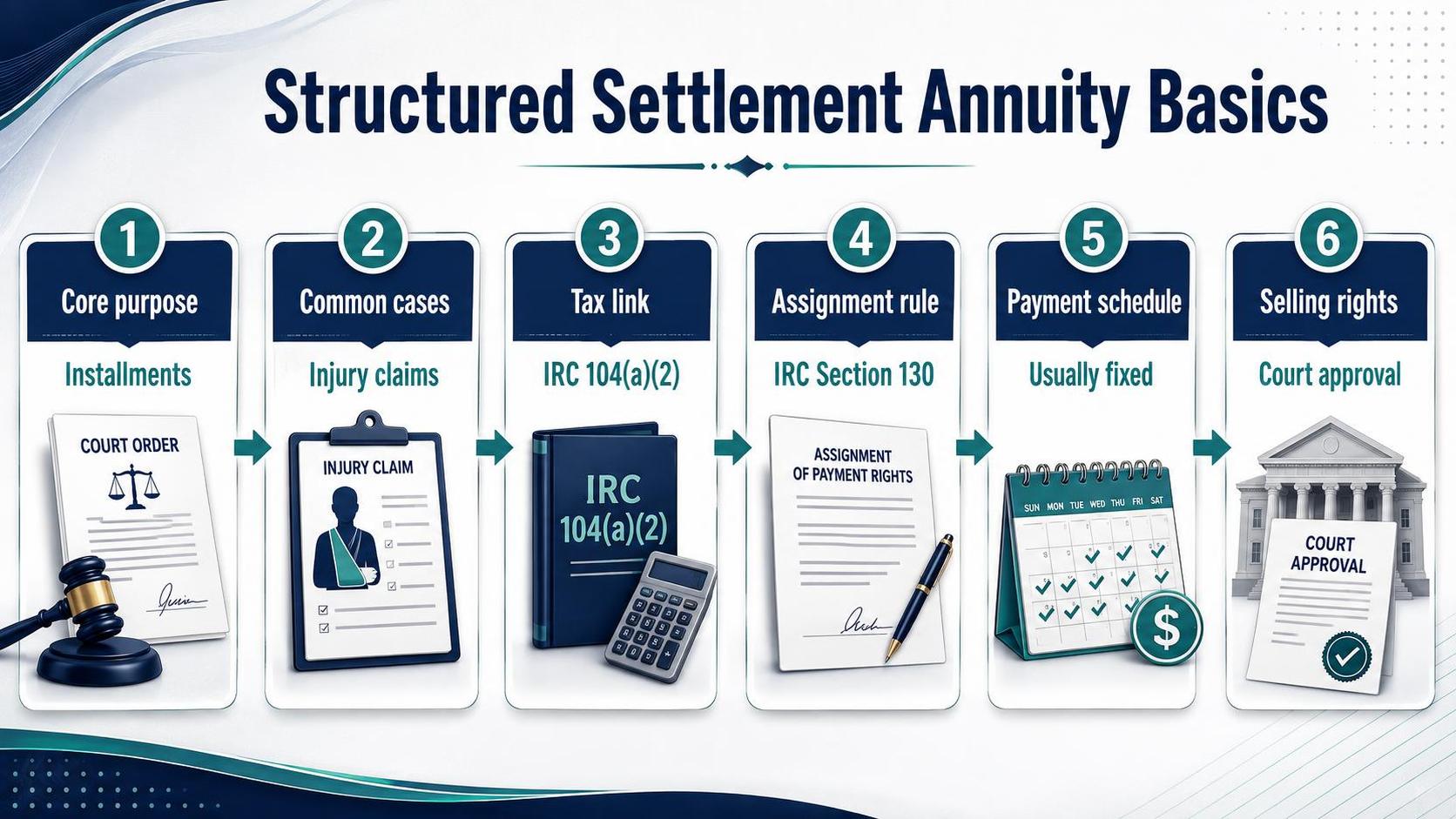
How structured settlement annuities work
A structured settlement annuity turns part or all of a legal settlement into scheduled future payments.
It is commonly used in personal injury and wrongful death cases because federal tax law can let qualifying payments stay free of federal income tax.
The structure is set when the case settles. After that, the payment stream is usually fixed, so the timing and amount matter as much as the total dollar figure.
In a typical case, the defendant or its insurer agrees to settle the claim. Instead of paying the full amount in cash to the claimant, the payor often makes a one-time payment to an annuity issuer through a qualified assignment.
Internal Revenue Code Section 130 governs qualified assignments, and Section 104(a)(2) excludes damages received on account of personal physical injuries or physical sickness from gross income, subject to the statute’s limits and exceptions.
The modern framework comes from the Periodic Payment Settlement Act of 1982, which amended the tax code to support periodic-payment settlements.
In practice, the annuity issuer then becomes responsible for making the scheduled payments promised in the settlement documents.
| Step | What happens | Primary source |
| 1 | The parties sign a settlement agreement that states the payment schedule. | Settlement contract; terms vary by case. |
| 2 | The defendant or insurer funds the obligation, often through a qualified assignment. | 26 U.S.C. Section 130. |
| 3 | A life insurer issues an annuity to match the promised payments. | Insurer contract; state insurance regulation applies. |
| 4 | The claimant receives periodic payments such as monthly income, lump sums, or both. | 26 U.S.C. Section 104(a)(2), if the claim qualifies. |
Payment designs can be customized. Common formats include monthly payments for living expenses, larger lump sums for future medical care, and delayed payments for college or retirement.
The schedule can start immediately or years later, depending on the settlement terms.
Once issued, the annuity usually cannot be accelerated or rewritten by simple request.
A person who wants cash sooner may try to sell payment rights, but those transfers generally require court approval under state structured settlement protection laws. Check the exact statute and procedure in the relevant state before acting.
- Tax treatment depends on the claim type and settlement wording. Review the settlement agreement and the tax code, not summaries alone.
- Insurer claims-paying ability matters because future payments depend on the issuing company’s obligations and applicable guaranty protections.
- Selling payments can sharply reduce the amount received today. Compare the transfer documents and court filings carefully before signing.

Payment options and payout schedules
A structured settlement annuity can pay in several patterns, not one standard format.
The schedule is negotiated in the settlement agreement, then funded through an annuity that an insurer issues under Internal Revenue Code sections 104(a)(2) and 130, the federal tax framework most structured settlements use.
Common options include monthly income, delayed future payments, and larger one-time payments at set dates. The right pattern depends on the injury, age, expected care costs, and whether court approval is required for any later transfer of payments.
The most common schedule is level periodic payments. That means the payee receives the same amount each month, quarter, or year for a fixed term or for life, depending on the contract language and settlement design.
Another option is a deferred start. Payments can begin years later, often to match college costs or retirement, while the annuity is purchased at settlement.
The National Structured Settlements Trade Association describes this as using future payments to meet known future needs.
Many settlements also use lump-sum installments. These are larger payments scheduled for specific years, often called “balloon” or “milestone” payments, while regular monthly income continues in between.
| Option | How it works | Typical use |
| Level monthly payments | Same amount every month for a set term or life | Budgeting for housing, food, and routine care |
| Deferred payments | No payment now; income starts on a future date | College, retirement, or later medical needs |
| Lump-sum installments | Larger payments at preset dates | Vehicle replacement, home modification, debt payoff |
| Increasing payments | Payments rise by a fixed percentage if written into the settlement | Inflation-sensitive long-term expenses |
| Life-contingent payments | Payments continue for the injured person’s lifetime | Permanent disability or lifetime care planning |
Tax treatment is a major reason schedules matter. Qualified damages for personal physical injuries or physical sickness are generally excluded from gross income under IRS Publication 4345 and Internal Revenue Code section 104(a)(2).
That treatment can be lost if a person later sells payments without understanding the consequences.
State transfer laws add another layer. According to the National Conference of State Legislatures, states enacted structured settlement protection acts to require court review before payment rights are sold.
That review is meant to test whether a transfer is in the seller’s best interest.
Caution: a payout schedule is hard to change after settlement.
Before agreeing to monthly amounts, start dates, or future lump sums, the reader should review the settlement agreement, annuity contract, and state transfer law with a qualified attorney or tax adviser.
Because mistakes can be costly and sometimes irreversible.

Tax treatment under federal law
Federal tax treatment of a structured settlement annuity depends first on why the settlement was paid.
When periodic payments resolve a claim for personal physical injuries or physical sickness, the payments are generally excluded from gross income under Internal Revenue Code Section 104(a)(2), according to the Internal Revenue Service and the U.S. Code.
That exclusion is the core tax benefit. If the arrangement meets federal rules, the recipient usually does not report each periodic payment as taxable wages, interest, or investment income.
Structured settlements are commonly set up through a “qualified assignment.” Under IRC Section 130, a defendant can assign the payment obligation to an assignment company.
And the assignee’s exclusion is capped at the “cost of any qualified funding asset,” usually an annuity contract, as stated in 26 U.S.C. 130(d).
The tax result changes when the underlying claim is outside Section 104(a)(2).
The IRS states in Publication 4345 that damages for emotional distress alone are generally taxable, except for amounts paid for medical care attributable to that emotional distress.
Punitive damages are generally taxable, even in personal injury cases, under IRC Section 104(a)(2).
| Federal rule | Source | Tax effect |
| Exclusion for damages received on account of personal physical injuries or physical sickness | 26 U.S.C. 104(a)(2) | Periodic payments are generally excluded from gross income |
| Qualified assignment treatment | 26 U.S.C. 130 | Supports structured settlement funding through an annuity |
| Tax on factoring transactions without proper approval | 26 U.S.C. 5891 | Imposes a 40% excise tax on the purchaser of payment rights unless the transfer qualifies under federal and state rules |
Federal law also discourages unapproved sales of structured settlement payment rights.
IRC Section 5891 imposes a 40% excise tax on the “factoring discount” in a transfer, unless the transfer is approved in advance in a qualified court order that complies with state structured settlement protection law.
For recipients, that does not mean every sale is tax-free or risk-free. Selling future payments can change cash flow, reduce total value, and involve legal approval. Acting on general tax summaries alone can be harmful.
- Check whether the original settlement involved personal physical injury or physical sickness.
- Review whether any part of the recovery was for punitive damages, interest, or non-physical claims.
- Verify transfer rules in the state court order and the text of 26 U.S.C. 5891 before selling payments.
If the settlement documents are unclear, the safest next step is to review the release, annuity contract, and court papers with a qualified tax professional. Federal tax outcomes turn on the actual claim language, not only on the payment schedule.

Court approval for selling payments
Selling structured settlement payments usually requires a judge’s approval before money changes hands.
The main reason is federal tax law: Internal Revenue Code Section 5891 imposes a 40% excise tax on a transfer unless it is approved in a qualified order under a state structured settlement protection law.
That court review is not a formality.
Judges generally examine whether the sale is in the payee’s best interest, taking into account the welfare and support of dependents.
A standard used across state Structured Settlement Protection Acts and reflected in the National Conference of Insurance Legislators model law.
The buyer typically files a petition in state court and must disclose the financial terms before the hearing.
Under the NCOIL Model Structured Settlement Protection Act, the disclosure statement must be delivered at least 10 days before the payee signs a transfer agreement.
Many states also require the payee to receive notice of the hearing and the sale terms in advance. Deadlines and required recipients vary by state, so the payee should check the exact statute or court rules where they live before signing anything.
| Requirement | Specific fact | Source |
| Federal tax penalty without proper approval | 40% excise tax on the factoring company for an unapproved transfer | Internal Revenue Code Section 5891(a) |
| Advance disclosure timing in model law | At least 10 days before signing the transfer agreement | NCOIL Model Structured Settlement Protection Act |
| FTC cooling-off benchmark for door-to-door sales | 3 business days, often cited for comparison, but not a substitute for state SSPA rights | Federal Trade Commission Cooling-Off Rule, 16 C.F.R. Part 429 |
At the hearing, the judge may ask why the sale is necessary, whether cheaper credit was explored, and how much of the settlement income will remain afterward.
Some courts also scrutinize the discount rate, fees, and whether the payee had independent professional advice.
This matters because a structured settlement often funds long-term medical care or living expenses. Once a transfer is approved and completed, the loss of future payments can be hard or impossible to reverse.
A payee should not rely on a buyer’s summary alone.
- Read the disclosure statement line by line.
- Compare the gross payments sold with the net amount actually received.
- Ask the court clerk or a lawyer about local filing and hearing rules.
- Check whether dependents rely on the payments for housing, care, or support.
Caution: court approval does not guarantee a good financial deal. It means the transfer met the legal standard presented to the judge. Before acting, verify the state statute, review the contract, and consider independent legal or financial advice.

Risks before transferring annuity rights
Selling structured settlement annuity payment rights can create a permanent cash shortfall. The main risk is simple: the buyer pays less today than the scheduled payments are worth over time, and the court process does not guarantee a good price.
Another risk is legal and tax complexity. A transfer changes rights that were originally set up to protect long-term injury compensation, so a reader should not rely on a quote or contract summary alone.
The first risk is loss of long-term income. Structured settlements are designed to convert injury proceeds into scheduled payments, often funded with an annuity, under rules in Internal Revenue Code Sections 104(a)(2) and 130.
Those sections support tax-favored treatment for qualifying arrangements, according to the Internal Revenue Code.
When payment rights are sold, the buyer typically applies a discount rate and fees, reducing the upfront cash.
The exact reduction varies by transaction, so a reader should demand a full disclosure statement and compare the gross payments being sold with the net amount actually received.
A second risk is that court approval focuses on minimum legal standards, not bargain hunting.
Under 26 U.S.C. Section 5891, a transfer generally must receive a qualified court order that finds the deal is in the seller’s best interest and considers dependents’ welfare.
A third risk is irreversible loss of future flexibility. Once specific payments are assigned, those payments may no longer be available for rent, medical costs, or later emergencies.
That matters because structured settlements are often intended to replace earning capacity over many years.
| Figure | What it means | Source |
| 40% | Federal excise tax imposed on the purchaser in a transfer that does not receive a qualified order under the structured-settlement transfer rules. | 26 U.S.C. Section 5891(a) |
| Best interest + dependents | The court must find the transfer is in the payee’s best interest, taking into account the welfare and support of dependents. | 26 U.S.C. Section 5891(c)(3)(A) |
| 0 immediate tax on qualifying injury damages | Qualifying damages for personal physical injuries or physical sickness are excluded from gross income, which is part of why preserving the original structure can matter. | 26 U.S.C. Section 104(a)(2) |
There is also a documentation risk. Anti-assignment language, prior liens, child-support claims, or conflicting beneficiary terms can delay or block a sale. Missing one issue can waste time and add costs without producing cash.
Plain caution: do not sign a transfer agreement based only on the advance amount. Review the full payment schedule, effective discount, fees, and court filings, and have a qualified attorney or tax professional review the deal before acting.

How buyout offers are priced
A structured settlement annuity buyout is usually priced by discounting future payments back to a lump-sum value today.
The two biggest drivers are time and the discount rate, because money due years from now is worth less today and the buyer adds profit, administrative cost, and risk.
Buyers start with the payment stream, not the annuity’s original premium. They total the payments being sold, map each payment by date, then apply a present-value calculation to each one.
Federal law also matters: a transfer company generally needs a court order, or it faces a 40% excise tax under 26 U.S.C. Section 5891.
The discount rate is the key pricing lever.
State transfer disclosures commonly require the buyer to show the “discounted present value,” the “discount rate,” and itemized fees, because a small rate change can materially alter the payout.
A higher rate means a lower offer.
| Illustrative payment sold | Discount rate used | Present value today | Math basis |
| $10,000 due in 3 years | 4% | $8,890 | $10,000 / (1.04)^3 |
| $10,000 due in 3 years | 8% | $7,938 | $10,000 / (1.08)^3 |
| $10,000 due in 3 years | 12% | $7,118 | $10,000 / (1.12)^3 |
Those figures are mathematical illustrations, not market quotes. They show the time-value method used in finance: present value equals future cash divided by (1 + rate) raised to the number of years.
The calculation itself is standard finance math; the legal disclosure items come from state Structured Settlement Protection Acts and court-review practice.
Offers may be reduced further by direct transaction costs. Many state disclosure forms require separate line items for commissions, processing charges, legal costs, or other administrative expenses if they apply.
That is why two companies can quote different lump sums for the same payment stream.
- Longer wait for payment usually lowers today’s value.
- Higher discount rates usually lower the offer faster than many sellers expect.
- Selling only part of the stream can preserve later income, but the pricing still depends on timing and rate.
Caution: do not judge an offer by the lump sum alone. Compare the gross amount, discount rate, net amount after fees, and the payments being given up, and check the court disclosure package and the governing state statute before signing.

What the editorial team reviewed
This section reflects a document review, not a hands-on purchase or sale of a structured settlement annuity.
A reader could lose money by acting on sample pricing or legal summaries alone, so every figure below should be checked against the original court papers, annuity contract, and state transfer law.
The editorial team reviewed the primary rules that shape how these annuities are created, taxed, and transferred. The goal was to verify how a structured settlement annuity works on paper before discussing value, liquidity, or sale options.
The review centered on four source groups: federal tax law, federal settlement law, a state transfer-law compilation, and insurer financial-strength references.
It also checked standard definitions against Consumer Financial Protection Bureau material to avoid using sales language in place of legal or financial terms.
| Source type | What the editorial team checked | Key fact verified |
| Federal tax law | Internal Revenue Code Section 104(a)(2) | Damages received on account of personal physical injuries or physical sickness can be excluded from gross income, subject to the statute and facts of the case. Source: Internal Revenue Code, Cornell Law School Legal Information Institute. |
| Federal settlement law | 26 U.S.C. Section 5891 | A transfer of structured settlement payment rights can trigger a 40% federal excise tax unless the transfer is approved in a qualified order under an applicable state structured settlement protection act. Source: U.S. Code, Legal Information Institute. |
| State-law reference | National Conference of State Legislatures compilation | States widely use structured settlement protection acts requiring court approval before payment rights are transferred. Source: NCSL 50-state resource. |
| Insurance solvency reference | State guaranty association and insurer-rating materials | Coverage limits vary by state, so no single dollar figure was treated as universal. Source: National Organization of Life & Health Insurance Guaranty Associations and state guaranty association materials. |
The editorial team also checked how the annuity is typically positioned in a settlement.
In a standard structure, the claimant usually receives a stream of future payments funded by an annuity issued by a life insurer, while the settlement obligation is often assigned to a qualified assignee.
Source: 26 U.S.C. Section 130 and insurer educational materials.
- The review did not estimate a universal discount rate for selling payments, because rates vary by buyer, payment schedule, credit assumptions, and state approval costs.
- The review did not treat insurer ratings as guarantees. Ratings can change, and state guaranty coverage limits are not identical across states.
- The review treated court approval as essential, not optional, because state transfer laws and federal tax rules interact.
Next step: compare the annuity contract, settlement agreement, and any transfer disclosure side by side. If numbers conflict, rely on the signed documents and the court order, then confirm tax questions with a qualified attorney or tax professional.

Questions to ask before signing
A structured settlement annuity can lock in income for years or decades. Before signing, ask who will issue the annuity, how payments are timed, and what rights can and cannot be changed later.
These questions matter because many terms become hard to reverse. Acting on a summary alone can be risky; the payee should read the settlement agreement, annuity contract, and any court order before signing.
1. Are the payments tax-free, and why? Periodic payments for physical injury or physical sickness are generally excluded from gross income under Internal Revenue Code Section 104(a)(2).
Qualified assignments used to fund many structured settlements are addressed in Internal Revenue Code Section 130.
2. Who is the annuity issuer, and what is its financial strength? Ask for the exact insurer name, not only the broker or settlement planner. Then verify current financial-strength ratings directly with A.M.
Best, S&P Global Ratings, Moody’s, or Fitch, because ratings can change.
3. What is the exact payment schedule? Confirm the start date, frequency, amount, duration, and any lump sums. A one-page summary is not enough; the signed settlement papers should match the annuity application and benefit schedule line by line.
4. What happens if cash is needed early? Most structured settlement payment rights cannot be accelerated by simply asking the insurer.
In many cases, a later sale of payment rights needs court approval under a state Structured Settlement Protection Act.
| Issue to verify | What the primary source says |
| Tax treatment | IRC Section 104(a)(2) generally excludes qualifying physical-injury damages from income. |
| Qualified assignment | IRC Section 130 sets rules often used when an assignee funds future payments with an annuity. |
| Improper transfer risk | IRC Section 5891 imposes a 40% federal excise tax on certain structured settlement factoring transactions that lack required court approval. |
5. Are there beneficiary or death-benefit terms? Some structures include guaranteed payments to an estate or beneficiary if the payee dies before all guaranteed payments are made. Others may stop at death. The contract language controls.
6. What protections back the insurer? State guaranty association coverage exists, but limits vary by state.
The National Organization of Life & Health Insurance Guaranty Associations says coverage is governed by state law, so the payee should check the state guaranty association directly.
- Ask for every document before the signing date, not at the table.
- Compare the draft settlement agreement with the final annuity schedule.
- Have a lawyer or tax professional review terms if tax status, beneficiary rights, or transfer limits are unclear.
Frequently Asked Questions
What is a structured settlement annuity?
A structured settlement annuity is an insurance contract used to fund scheduled payments that were negotiated in a legal settlement, often in personal injury or wrongful death cases.
The periodic-payment framework comes from Section 130 of the Internal Revenue Code and Section 5891 of the Internal Revenue Code, which govern qualified assignments and transfers of structured settlement payment rights.
How does a structured settlement annuity work after a case settles?
After the parties sign the settlement, the defendant or its insurer commonly transfers the payment obligation to a qualified assignment company, which then purchases an annuity from a life insurer to match the payment schedule.
The tax treatment of damages for personal physical injuries or physical sickness is addressed in Internal Revenue Code Section 104(a)(2).
Readers should confirm settlement-specific tax issues with a tax professional because not every payment in every case is treated the same way.
Are payments from a structured settlement annuity tax-free?
They often are tax-free when they stem from damages for personal physical injuries or physical sickness, based on Internal Revenue Code Section 104(a)(2).
Caution: tax treatment can differ for punitive damages, interest, employment claims, or non-physical injury claims, so acting on a general rule alone can be costly; check the settlement documents and the IRS rules or a qualified tax adviser.
Can a structured settlement annuity be sold for cash?
Yes, payment rights can be transferred in many cases, but the transfer usually requires court approval under state structured settlement protection laws and is also addressed federally by Internal Revenue Code Section 5891.
Caution: selling future payments usually means accepting less than the total scheduled amount, and the effective discount can materially reduce long-term value, so readers should review the disclosure statement and the state court petition before signing.
What happens if the annuity issuer fails?
Structured settlement annuities are general obligations of the issuing life insurance company, so claim-paying ability depends on that insurer, not on a federal deposit program.
State guaranty associations may provide limited protection if a licensed insurer becomes insolvent, but coverage limits vary by state and are typically described by the National Organization of Life &.
Health Insurance Guaranty Associations and each state guaranty association; readers should verify the limit in their state before relying on any specific amount.
Can payment terms be changed after the annuity is issued?
Usually not by simple request, because structured settlement payment schedules are designed to match the settlement agreement and the annuity contract purchased to fund it.
In some situations a transfer of payment rights may be possible through a court-approved sale process under state law, but changing terms without legal and tax review can create serious financial consequences.
So readers should check the original settlement and primary state law source first.
Related Reading
- Structured Settlement Funding
- Vanguard Immediate Annuity Rates
- Structured Settlement Annuity Companies
- Can I Sell My Neap Annuity?
- Structured Settlement Sale
- All Blog Guides
Sources & References:
- Internal Revenue Service (2024)
- Congress.gov (1982)
- Legal Information Institute, Cornell Law School (2023)
- Legal Information Institute, Cornell Law School (2023)
- Consumer Financial Protection Bureau (2023)
- Investor.gov (U.S. SEC) – Annuities
- United States Courts
- MedlinePlus (U.S. National Library of Medicine)
- National Cancer Institute