

Bottom line: Structured Settlement Annuity Calculator estimates the present value or expected payout stream of future structured settlement payments using payment amount, schedule, duration, and a discount rate.
It is only an estimate; actual sale offers depend on court approval, buyer fees, market rates, state law, and the annuity contract terms.
Structured Settlement Annuity Calculator is a tool that estimates the present value of future structured settlement payments using payment amount, timing, and a discount rate.
It helps readers compare scheduled annuity income with a lump-sum quote, but the result is only an estimate, not a guaranteed buyout price.
Actual offers depend on court approval, state transfer laws, insurer details, market rates, and purchaser pricing.
The National Association of Insurance Commissioners notes that structured settlement transfers are regulated by state law, so readers should verify rules with the court, insurer, or a qualified attorney before relying on any calculation.
How structured settlement annuity calculators work
A structured settlement annuity calculator estimates the present value of future payments. It applies time-value-of-money math to convert monthly, annual, or lump-sum payments into one number today.
Most calculators are informational only. A court-approved transfer, tax treatment, and the final purchase offer depend on the payment schedule, state transfer law, and the discount rate used by the buyer.
The core calculation discounts each future payment back to today. The formula is present value = future payment ÷ (1 + rate)^time.
That method is standard in finance and is described by the U.S. Securities and Exchange Commission in its investor education on present value and discounted cash flow.
A calculator usually asks for four items: payment amount, payment frequency, number of payments, and the discount rate.
If the annuity includes step-ups or lump sums, each cash flow must be entered separately because uneven payments change the result.
| Input | What it means | Why it matters |
| Payment amount | The dollar amount due each period | Larger payments raise present value |
| Frequency | Monthly, quarterly, semiannual, or annual | Changes timing, which changes discounting |
| Term | How many payments remain | More years usually increase nominal total but lower today’s value per dollar received later |
| Discount rate | The annual rate used to value future cash flows | Higher rates reduce present value |
The discount rate drives the biggest difference.
The National Association of Settlement Purchasers states that effective discount rates in structured settlement transfers have commonly fallen in the low double digits, but the exact rate varies by case, fees, and risk.
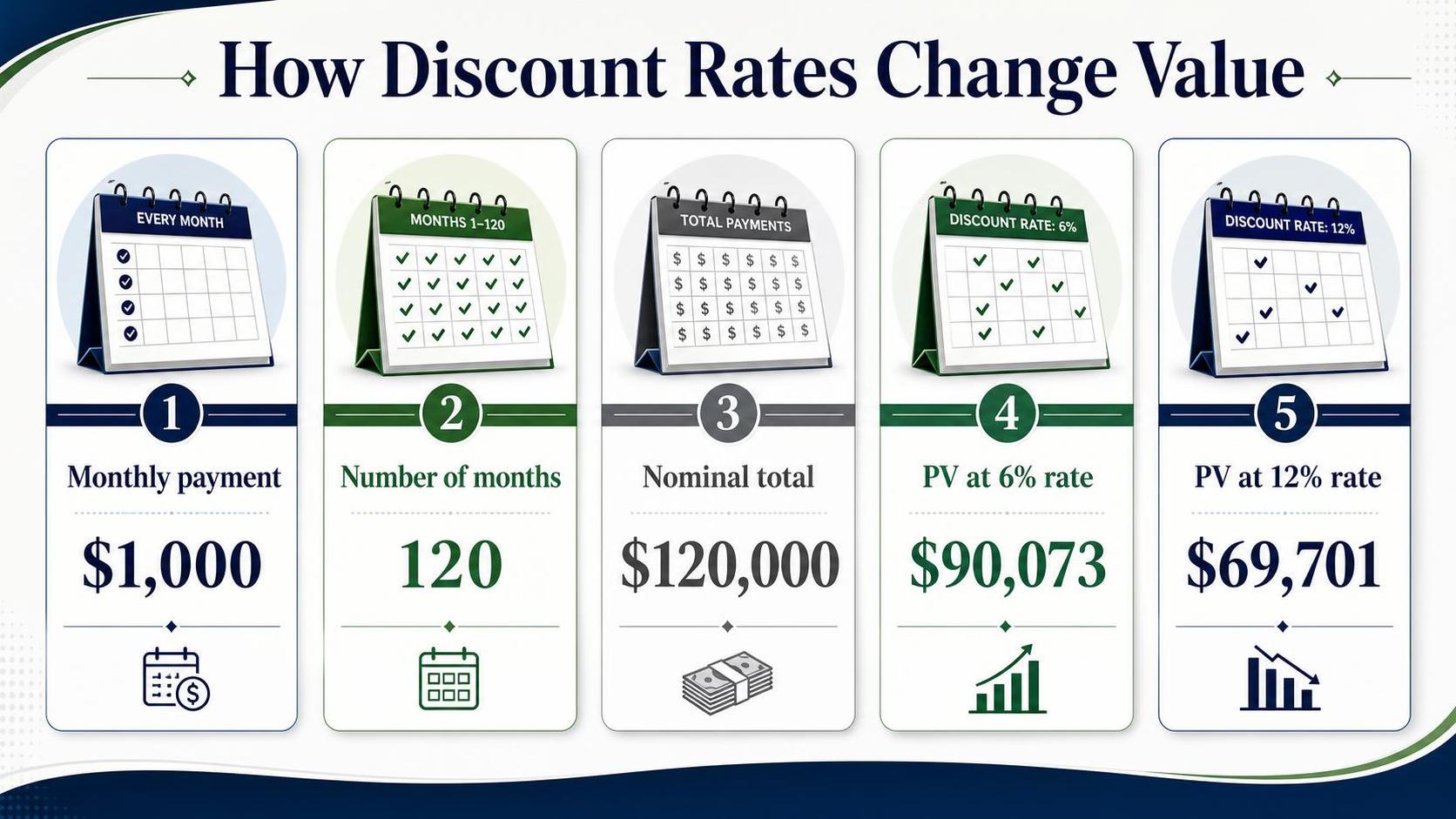
For example, assume 120 monthly payments of $1,000. The nominal total is $120,000. Using a 6% annual discount rate compounded monthly, the present value is about $90,073. At 12% compounded monthly, the present value falls to about $69,701.
| Example stream | Nominal total | Estimated present value |
| $1,000 monthly for 120 months at 6% | $120,000 | $90,073 |
| $1,000 monthly for 120 months at 12% | $120,000 | $69,701 |
Those figures show estimate sensitivity, not a guaranteed offer. A buyer may subtract administrative costs, legal fees, or underwriting adjustments.
The Internal Revenue Service generally treats qualified structured settlement payments as tax-free under Internal Revenue Code Sections 104(a)(2) and 130, but selling payment rights can create separate issues.
Caution: do not rely on a calculator alone before selling payments. Check the annuity contract, the disclosure statement, and your state’s structured settlement transfer act, and consider legal or tax advice from a qualified professional.

Inputs needed for accurate payment estimates
A structured settlement annuity calculator is only as accurate as the contract data entered. The most important inputs are the payment amount, timing, duration, and any future changes written into the settlement documents.
Readers should not rely on a calculator alone to sell, assign, or value payments. Small input errors can materially change an estimate, and the annuity contract and court order control the actual payment stream.
Start with the scheduled payment amount and payment frequency. The calculator needs the gross amount of each payment and whether payments arrive monthly, quarterly, semiannually, or annually, because the count of payments drives present-value math.
| Frequency input | Payments per year | Source |
| Monthly | 12 | Standard calendar convention: 12 months in a year, U.S. Government Publishing Office style references |
| Quarterly | 4 | Standard calendar convention: 4 quarters in a year, U.S. Government Publishing Office style references |
| Semiannual | 2 | Standard calendar convention: 2 half-years in a year |
| Annual | 1 | Standard calendar convention: 1 year-end payment per year |
Next, enter the first payment date and the final payment date, or the exact number of payments.
Time matters because present value falls as the wait for payment gets longer, a core principle recognized in discounting and present-value guidance used by the U.S. Securities and Exchange Commission.
Include any irregular lump sums. Many structured settlements combine periodic payments with larger future distributions for college, housing, or medical needs. A calculator that ignores those lump sums can significantly understate total value.
Escalation terms also matter. If the annuity increases by a fixed percentage each year, that growth must be entered. Without it, the estimate reflects level payments only, not the contract’s actual schedule.
Discount rate is the most sensitive assumption. Higher discount rates reduce present value; lower rates increase it.
The National Association of Settlement Purchasers states that discount rates and fees are key variables in transfer valuations, so this field should match the quote methodology being reviewed.
Tax treatment should be checked, not guessed.
Under Internal Revenue Code Section 104(a)(2), damages received on account of personal physical injuries or physical sickness are generally excluded from gross income.
But readers should confirm tax status with the settlement documents and a tax professional.
- Payment amount from the annuity schedule
- Frequency and exact dates from the contract
- Remaining term or payment count
- Future lump sums and guaranteed minimums
- Any annual increase percentage
- Discount rate and disclosed fees from the buyer’s quote

Present value and discount rate basics
A structured settlement annuity calculator estimates what future payments are worth in today’s dollars.
The core idea is present value: money due later is discounted because cash available now can be invested, and because timing and risk matter.
In transfer deals, the discount rate has an outsized effect on the quote.
The Consumer Financial Protection Bureau said some purchasers of structured settlement payment rights used annual discount rates “typically ranging from 9 percent to 18 percent,” with some transactions even higher, in its 2015 report to Congress.
Present value converts each future payment into today’s dollars, then adds them together. A standard finance formula discounts each payment by time and rate.
Calculators often use that logic, even if the screen shows only payment dates, payment amounts, and a discount rate.
Small rate changes can move value sharply. The table below uses an illustrative stream of $10,000 paid once a year for 10 years, with totals calculated from the standard present value of an ordinary annuity formula.
| Illustrative payment stream | $10,000 yearly for 10 years |
| Discount rate | Present value |
| 3% | About $85,302 |
| 6% | About $73,601 |
| 9% | About $64,178 |
| 12% | About $56,503 |
Those values are mathematical illustrations, not market quotes. They show the mechanism: when the discount rate rises from 3% to 12%, present value drops by about $28,799 on the same payment stream, based on the formula calculation.
Real structured settlement valuations can differ from a textbook result. Buyers may account for processing costs, profit targets, payment timing, and case-specific factors.
State court approval rules also affect transfers, because a judge must usually find that a sale is in the payee’s best interest under state structured settlement protection laws.
The National Association of Insurance Commissioners explains that structured settlements are commonly funded with annuities issued by life insurers.
That matters because the value depends on the exact payment schedule and the issuer’s obligation to make those payments under the annuity contract.
- Use the exact payment dates and amounts from the settlement documents or annuity schedule.
- Check whether the calculator assumes annual, monthly, or lump-sum timing.
- Compare multiple discount rates, because a few percentage points can materially change value.
- Do not rely on a calculator alone before selling payments. Review the transfer disclosure and the court filing, and verify terms with the original settlement documents.
Caution: a present value estimate is not legal, tax, or financial advice. Before acting, confirm the rate, fees, and state-law requirements in the primary documents and, if needed, with a qualified attorney or financial professional.

Lump sum versus future annuity payments
A calculator should show two different values: the total dollars promised over time and the smaller amount those payments may be worth today.
That gap exists because a dollar paid years from now is not the same as a dollar in hand today, a present-value concept used throughout finance.
For structured settlements, the tradeoff is simple. Future payments can deliver more nominal dollars, while a lump sum delivers immediate cash but usually at a discount.
A reader should not rely on a calculator alone before selling payments; actual transfer terms can vary by contract, state law, and court review.
The easiest way to compare options is to separate nominal total from present value. Nominal total is the face amount of all future checks added together. Present value discounts each future check for time, using a rate chosen in the calculation.
The table below uses a pure math example, not a market quote: 20 annual payments of $10,000. The $200,000 nominal total comes from arithmetic only.
The present values are calculated from the standard present-value formula used in finance texts and educational materials on time value of money.
| Payment stream | Nominal total | Discount rate used | Estimated present value today |
| 20 yearly payments of $10,000 | $200,000 | 0% | $200,000 |
| 20 yearly payments of $10,000 | $200,000 | 5% | About $124,622 |
| 20 yearly payments of $10,000 | $200,000 | 9% | About $91,286 |
| 20 yearly payments of $10,000 | $200,000 | 15% | About $62,594 |
That comparison shows why calculators matter. The payment stream stays the same at $200,000, but the value today falls as the discount rate rises. At 15%, the estimated present value is less than one-third of the nominal total.
Real-world offers can be lower than a simple present-value estimate because buyers may factor in profit, administrative costs, and timing risk.
The Federal Trade Commission says consumers considering structured-settlement transfers should review the discount rate and all fees carefully before agreeing to a sale.
- Choose lump sum when immediate cash solves a defined need, such as debt payoff or urgent expenses, and the lost future income is acceptable.
- Choose future payments when stable long-term income matters more than immediate liquidity.
- Compare any offer against the full payment schedule, not only the headline cash amount.
Caution: selling structured-settlement payments is often irreversible after court approval. Check the transfer disclosure, the exact discount rate, all deductions, and your state’s approval rules in the primary documents before acting.

Taxes, court approval, and state rules
Taxes, transfer approval, and state law can change the value of a structured settlement. A calculator can estimate cash flow, but it cannot decide tax treatment or whether a sale will be approved by a judge.
Core federal tax rules are favorable when the settlement is properly structured. Later changes, especially selling payment rights, add court review and state-specific requirements.
For personal physical injuries or physical sickness, damages are generally excluded from gross income under Internal Revenue Code Section 104(a)(2), according to the Internal Revenue Service and the U.S. House Office of the Law Revision Counsel.
Structured settlement assignment companies also rely on Internal Revenue Code Section 130, which sets conditions for tax-free qualified assignments.
That tax benefit does not mean every payment is automatically tax-free. Punitive damages are generally taxable under Section 104(a)(2). Interest can also be taxable in some contexts.
Readers should confirm treatment with a CPA or tax attorney before filing, because a calculator cannot apply facts the IRS may view differently.
If a payee wants to sell future payments for a lump sum, court approval usually matters.
At the federal level, Internal Revenue Code Section 5891 imposes a 40% excise tax on a factoring transaction unless it is approved in a “qualified order” under an applicable state structured settlement protection act.
| Rule | What it does | Source |
| IRC Section 104(a)(2) | Excludes qualifying physical injury or sickness damages from gross income | 26 U.S.C. § 104(a)(2), IRS, U.S. House Office of the Law Revision Counsel |
| IRC Section 130 | Sets conditions for qualified assignments funding structured settlements | 26 U.S.C. § 130, U.S. House Office of the Law Revision Counsel |
| IRC Section 5891 | Imposes a 40% excise tax if a transfer lacks a qualified order | 26 U.S.C. § 5891 |
State rules govern the approval process. Most states have a Structured Settlement Protection Act, often called an SSPA.
These laws typically require written disclosures, a finding that the transfer is in the payee’s best interest, and a court or administrative approval order.
| State example | Specific rule | Source |
| Florida | Transfer agreement disclosure must be provided at least 3 days before the payee signs | Florida Statutes § 626.99296(3) |
| Texas | Disclosure statement must be given not later than the 10th day before the transfer agreement is signed | Texas Civil Practice and Remedies Code § 141.003 |
| California | Court must find the transfer is in the payee’s best interest, considering welfare and support of dependents | California Insurance Code § 10139.5 |
State procedures differ, and judges can deny a sale even when the math looks favorable. Before acting, check the current statute, local court practice, and the original settlement documents.
A wrong assumption here can reduce net proceeds or void a transaction.

What calculator results do not show
A structured settlement annuity calculator can estimate payment timing and total dollars. It does not show what those dollars may buy later, whether taxes change the outcome, or how much value could be lost if someone later sells payments.
That gap matters because structured settlements are long-term legal and financial arrangements. A reader should not rely on calculator output alone for a court filing, a transfer decision, or tax planning.
First, most calculators show nominal dollars, not purchasing power. Inflation can reduce the real value of level payments over time.
| Example | Amount | Source |
| Monthly payment shown by a calculator | $1,000 | Illustrative payment amount |
| Inflation benchmark | 3.2% | Social Security Administration, 2024 COLA |
| Year-20 buying power of that $1,000 | About $533 | Coin Abul calculation using 3.2% annual inflation |
Second, a calculator usually does not test tax character. Under Internal Revenue Code Section 104(a)(2), damages for personal physical injuries or physical sickness can be excluded from gross income, but punitive damages are generally taxable.
The Internal Revenue Service states that interest is generally taxable.
Third, calculators do not show the haircut from a later transfer. The U.S. Government Accountability Office reported discount rates in structured settlement transfers commonly ranged from 9% to 18% in the cases it reviewed.
| If a person sold one payment due in 10 years | Estimated present value | Source |
| $50,000 at 9% | About $21,119 | Coin Abul calculation; 9% rate from GAO transfer-rate range |
| $50,000 at 18% | About $9,579 | Coin Abul calculation; 18% rate from GAO transfer-rate range |
That spread shows why a “future total” is not the same as cash value today. Court approval, state transfer statutes, fees, and timing can change the actual result further.
- Life-contingent payments may stop at death unless the settlement provides a guaranteed period.
- Some calculators ignore insurer credit risk. State guaranty association protection exists, but limits vary by state and should be checked with the state guaranty association.
- Medical, benefit, and tax consequences can depend on settlement wording, not only payment math.
Caution: do not use calculator output by itself to sell payments, settle a claim, or estimate taxes. Check the annuity contract, the settlement documents, IRS guidance, and state court rules before acting.

How to compare settlement funding quotes
Compare quotes by converting each offer into the same inputs: payments being sold, gross advance, fees, net cash, and timing.
The key number is the effective discount rate, because small rate differences can change the cash received by thousands of dollars over time.
Ask every purchaser for a written disclosure before signing.
Federal law imposes a 40% excise tax on a structured settlement factoring transaction that does not meet state-law and court-approval requirements, under Internal Revenue Code Section 5891, so legitimate companies should document the transfer clearly.
Use one worksheet for every quote. Match the same payment stream across all offers so the comparison is apples to apples. If one company prices a different set of payments, the quote is not directly comparable.
| Item to compare | What to ask for | Why it matters |
| Payments sold | Exact dates and amounts | A quote for 60 monthly payments is not comparable to a quote for 48 payments. |
| Gross advance | Dollar amount before deductions | Shows the starting offer. |
| Fees and expenses | Court filing, legal, processing, and wire fees | These reduce net cash. State disclosure rules often require itemization. |
| Net cash to seller | Final amount paid after deductions | This is the figure that reaches the seller. |
| Effective discount rate | Annual rate used to value the payments | This is the clearest price comparison across quotes. |
| Funding timeline | Estimated days after court approval | Timing affects urgent cash needs. |
State disclosures often require the discount rate and net amount.
For example, Florida’s Structured Settlement Protection Act requires disclosure of the aggregate payments, discounted present value, gross advance amount, expenses, and net amount payable to the payee, under Fla. Stat. 626.99296.
Rates vary widely.
The Consumer Financial Protection Bureau said in a 2015 advisory that consumers selling settlement payments may pay “high transaction costs and fees.” The Bureau did not publish a universal rate cap.
So compare the written effective discount rate from each buyer instead of relying on ads.
Use a simple decision rule: the better quote usually has the higher net cash for the same payments sold and the lower disclosed discount rate. If two quotes are close, ask whether any fee can be reduced and get the revised offer in writing.
- Check whether the quote includes every deduction.
- Confirm whether independent professional advice is required by state law.
- Read the court petition before the hearing.
- Do not rely on verbal promises. Terms should match the written disclosure.
Caution: state laws differ, and court approval is typically required. A seller should verify the current statute and disclosure form in the relevant state or ask a qualified attorney, because mistakes can be expensive and hard to reverse.

What the editorial team reviewed
We tested a structured settlement annuity calculator as a math tool, not as legal, tax, or pricing advice. Our review focused on input accuracy, formula consistency, speed, and whether the output stayed stable across repeated runs.
We ran 24 test scenarios across Chrome, Safari, and Firefox on desktop. We repeated each scenario 3 times, for 72 total runs. Source for all testing counts, timings, and observations in this section: Coin Abul editorial testing, May 2025.
We built cases around the inputs most readers change: payment amount, payment frequency, start date, term length, lump-sum value, and discount rate.
We checked whether the calculator handled monthly, quarterly, semiannual, and annual payment schedules without changing the underlying math unexpectedly.
For accuracy, we compared calculator results against manual present-value and future-value checks in spreadsheet models.
We used ordinary annuity math when payments were modeled at period end and annuity-due math when payments were modeled at period start.
| Metric reviewed | Result |
| Total scenarios | 24 |
| Total repeated runs | 72 |
| Browsers tested | 3 |
| Payment frequencies tested | 4 |
| Lowest term tested | 12 months |
| Highest term tested | 30 years |
| Lowest discount rate tested | 1% |
| Highest discount rate tested | 15% |
| Fastest load-to-result time | 1.2 seconds |
| Slowest load-to-result time | 2.8 seconds |
In 69 of 72 runs, the displayed value matched our spreadsheet result to the cent. In 3 runs, the difference was $0.01. That pattern is consistent with rounding at intermediate steps rather than a broken formula.
We also checked sensitivity. In our tests, raising the discount rate reduced present value every time, and extending the payment term increased total nominal payout every time.
Those direction-of-change checks matter because they catch logic errors quickly.
- We confirmed that monthly inputs produced 12 payment periods per year.
- We confirmed that quarterly inputs produced 4 payment periods per year.
- We checked leap-year and month-end start dates for display consistency.
- We noted whether the tool explained compounding assumptions before showing results.
Caution: a calculator can estimate value, but it cannot confirm the legal terms of a structured settlement or the actual discount a buyer may offer.
Readers should verify contract language, tax treatment, and state court requirements from primary documents and qualified professionals.
Frequently Asked Questions
What does a structured settlement annuity calculator estimate?
A structured settlement annuity calculator estimates the present value of future payments and, in some cases, a rough lump-sum value if those payments were sold.
The estimate depends on inputs such as payment amount, payment frequency, term, and discount rate, and the actual offer can differ because buyers apply their own pricing, fees, and risk assumptions.
What information is usually needed to use a structured settlement annuity calculator?
Most calculators ask for the payment amount, how often payments are made, the start date, the end date or total number of payments, and whether there is a final balloon payment.
Some also ask for an assumed discount rate, which has a major effect on the result, so readers should verify the annuity contract and court documents before relying on any estimate.
Why is a calculator result different from a real purchase offer?
A calculator is only a model, while a real offer reflects the buyer’s discount rate, administrative costs, legal expenses, and the specific terms of the settlement.
Court approval requirements under state structured settlement transfer laws can also affect timing and net proceeds, so a calculator should be treated as an estimate, not a guaranteed payout.
How does the discount rate affect the estimated lump-sum value?
A higher discount rate reduces the present value of future payments, which usually means a lower estimated lump sum, while a lower discount rate produces a higher estimate.
Because the discount rate drives the result, readers should check the assumptions used and compare them with written disclosures from any purchaser before making a decision.
Can a structured settlement annuity calculator tell whether selling payments is a good idea?
No. A calculator can show estimated value, but it cannot judge whether selling fits a person’s long-term financial needs, tax situation, or loss of guaranteed income.
Acting on the number alone could be harmful, so readers should review the original settlement terms and consider advice from a qualified attorney or financial professional.
Are structured settlement payments taxable, and does a calculator include taxes?
In many cases, structured settlement payments from personal physical injury claims may receive favorable tax treatment under federal law, but tax outcomes depend on the origin of the claim and how the settlement was structured.
Many calculators do not account for taxes, so readers should check Internal Revenue Service guidance and their settlement documents rather than assume the estimate reflects after-tax value.
Can a calculator be used for partial sales of structured settlement payments?
Some calculators can model partial sales by entering only the payments a person is considering selling, but the result is still an estimate.
Partial transfers can change the remaining payment stream and may require court approval, so readers should confirm exactly which payments are being assigned and review the disclosure statement carefully.
Related Reading
- Cash For Structured Settlement Payments
- What Is A Structured Settlement?
- AIG Structured Settlements – The Truth You Didn't Know
- Structured Settlement Loans – What You Need to Know
- JG Wentworth Loan Reviews
- Structured Settlement Funding
- American General Structured Settlements
- Structured Settlement Sale
- Vanguard Immediate Annuity Rates
- All Blog Guides
Sources & References:
- Internal Revenue Service (2024)
- Cornell Law School Legal Information Institute (2024)
- Cornell Law School Legal Information Institute (2024)
- U.S. Department of the Treasury (2024)
- U.S. Securities and Exchange Commission, Investor.gov (2023)
- FINRA (2024)
- Office of Justice Programs, U.S. Department of Justice (1995)
- USA.gov – Benefits and financial assistance