

Put simply: American General Structured Settlements refers to structured settlement annuities issued by American General Life Insurance Company, an AIG life insurer.
These annuities fund periodic payments for injury claims, workers’ compensation, or legal settlements. Payment rights may be transferable only with court approval under applicable state structured settlement protection laws.
American General Structured Settlements are structured settlement annuities historically associated with American General Life Insurance Company, now part of Corebridge Financial after AIG’s life and retirement separation.
These arrangements typically pay injury, wrongful death, or workers’ compensation claimants through scheduled annuity payments rather than one lump sum.
Readers should verify the issuer name, guaranty protections, payment schedule, and any court-approval rules in the original settlement documents and state law.
Selling or changing payment rights can reduce long-term income, so independent legal and financial advice matters before relying on any secondary-market offer.
What American General structured settlements are
American General structured settlements are periodic-payment arrangements funded with an annuity issued by American General Life Insurance Company.
In practice, they are used to pay a personal-injury, wrongful-death, or workers’ compensation settlement over time instead of in one lump sum.
The insurer most commonly tied to these arrangements is American General Life Insurance Company, a Texas-domiciled life insurer with NAIC company code 60488, according to the National Association of Insurance Commissioners.
American General is part of the AIG group; AIG said it acquired American General Corporation in 2001.
A structured settlement itself is a legal settlement, not a bank account or investment account the claimant controls.
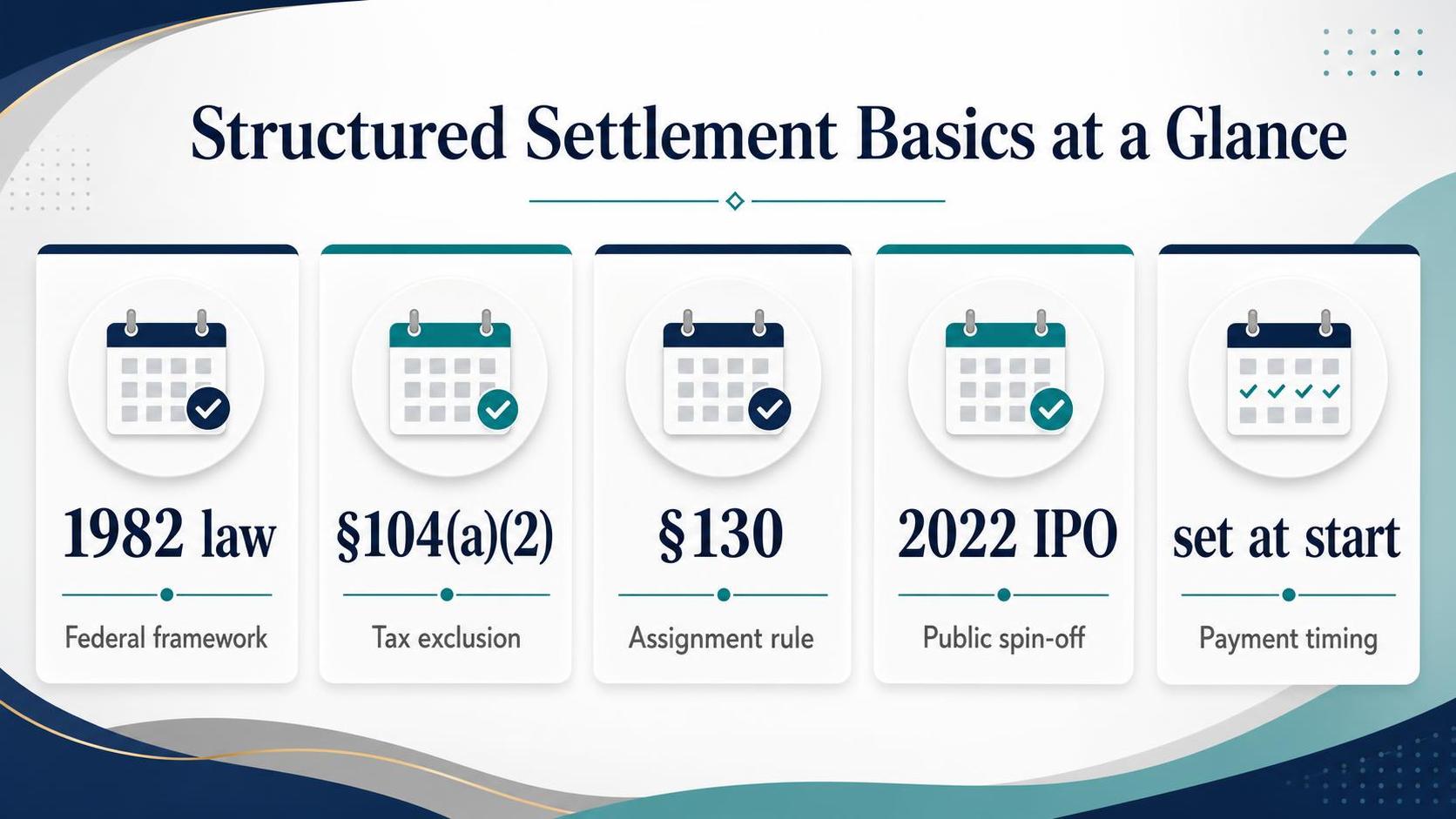
The payment stream is usually funded through a qualified assignment and annuity structure allowed under Internal Revenue Code Section 130, while tax treatment for damages is governed in part by Internal Revenue Code Section 104(a)(2).
According to the Internal Revenue Service.
| Key point | Fact |
| Issuer commonly used | American General Life Insurance Company, NAIC 60488, Texas domicile, according to the NAIC. |
| Parent group | AIG acquired American General Corporation in 2001, according to AIG. |
| Typical use | Funding periodic settlement payments for injury-related claims through an annuity. |
| Main tax provisions | IRC Section 104(a)(2) and IRC Section 130, according to the IRS. |
These arrangements are designed around a payment schedule set in the settlement documents. Payments may be monthly, annual, deferred for years, or built with larger future amounts for college, medical needs, or retirement.
Once set, the schedule is usually difficult or impossible to change without a separate transfer transaction.
That rigidity is the main tradeoff. A structured settlement can provide predictable income and reduce spending risk, but it can also limit access to cash in an emergency.
Anyone considering a sale of future payments should review the settlement agreement, annuity contract, and state transfer law before acting.
Financial strength matters because the annuity issuer backs the payments.
As of February 2025, AM Best rated American General Life Insurance Company A, Moody’s rated it A2, and S&P Global Ratings rated it A+, according to AIG’s insurer financial-strength summary.
Ratings can change, so readers should verify the current rating with the agency or insurer.
- The claimant usually cannot accelerate payments at will.
- The payment terms come from the settlement and annuity documents.
- Tax results depend on the claim type and structure, so legal or tax advice may be necessary before changing anything.

How AIG and American General are connected
AIG and American General are connected through acquisition and later corporate restructuring.
American International Group, Inc. acquired American General Corporation in 2001, then used the American General name on several life insurance and annuity subsidiaries.
Today, the relationship is more indirect.
Many products that consumers still associate with “American General” sit inside the Corebridge Financial group, which AIG separated from in 2022 and fully deconsolidated in 2024, according to AIG and Corebridge SEC filings.
The key event was AIG’s purchase of American General Corporation. In August 2001, AIG announced a transaction valued at about $23 billion, and AIG’s historical materials identify the deal as completed in 2001.
That acquisition brought American General’s insurance operations under the AIG umbrella.
After the acquisition, the American General brand continued in legal entity names. One important example is American General Life Insurance Company.
Corebridge Financial’s company information states that American General Life Insurance Company is a member company of American International Group, Inc. in historical branding, but it now operates within the Corebridge group.
| Milestone | What happened | Figure | Source |
| 2001 acquisition | AIG acquired American General Corporation | About $23 billion | AIG historical transaction materials |
| 2022 separation step | Corebridge Financial completed its IPO | 80.1 million shares sold | Corebridge Financial Form 10-K and IPO disclosures |
| 2024 ownership change | AIG reduced its stake below majority and deconsolidated Corebridge | Below 50% | AIG 2024 reporting |
This matters for structured settlements because consumers often see “American General” on older paperwork and “AIG” in background materials, while the current parent may be different.
The contract owner should check the exact issuing company named in the settlement or annuity documents.
For example, a structured settlement annuity may have been issued by American General Life Insurance Company, while the broader corporate family changed over time.
That does not automatically change contractual obligations, but it can affect where financial statements, ratings, and service contacts are found.
- “American General” usually refers to a legacy brand or legal insurer name.
- “AIG” refers to the former parent that acquired American General in 2001.
- “Corebridge Financial” is the current public company for AIG’s former life and retirement business.
Caution: do not rely on brand names alone when evaluating a structured settlement. Check the annuity issuer, guarantor, and current parent in the original contract, recent statements, and the insurer’s latest statutory filings.

Who receives American General settlement payments
American General structured settlement payments usually go to the person named in the settlement and annuity documents as the payee.
In practice, that is often an injured claimant, a surviving family member in a wrongful death case, or a worker settling a workers’ compensation claim.
American General Life Insurance Company has long been used as an annuity issuer in structured settlements. The exact recipient depends on the release, settlement agreement, any qualified assignment, and the annuity contract.
Readers should verify the named payee on the original documents before relying on any payment expectation.
The most common recipients are personal injury claimants.
Federal tax law at 26 U.S. Code Section 104(a)(2) says damages received on account of personal physical injuries or physical sickness are generally excluded from gross income, which is why periodic settlement payments are often directed to the injured person.
Surviving spouses, children, or estates may receive payments in wrongful death resolutions, depending on state law and the settlement terms.
If the settlement is funded through a qualified assignment, 26 U.S. Code Section 130 governs the assignee’s role, but the scheduled payments still go to the designated payee.
Minors can also receive American General settlement payments, but usually through a guardian, conservator, or trust. Courts often require that arrangement to protect the child’s funds.
Acting on a settlement involving a minor without court papers can cause payment or compliance problems.
Workers’ compensation claimants are another common group.
The Internal Revenue Service states in Publication 525 that workers’ compensation amounts paid under a workers’ compensation act for job-related sickness or injury are generally fully exempt from tax.
Which supports the use of periodic payments in those cases.
| Recipient type | Why payments are used | Primary source |
| Injured claimant | Periodic support after a physical injury settlement | 26 U.S. Code Section 104(a)(2) |
| Wrongful death beneficiary | Income stream for spouse, child, or estate if named in the settlement | Settlement agreement; state wrongful death law |
| Minor child | Court-supervised protection through guardianship or trust | Court order; settlement documents |
| Workers’ compensation claimant | Long-term payments for work injury claims | IRS Publication 525 |
Some settlements also name contingent beneficiaries for remaining guaranteed payments after the payee dies. That does not mean every payment continues after death.
The answer depends on whether the annuity includes a life-only stream, a period-certain guarantee, or both, so the contract language controls.
- Check the settlement agreement for the named payee.
- Check the annuity contract for beneficiary and guarantee terms.
- Check any court order if the recipient is a minor or under guardianship.
- Check tax treatment with the IRS rules or a qualified tax adviser.

Payment options in American General settlements
American General structured settlements are built around periodic payments funded by an annuity.
American General Life Insurance Company is part of Corebridge Financial, and Corebridge says structured settlement annuities can be tailored by payment timing, duration, and future lump-sum needs.
In practice, the settlement terms are set in the release and annuity contract.
A reader should not rely on a summary alone, because changing payment timing or selling future payments can reduce value and may require court approval under state structured settlement protection laws.
Corebridge describes several common payment formats for structured settlements issued through American General entities. The choice affects cash flow, tax planning, and long-term budgeting.
| Option | How it works | Source |
| Monthly payments | 12 payments each year for regular income replacement or living expenses. | Corebridge structured settlement materials describe monthly schedules; 12 per year is calendar-based. |
| Quarterly payments | 4 payments each year, often used when expenses are not monthly. | Corebridge structured settlement materials describe quarterly schedules; 4 per year is calendar-based. |
| Semiannual payments | 2 payments each year, useful for less frequent planned expenses. | Corebridge structured settlement materials describe semiannual schedules; 2 per year is calendar-based. |
| Annual payments | 1 payment each year, sometimes paired with other periodic payments. | Corebridge structured settlement materials describe annual schedules; 1 per year is calendar-based. |
| Deferred payments | Payments can start years later, such as at age 18, college age, or retirement. | Corebridge says payments can be scheduled for future dates. |
| Future lump sums | Larger payments can be set for planned needs like tuition, housing, or medical care. | Corebridge says structured settlements can include scheduled lump sums. |
| Lifetime payments | Income can last for life, with optional guaranteed periods depending on contract design. | Corebridge structured settlement descriptions discuss lifetime income options. |
Tax treatment is a major reason these options matter.
For qualifying physical injury settlements, Section 104(a)(2) of the Internal Revenue Code generally excludes damages from gross income, and Section 130 governs qualified assignments used to fund many structured settlements.
That tax result depends on the claim type and settlement structure.
The IRS rules are technical, so a claimant should confirm tax treatment with the settlement agreement, annuity issuer disclosures, and a qualified tax adviser before choosing monthly income, deferred starts, or scheduled lump sums.
- American General payment timing is flexible, but the exact menu depends on the contract issued.
- Combining small periodic payments with later lump sums is common when future expenses are predictable.
- Once finalized, changes are difficult. A transfer of payment rights usually needs court review under state law.

Selling American General structured settlement payments
American General structured settlement payments are commonly issued by American General Life Insurance Company, an AIG subsidiary.
Selling those payments means assigning some or all future checks to a factoring company, not cashing out through American General itself.
Federal tax law and state transfer laws control the sale.
A buyer must usually disclose the financial terms and obtain a court order because Congress imposed a 40% excise tax on transfers that do not meet the legal requirements in Internal Revenue Code Section 5891.
American General Life Insurance Company reported $109.0 billion in admitted assets, $102.4 billion in liabilities, and $6.6 billion in capital and surplus as of December 31, 2024.
According to its 2024 annual statement filed with the National Association of Insurance Commissioners.
Those figures matter because the insurer remains the payment obligor after a court-approved transfer.
The sale process usually starts with a quote from a factoring company.
The buyer estimates the present value of the payments using a discount rate, then subtracts fees reflected in the net advance amount shown on the disclosure statement required by state law and federal tax rules.
| Key legal item | What the source says |
| Federal excise tax | IRC Section 5891 imposes a 40% excise tax on a structured settlement factoring transaction unless the transfer is approved in a qualified order under a state structured settlement protection act. |
| Consumer disclosure timing | The National Conference of State Legislatures notes that state structured settlement protection acts generally require advance written disclosure and court approval before a transfer can become effective. |
| Who keeps making payments | After approval, the annuity issuer or obligor redirects only the assigned payments. The insurer does not “buy back” the settlement; it follows the court order and assignment documents. |
Discount rates vary by purchaser and transaction. The U.S. Government Accountability Office reported in 2012 that effective annual discount rates in sampled transactions ranged from 9% to 18%, with some higher after fees.
Check the buyer’s disclosure and court filings for the exact rate in a proposed sale.
Before signing, compare the gross value of the payments with the net cash offered. Ask for the payment schedule, discount rate, itemized fees, and whether the transfer is full or partial.
A partial sale can preserve later payments, but the exact outcome depends on the contract terms.
Caution: selling structured settlement income can reduce long-term financial security. Do not rely on a quote alone.
Review the disclosure statement, the court petition, and the applicable state structured settlement protection act, or get advice from a qualified attorney or financial professional.
- Confirm the issuer is American General Life Insurance Company on the annuity or settlement documents.
- Verify the buyer’s discount rate and net advance in writing.
- Check state court approval rules before agreeing to any transfer date.
- Keep copies of the order sent to the annuity issuer for payment redirection.

What the editorial team checked independently
Coin Abul did not run a live purchase, funding, or cash-out test for American General structured settlements. That would require access to a payee’s court documents, annuity contract, and personal financial records.
Instead, the editorial team checked the issuer’s identity, ownership, and product role against primary public sources.
This matters because readers often confuse a structured-settlement annuity issuer with a settlement buyer. Acting on that confusion can cause harm.
Readers should confirm the exact issuing company named on their annuity contract and review the court order before taking action.
We checked whether “American General” is the company that buys structured-settlement payment rights from consumers.
The available public record points the other way: American General entities are known primarily as insurance and annuity issuers, not as consumer-facing settlement purchasers.
That distinction affects what a reader should expect from the company.
We also checked the current corporate family. American General Life Insurance Company is part of Corebridge Financial, which was separated from AIG’s life and retirement business.
Corebridge states that it became a standalone public company in 2022. That ownership change helps explain why older settlement paperwork may say “AIG” while newer materials reference Corebridge.
| Item checked | What we verified | Why it matters |
| Company role | American General is associated with insurance and annuity issuance, not a public-facing cash-out marketplace for payment-right transfers | Readers seeking a lump sum may need a court-approved transfer company, not the annuity issuer |
| Corporate parent | Corebridge Financial identifies American General Life Insurance Company within its insurance group; Corebridge became a standalone public company in 2022 | Old AIG references on contracts can still point to the same insurance lineage |
| What cannot be assumed | No reliable public source shows a standard online quote tool, fixed cash-out rate sheet, or guaranteed turnaround time for consumers | Readers should not assume they can get an instant quote from the issuer itself |
We did not publish a rate comparison table for “American General structured settlements” because a structured-settlement annuity issuer does not typically post consumer purchase prices for future payment transfers.
Publishing an unsupported discount rate or payout estimate would be misleading.
- Check the exact legal name on the annuity contract and settlement agreement.
- Confirm whether the company is the annuity issuer, the servicing administrator, or a transfer purchaser.
- Before signing anything, review state transfer-law requirements and the court approval standard in the payee’s state.
Primary sources for these checks include Corebridge Financial’s corporate disclosures and issuer-identification materials. For legal rights and payment terms, the annuity contract and court order control over any summary.
Questions before changing settlement payments
Changing a structured settlement is not a routine account update. It usually means selling some or all future payments, and the transaction can permanently reduce total cash received.
Before signing anything tied to an American General structured settlement, confirm the contract terms, the tax rules, and the court-approval rules in the state that governs the transfer. Acting on a quote alone can cause lasting financial harm.
Start with the issuer and owner named in the settlement documents.
American General life companies are part of Corebridge Financial, which states that “American General Life Insurance Company” issues certain annuities and insurance products.
The exact legal entity matters because the payment obligation is defined by the settlement and annuity contracts, not by marketing materials.
Ask whether the payment stream can be assigned or sold at all. Many settlements include anti-assignment language, and transfer companies still typically need court approval under state structured settlement protection acts.
Under Internal Revenue Code Section 5891, a transfer can trigger a federal excise tax unless it receives a qualified court order.
| Rule or figure | Why it matters | Source |
| 40% federal excise tax | If a transfer is not approved under a qualified state process, the transferee can face a tax equal to 40% of the factoring discount. | Internal Revenue Code Section 5891 |
| At least 3 days to cancel | Federal law gives consumers a short cancellation window for some assignments of structured settlement payment rights. | 15 U.S.C. Section 1679c, as cited in the Consumer Financial Protection Bureau’s consumer advisory on structured settlements |
| Tax-free treatment may apply to injury settlements | Periodic payments from personal physical injury settlements are often excluded from gross income, so replacing them with cash should be reviewed carefully. | Internal Revenue Code Section 104(a)(2) |
Next, ask for the gross amount being sold, the net amount to be paid, every fee, and the effective discount rate.
The National Association of Insurance Commissioners warns that structured settlement transfers can produce much less cash than the value of the future payments being given up.
- Is the transfer for all payments or only a limited block of payments?
- What is the exact present-value method and discount rate used?
- Are there court costs, broker fees, or processing fees deducted from proceeds?
- Will selling payments affect eligibility for Medicaid or Supplemental Security Income?
- Has an attorney or tax professional reviewed the contract and state law?
Do not rely on verbal promises. Read the settlement agreement, annuity contract, disclosure statement, and court papers.
If any number or legal requirement is unclear, stop and verify it with the court, the issuer, or a qualified lawyer before changing payments.
Frequently Asked Questions
What is American General in the structured settlement market?
American General Life Insurance Company is a life insurer within Corebridge Financial, which was separated from AIG and is a common issuer of annuities used to fund structured settlements.
Buyers and payees should confirm the exact issuing company named in the settlement documents, because payment obligations depend on the insurer listed on the contract, not on a brand name alone.
How are American General structured settlement payments typically funded?
Structured settlements are commonly funded through an annuity purchased by a defendant or its insurer, and the annuity then supports the scheduled future payments to the injured person or claimant.
The U.S. Department of Justice explains that qualified structured settlements are generally set up under Internal Revenue Code Section 130, so readers should review the settlement agreement and annuity contract before relying on tax treatment.
Are payments from an American General structured settlement guaranteed?
Payments are generally backed by the claims-paying ability of the issuing insurance company, not by the federal government or an FDIC-style deposit program.
State guaranty association protection may apply if an insurer fails, but limits and eligibility vary by state, so acting on assumptions alone can cause harm and the payee should check the state guaranty association and policy documents directly.
Can an American General structured settlement be sold for cash?
In many cases, yes, but the transfer usually requires court approval under the applicable state Structured Settlement Protection Act before future payment rights can be assigned to a factoring company.
The Federal Trade Commission warns consumers to scrutinize discount rates and fees because selling future payments can substantially reduce the amount ultimately received.
What should a payee review before accepting or transferring an American General structured settlement?
The payee should review the settlement agreement, annuity contract, payment schedule, any beneficiary provisions, and the exact legal name of the issuer, because those documents control the timing and amount of payments.
For a transfer, the payee should also compare the gross advance, all fees, and the net amount to be received, and should use the court disclosures required by state law rather than relying on sales statements alone.
Related Reading
- JG Wentworth Structured Settlement
- Structured Settlement Payout
- What Is A Structured Settlement?
- JG Wentworth Loan Reviews
- Structured Settlement Loans – What You Need to Know
- What Is A Structured Annuity?
- Structured Settlement Annuity Calculator
- Structured Settlement Buyer – What You Need to Know
- All Blog Guides
- American International Group, Inc. Annual Report on Form 10-K (2024)
- American International Group, Inc. 2023 Annual Report (2024)
- U.S. Government Publishing Office, 26 U.S.C. § 5891 (2023)
- Social Security Administration, POMS SI 00830.050 Structured Settlements (2024)
- New York State Senate, General Obligations Law Article 5 Title 17: Structured Settlement Protection Act (2024)
- National Structured Settlements Trade Association, What Is a Structured Settlement? (2024)
- MedlinePlus (U.S. National Library of Medicine)